
There’s little shocking or all that provocative when performance artist Ann Marie Dorr abides by the title of their show and, in the dark, takes their pants off (about three minutes into the show). Downtown and experimental theater scenes are, by now, probably used to that kind of confrontation between the artist’s body and generally unassuming audiences, so if that were all Dorr and director William Burke had to offer, it would risk feeling cliché. Dorr, for much of the show’s duration, doesn’t present their body as shocking or incendiary. Abetted by a silvery tan shag rug, numerous head lamps, and one overhead lighting fixture, they appear to be in a rather low key, often laconic state. From flashcards, Dorr reads their memories and tangents to the audience, each anecdote and rambling almost freely associated, jumping from one idea to the next and hazily connected to their adolescence. Occasionally, they asks an audience member to assist with holding a prop, but audience participation stops there, lingering on a kind of unmet potential of what the interaction could be. And much of the show is either in the dark for spurts at a time or using a single light source from a headlamp provided to an audience member, which at once crafts impressive frames (from any vantage point in the circle of audience members) but also leaves the feeling of an unmet danger in the show.
Ultimately, it feels more akin to a sleepover listening to your depressed, existential dread-filled friend. Dorr, reading in a kind of nonchalant yet fatigued tone, pulls the audience along their strange, not quite clownish and almost lyrical stream of consciousness. Their show is filled with memories of their adolescence—occasionally going out to eat with their family, fishing with their father, spiraling about viruses, interrogating their adoration for certain love songs by Jim Croce, and inviting them to, to paraphrase David Foster Wallace, consider the cod fish.
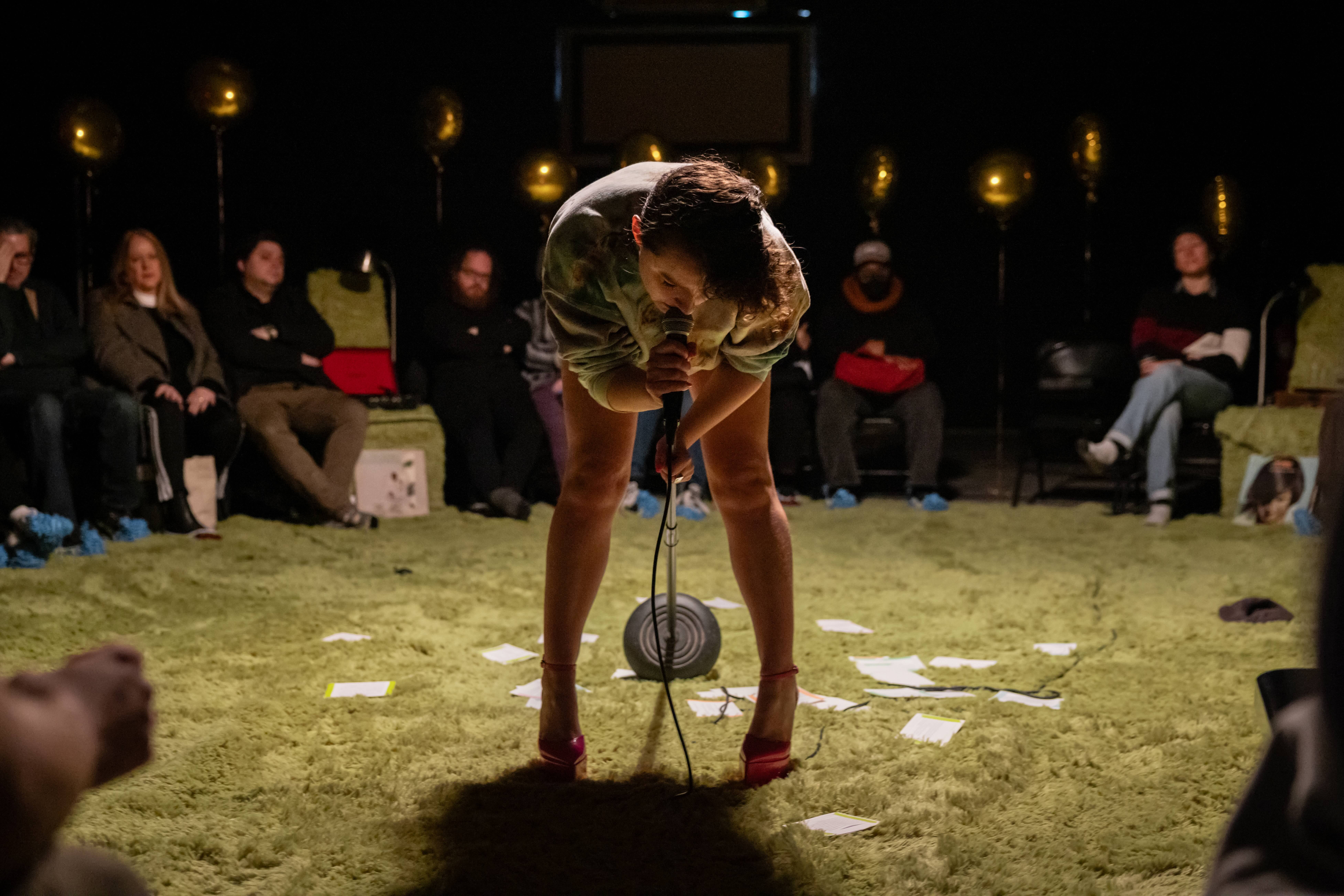
The looseness and somewhat scattered nature of what Dorr chooses to use as rhetorical prompts has its intermittent charms, akin to the random tangents one has alone in bed in nothing but a sweatshirt and underwear. The juxtaposition between the prosaic nature of those thoughts and the angles at which Dorr sometimes positions their body—in heels, bent over and leaving their behind vulnerable; curled on the floor reading from a German book—is sometimes compelling, but there’s frequently a feeling that ambition and execution are not aligning. The observations seldom reach profundity, even in their smallness and closeness, and the writing gets aphorism heavy, leaning into certain word repetitions that, as opposed to being clever, verge on exhibiting a more limited poetic imagination.
But, despite Dorr’s mix of disaffection and agreeableness, i’m going to take my pants off now contains striking moments of still, electric energy. The lighting design, by Megan Lang, is partly achieved through audience interaction when Dorr goes up to many audience members asking if they will “do [them] a kindness." Certain spectators are given headlamps to wear and the most affecting images in the show occur when only a single headlamp is on. Sculpting bewitching chiaroscuro and intoxicating silhouettes form when Dorr stands in front of these single beams of light. There are also moments when Dorr dances with an audience member or grips their hand while an old record plays. When the show leans into these elements of fantasy, intimacy, and romance, it's exhilarating.
But there are sometimes too many ideas in the show that end up being a little too disorganized and, despite the terror and thrill of potential audience participation, those elements are not dangerous enough in their confrontationally close nature for the performance’s entirety to cohere. There’s certainly something roiling in Dorr’s show about connecting in the most private moments and spaces, and the strange fixations that, despite their seeming irrelevance reappear as a framework through which to view our lives and world, but the pants need a few more garments to make the fit totally work.
In the early hours of the morning, Deb (Layla Khoshnoudi) and Hugo (Peter McNally) meet by chance in a Brooklyn park after Hugo's dog Knuckle (Andrew Hardigg) mows Deb over. They’re watched by an omniscient, drunk red-tailed hawk that occasionally takes the form of Deb’s paranoid and world weary mother or Hugo’s alcoholic and beleaguered father. Between awkward glances and tentative flirtations, the bird (Pete Simpson) comments on all the cosmic potential of each of their gestures and all of the ones that led them to the park that day. Throughout Nurit Chinn’s Godbird, infinite portals of possibility, tragedy and comedy, seem to surround this pair, their meet-cute a colossally spiritual and otherworldly collision between two seemingly secular characters. Or at least, that seems to be the ambition.
Seated on a large, angular rock-like formation designed by Raphael Mishler, Deb and Hugo realize that they’ve encountered one another before, albeit on the internet. Both former trawlers of a reddit thread for people to post nude photos of themselves, their former digital acquaintanceship offers a somewhat novel and increasingly common in the real world take on first time meetings: between them there’s an uncanny familiarity (Hugo recognizes a birthmark on Deb’s shoulder) that is at once superficial and yet also vulnerable. They’ve barely interacted before but they’ve both come to understand a concealed aspect of one another’s personality: Hugo’s desire to see, Deb’s longing to reclaim her body.
It’s a shame then that the characters are kind of boring, all their specificity in illustration rendered staid and affected, especially when the script gets overwrought. Each tilt of the head, sidelong look, and nervous jump at connection feels calculated, absent of the jittery excitement or reluctance of a real meeting. They come off less as people and more like scene study experiments, all the detail of their background, their respective longings (Hugo gets the short end of the stick, his interiority backloaded into a brief scene with his father) unusually flat and absent of spontaneity.
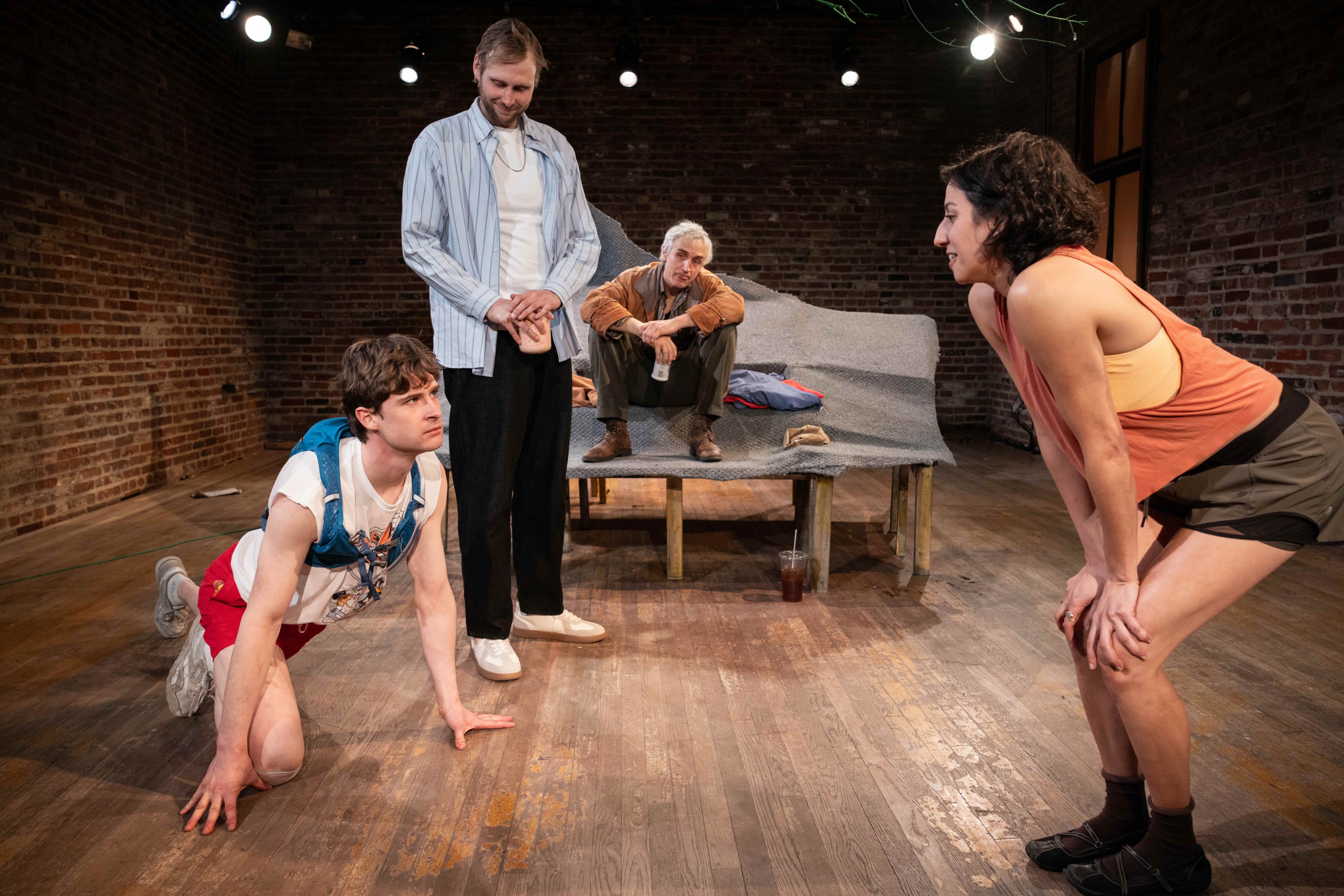
Though the presence of this Godbird is supposed to lend the scenario a larger than life, metaphysical sensibility, instead it has the effect of feeling overwritten in no particular direction. The dog also appears to be there to give the show scale, but in the opposite direction, grounding it in opposition to Godbird’s dilating. Here, the bird is on one end seeing a kind of infinity of choices and attractions between Deb and Hugo, and the dog on other, focusing on the immediate desire for touch and love, without human neuroses.
Simpson works his way through the inconsistent writing diligently, effectively playing beer chugging Brooklyn bird and transforming into helicopter mother and gruff Suffolkian father. Although its lofty, circular style threatens to grate, seldom focusing on any of its grab bag of ideas for long, he adds a sense of personality that the two leads lack. Hardigg, too, fully commits as Deb’s ex-boyfriend and Hugo’s dog, supplying an impressive burst of energy.
Its most interesting thread is one that is intermittently considered, in terms of the choices we make in who we are in the digital world and the material one, and how those illusions shape how we get to know someone, or a version of them. But Godbird doesn’t really settle on this or fully flesh it out. Instead, the show is shaggy, uncertain of where the dramatic tension is. As opposed to a swooping, birdlike magisterial quality, Godbird comes off as featherlight.
The thought sometimes flits across my mind that humans were never intended to receive or send so many emails. There is both banality and overstimulation in the anticipation, deluge of, and labor of responding to all those emails. Glacially slow death by a thousand pings.
Playwright and director Hillary Gao draws a squiggly line from the endless cascade of work emails (though signified by a single important one) and the narcotic of ASMR and makeup tutorial videos viewed while waiting to respond to said emails to millennia of donkeys suffering and the memory of her grandmother and her mix of interests both traditional (old wives’ tales about devils in wells and sliced eyes that become the full moon) and modern (tennis, a perfect wingtip). I want to hold onto something beautiful and empty, a mix of repetition, magical realism, poetic literalism, and absurdity contained within the aching dullness of contemporary office culture life, offers a compelling concept that never really comes together in an especially tight or thorough way.
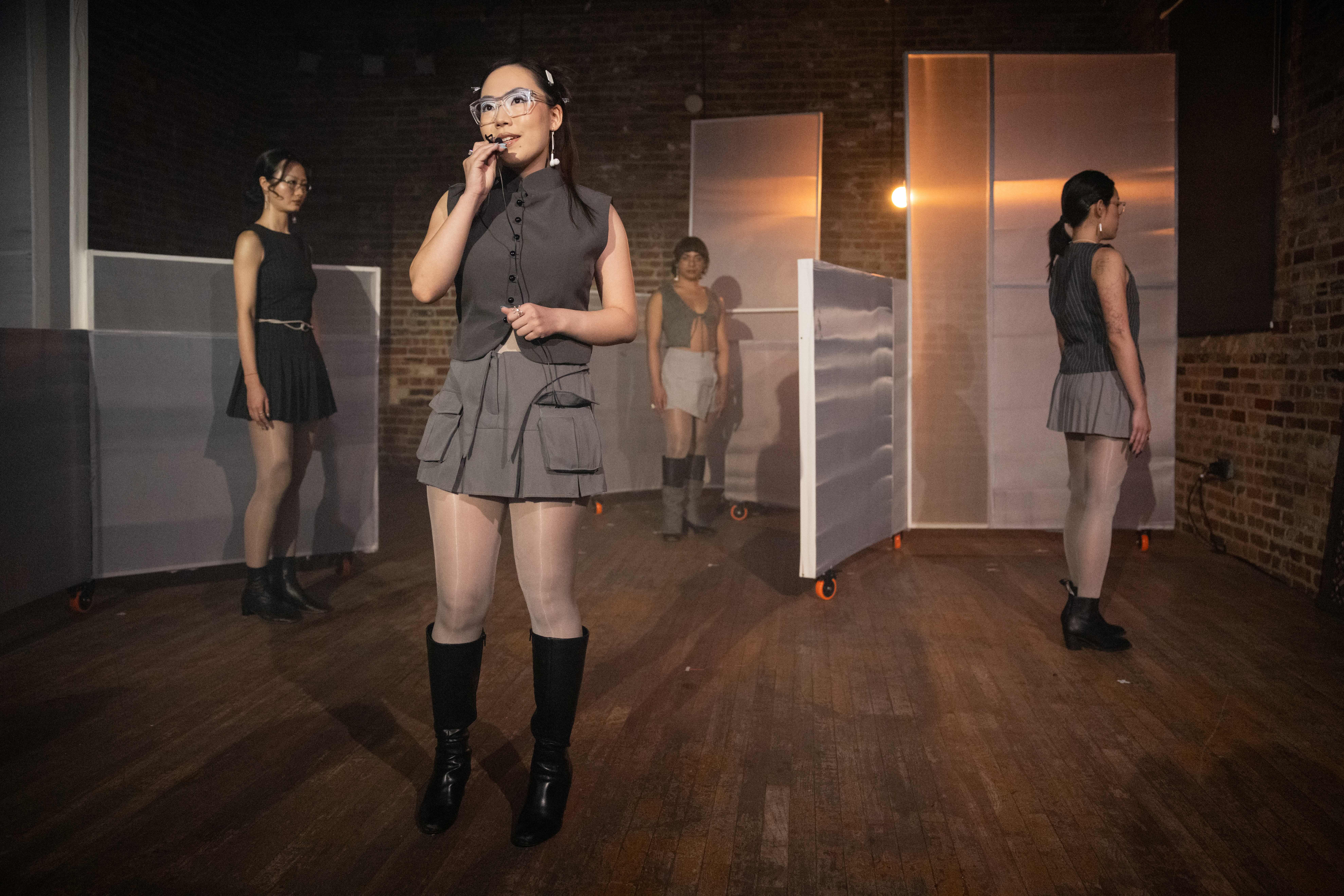
The 80-minute piece features performers Nikkie Samreth, Miranda Kang, Sam Xu, and Ring Yang as SHEIN employees. Coiled into pencil dresses, pinstripe blazers, and heeled boots, the employees effusively compliment one another’s outfits, “checking in” with one another upon their morning arrival, and eagerly waiting for the day’s email from their manager (Isabel Ebeid), this boss sometimes seen specter-like adjusting the employee’s clothes. They move around large white dividers, the production design by Forest Entsminger sometimes looking like a Kafka-sequel cubicle.
The play is framed by an ASMR conceit that invites audiences to enter a dream space where white collar work is emblematic of an unsettled Chinese diasporic fantasy of success. Each performer mimics the whispery tone of an influencer both offering makeup tips and elation at the computer screen, prompting the user to go through two-factor authentication. All the while in their office chair, Gao tries to thread memories of her grandmother’s separation from her husband, her potentially disapproving attitude about the character's life spent choosing emails over time spent talking to her grandmother, and ultimately her grandmother's death.
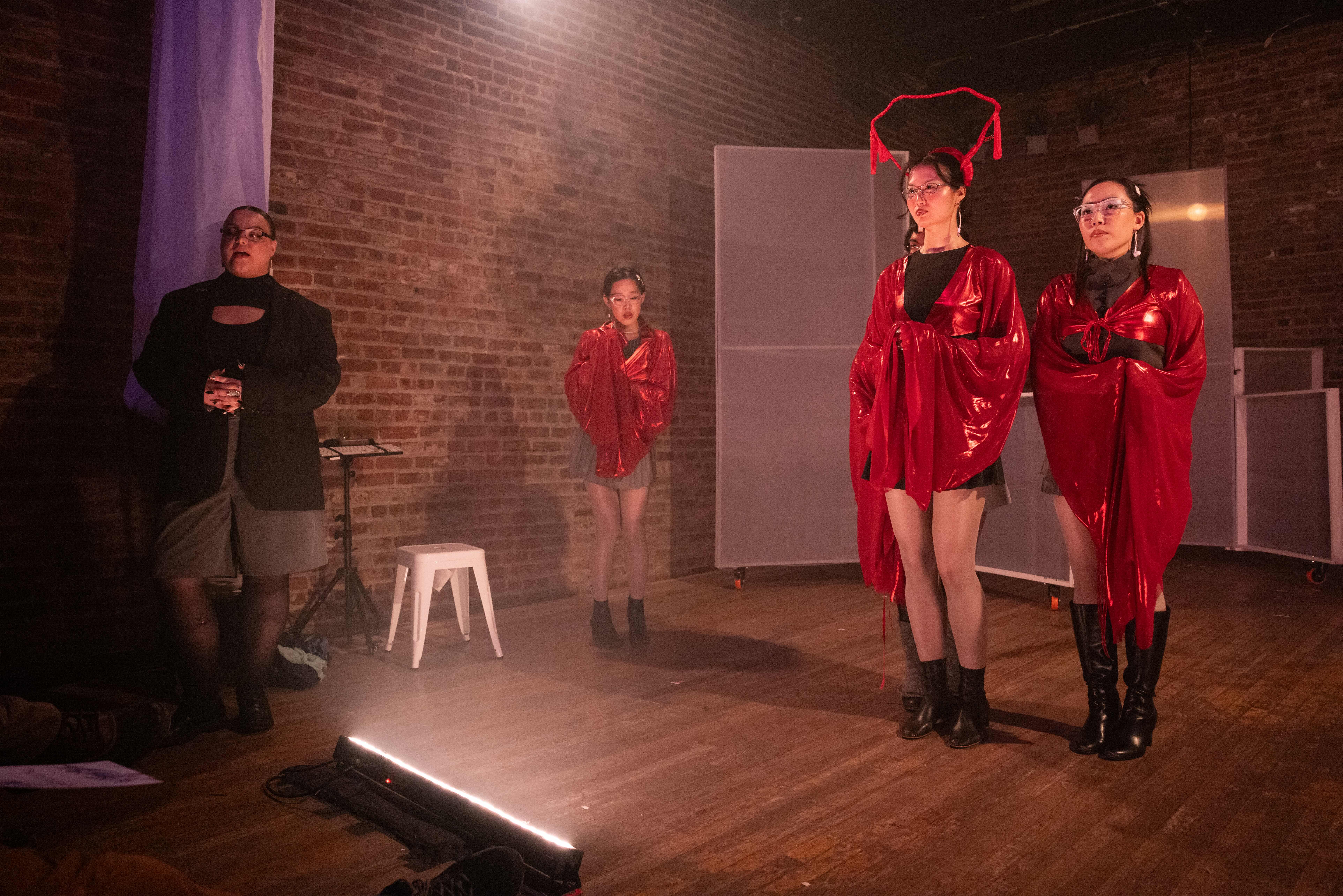
I want to hold onto something beautiful and empty is a more novel frame for a type of Asian diaspora blues piece that are still hung up on guilt, intergenerational dissonance, and a bereavement of the culture and rituals lost through racial/cultural assimilation. If the show has little new to say or add to that subject matter, there are at least flashes of fun surrealism in here, like when the performers turn into donkeys and bray or when, in the middle of the wild, the performers still wonder where their computer is so they can login on time for work.
But there’s a looseness to the structure that never feels satisfying, as if each of its aesthetic and thematic components have yet to be sculpted to fit together. Even as the show tries to wrap things in a bow at the end, there’s a kind of dutiful and uninspired nature to the actual performance. Jokes don’t so much land with arch comic timing so much as they dribble half heartedly from actors’ mouths. And its attempts to create subversion or surprise from these objects of critique/consideration instead elicit a shrug, as if the show is itself uncertain of its capacity for satire and sincerity, merely repackaging other anticapitalist and AAPI reclamation talking points in the language of Brooklyn performance art instead of invigorating them.
That the show is so heavy on “I remember” type recitations tends to squander the potential for theatricality or dramatization. Its pantomime bits—typing on the computer while volleying inane coworker chit chat; an all out brawl between disaster survivors—suggest a funnier, more expressive show. The lighting design by Connor Sale, however, keeps things atmospheric and moody, helping illustrate environment and sensibility in a way that the script and performers sometimes struggle to do. A soft orange bulb will glow with diffuse blue light and fog washing over the stage in dreamy scenes, and hanging fluorescents will ominously flicker while performers gab about lunch happy hour in another. Sale’s work channels the mordantly funny ways that, even in a work from home landscape, the sheer monotony of white collar work, and the ambivalence about success and security it can elicit (from children of immigrants or otherwise), can redress every other part of your life and memory into the same purgatory you Slack coworkers from.