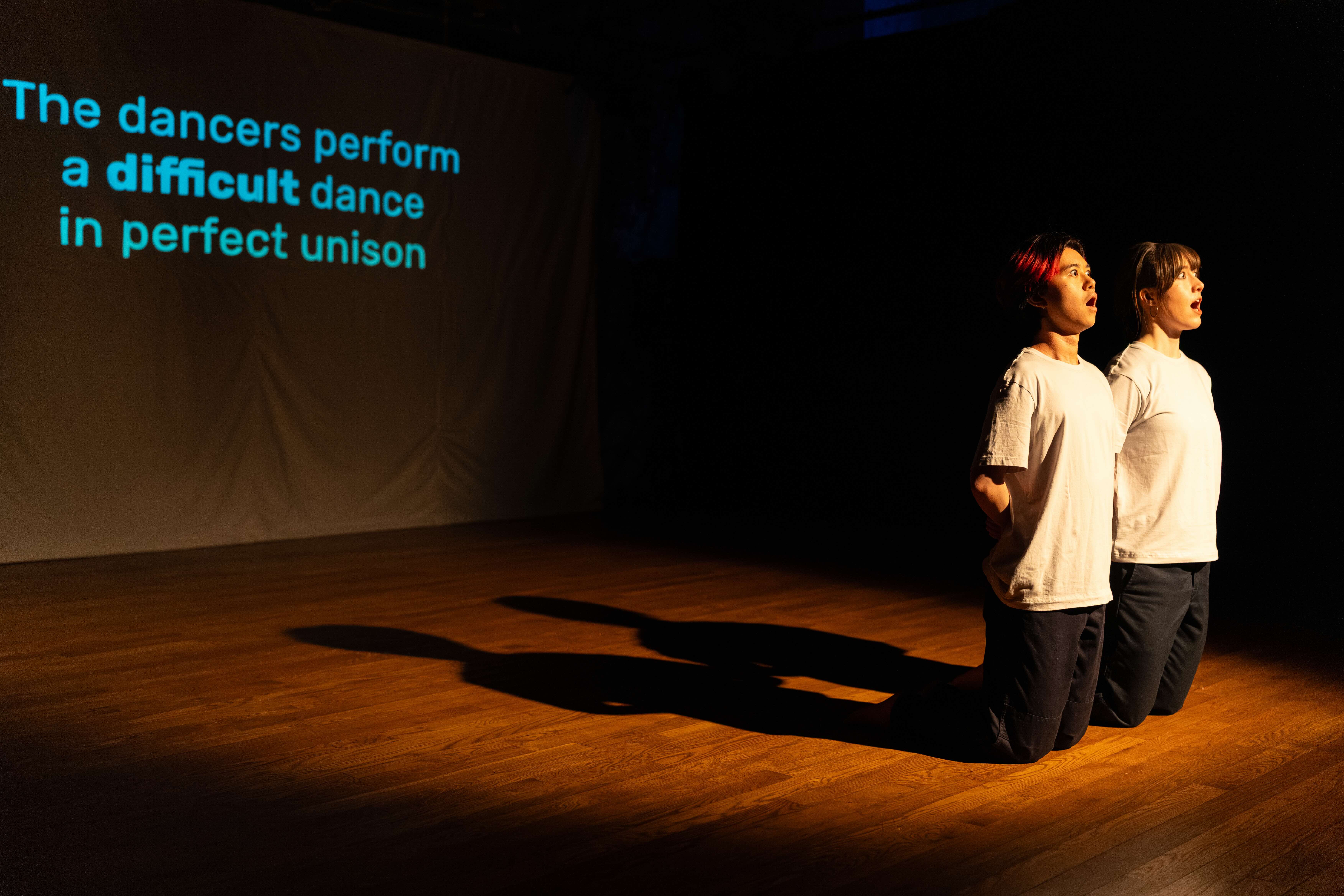
A radio broadcast on the history of the computer crackles over a tinny dance beat. Enter two dancers (Miranda Brown and Noa Rui-Piin Weiss). A command appears on the upstage wall: “The dancers dance.” They do, then return their gazes to the wall, where the command is replaced with words of praise. As they shift their bodies around the bare floor they receive another command: “The dancers need to train more before they keep dancing.” Brown and Weiss discuss their options then, palm-to-palm, do push-ups against each other, bestowing a tender forehead kiss each time they come together. Next command: “The dancers perform a difficult dance in perfect unison.” We hear the discipline, the ruthless precision, of a metronome. The text refreshes: “…a *difficult* task…” The computer is dissatisfied. Once more with feeling.
Enter. Command; shift; option; return; delete. Command; shift; option; return; delete; escape?
¿¡¡simon negs≈≈>:(:{{** (work-in-progress), created by Brown and Weiss as a follow-up to their 2024 piece !!simon says~~!:));)$$, taps into the hyper-contemporary fear that we as humans have become cybertechnology’s tools. That we are the helpless intimates of the digital’s unscrupulous seduction. That we are merely sleeper agents ready at any moment to be activated by a ring, a buzz, a vibration. That human artistic success is measured on the ability of the human to reach the bar set by a computer—not the other way around. We can find comfort, the piece seemingly wants to remind us, in the fact that we as humans have the power to decide what the future of computer technology looks like.
But Brown and Weiss’ piece gives an ambiguous impression of its dancers’ agency, and of the extent—actual or perceived—of the computer’s authority. Why don’t the dancers just leave? Do they like being told what to do? What happens if they disobey? “I just want to dance,” Brown tells Weiss, as if her ability to dance is conditional on her continued obedience to the computer. Is it? Over the course of the performance, the computer’s commands become increasingly sinister, culminating in the order, “The dancers kill someone.” In a move reminiscent of the fate of HAL 9000 in 2001: A Space Odyssey, the dancers ultimately—and predictably—game the system, realizing the “someone” they kill can be the computer itself. They clamber through the audience to reach an overhead projector, which they unplug with a gentle tug. Oz the Great and Terrible is nothing more than Microsoft PowerPoint 2024. If only it were that easy.
As soon as the Big Bad is defeated, the lights go down and the show is over. But what happens after we unplug? Do we get to dance? Or was it the constraints that made creativity possible? ¿¡¡simon negs≈≈>:(:{{** (work-in-progress) is let down by its lack of a denouement. The silly, tender, hypervigilant, unreadable, unpredictable world the dancers inhabit is defused in a single moment. If we’re meant to recognize the powers-that-be are nothing more than fragile Potemkins—sheep in wolves’ clothing—then the dancers’ clear-sighted bravery in resisting is overshadowed by a vague sense of their folly in complying for so long. Had we been allowed to sit for a beat in the moment of victory, the ¿¡¡simon negs≈≈>:(:{{** (work-in-progress) contradictions of might have had space and time to unravel. Time and space may be luxuries in times like these, but they are luxuries the theater can provide.
In the pre-show set-up of Maria Reads a Book: Higher Eyes on Aricama, created and performed by visual theater artist and hypnosis practitioner Maria Camia, a white curtain drops to reveal a 4’x16’ wall installation resembling a speculative collaboration between Sun Ra, Salvador Dali, and the Teletubbies. In the minutes before curtain, UJ Mangune (live videographer for the production) places three cameras on tripods facing the painting, as if in anticipation of a heist—or, as it transpired, a livestream.
As Camia retreats behind the cameras to the canvas, it becomes clear that the live audience is secondary to the one viewing Maria Reads a Book remotely as it’s livestreamed to YouTube. With a fourth camera pointed at her back, Camia sidles to the downstage edge of the playing space and assumes a cutesy pout and a voice suited to children’s television. This project, she tells the audience(s), was born as an antidote to the 3am doomscroll, a hypnosis-inspired reclamation of focus and the gifts of the present moment.
For a show preaching the salvific power of presence, Maria Reads a Books was an exercise in divided attention. Upstage, Camia opens the painting like a pop-up book and, with the help of dozens of colorful paper puppets, she tells the story of Ari and Cama, two human-flower hybrids that embark on a tempestuous journey toward achieving a state of extreme focus. Their adventures are a spasmodic stream of MadLibs. I craned my neck to watch Ari and Cama power walk with Saturn’s Pope and encounter oppressive poisonous bees. Did she mean venomous? No, I decided, probably not.

The difficulty of following the deliberately chaotic plot was exacerbated by the necessity of toggling between watching the performance on two different monitors and in real life. A child in the audience delivered damning feedback in the middle of an elaborate puppet sequence; turning on her mother’s lap she whispered loudly, “Mama, can you tell me a story?”
But a different child was evidently enchanted. A spectacularly giant rainbow puppet resembling a tapered stack of pancakes opens its simpering maw to ask us when the last time was that our hearts were seen by our eyes, when was our last check-in. A human arm poked out as the puppet performed an act of auto-cannibalism and the awed child gasped, “She’s in there!”
As a puppeteer and craftsperson, Camia makes magic. In her hands, two-dimensional paper dolls wake up from a nightmare, use power tools, and blink eye crust out from under their inert lids. Camia returns to the stage inside a sculptural costume featuring the stacked faces of the rainbow-lilypad-pancake stack. She addresses the audience in a made-up language Camia calls “Aricama light language” (translated into English by Aaron Banes, the show’s live musician and composer): “Oh Goddess of my being, when will I let my sun rise?” We are told to press our fingertips together.
Maria Reads a Book felt like a guided mediation at its most frustrated. My attempts to ponder when was the last time my heart was seen by my eyes were stymied by the all-too-recent authoritarian bees, purple palaces, melting spectacles, and potato-people-comrade-hivemind. Maybe my attention was supposed to fracture along with Ari and Cama’s. But if the meat of the piece was designed to create the split focus, the sensory overload, of the doomscroll, only for Camia to swoop down at the end to bring us back from the brink, it didn’t work. I left the theater less in the present than I was when I arrived, but because, to Camia’s credit, I couldn’t get the potato-people out of my mind.
If creature comforts are those material effects that straddle the line between luxury and necessity, then the new Atomic-Era gay scientist monster pop musical from drag duo Excess Materials and Hugh Mann Race is aptly named. In fact, Creature/Comfort manages on several counts to have its cake and eat it too. As wholesome as it is raunchy, as sentimental as it is satirical, as nostalgic as it is critical, the musical’s triumph is in its ability to make entertaining wild fantasies the only viable way forward.
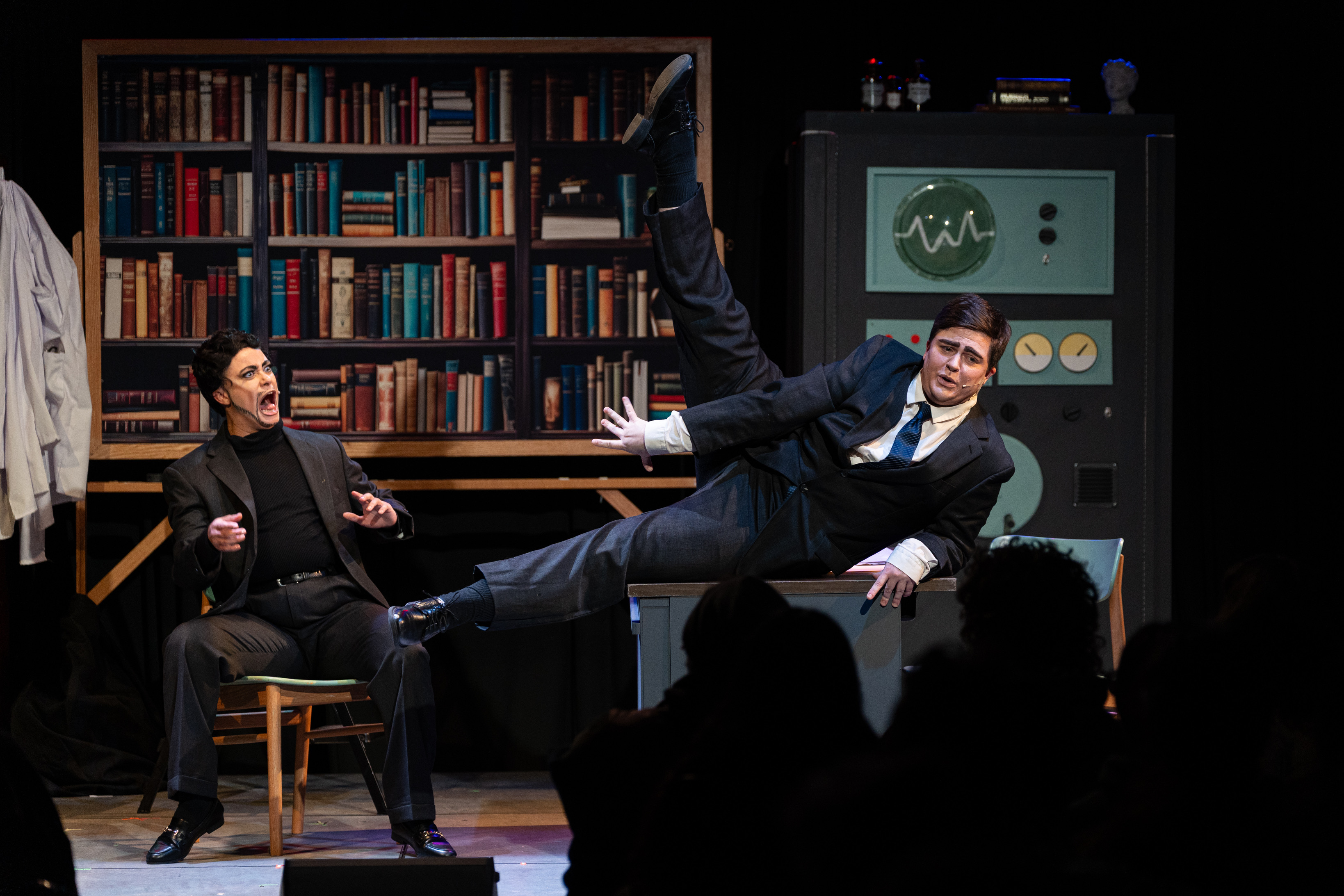
The year is 1953 and Transatlantic university scientist Dr. Bartholmew Bright (Sailor Jerry/Meg Gomez-Campbell) and his heartsick assistant Kevin (Excess Materials) are on the brink of an incredible discovery: biomedical technology that can change any organism’s sex. It’s worked already on lab chicken Larry (an adorably fluffy butter yellow puppet) when Department Chair Humboldt (Masc Ari), harboring a personal vendetta against Bright, recruits a rookie FBI agent (Hugh Mann Race) to ruin Dr. Bright’s career by confirming his suspicion that Bright is in fact a homosexual. As Bright and Kevin confront red tape and the Red Scare, their relationship transforms from a Bunsen and Beaker, Mushnik and Son, Toymaker and Grumio-type dynamic to a passionate queer monster romance in a world where “love and violence conquers all.”
The musical’s book and lyrics are studded with this reviewer’s favorite of creature comforts: puns. There is certainly a first draft-quality to the score, in which anthems are overrepresented and lyrics often ring of clever rhymes shoehorned-in. A character’s sly reference to what’s hidden “in my jeans” [get it? genes? Cause he’s a biologist?] puts Sydney Sweeney to shame. Ari elicited shrieks and cheers from the audience with their vogue number in which the homophobic Humboldt declares his punning plan to destroy Bright: “it’s about time Dr. Bright was humbled” [get it? Like Humboldt? His name?]. Bright nearly bubbles over with enthusiasm describing the mitochondria (“the powerhouse of the cell!”). Much of the delight in Creature/Comfort comes from getting to witness Dr. Bright and Kevin inventing modern biochemistry and millennial culture at the same time.
More often than not, in Creature/Comfort, the abundant word-play is the point and the anthems—particularly Kevin’s soulful lament on how “Kevin rhymes with nothing that’s romantic” (spoiler: it actually does)—carry a poignancy that cuts to the heart of the silliness. Creature/Comfort shows us a fantasy world in which the death of J. Edgar Hoover marked the beginning of free and accessible HRT for all who desire it, government thugs miraculously metamorphose into leftists, and university science and arts programs get the funding they deserve. These things are not creature comforts, they’re necessities, and Creature/Comfort shows us a tantalizing glimpse of Brave New World in which they are realities.
Before too much time has passed in Virginia Woolf’s 1927 novel To the Lighthouse, the reader gets the chance to see through the inner life of sometime-protagonist Mrs. Ramsey to another tale: the story of the Fisherman’s Wife. We get only glimpses of the story peeking, like the crest of waves, over the deep current of Mrs. Ramsey’s feeling. Woolf uses a musical metaphor: “Mrs. Ramsey wondered, reading and thinking, quite easily, both at the same time; for the story of the Fisherman and his Wife was like the bass gently accompanying a tune, which now and then ran up unexpectedly into the melody.”
The relationship of a bass line to its melody aptly describes the ideal relationship between the two source texts behind The Goat Exchange’s Time Passes (for Ellen Brody): the brief, decade-spanning middle section of Woolf’s novel titled “Time Passes,” and Steven Spielberg’s 1975 cult classic film Jaws, specifically every line spoken by the character Ellen Brody, wife to police chief-turned-shark-catcher Martin Brody, during her five minutes of screen time.
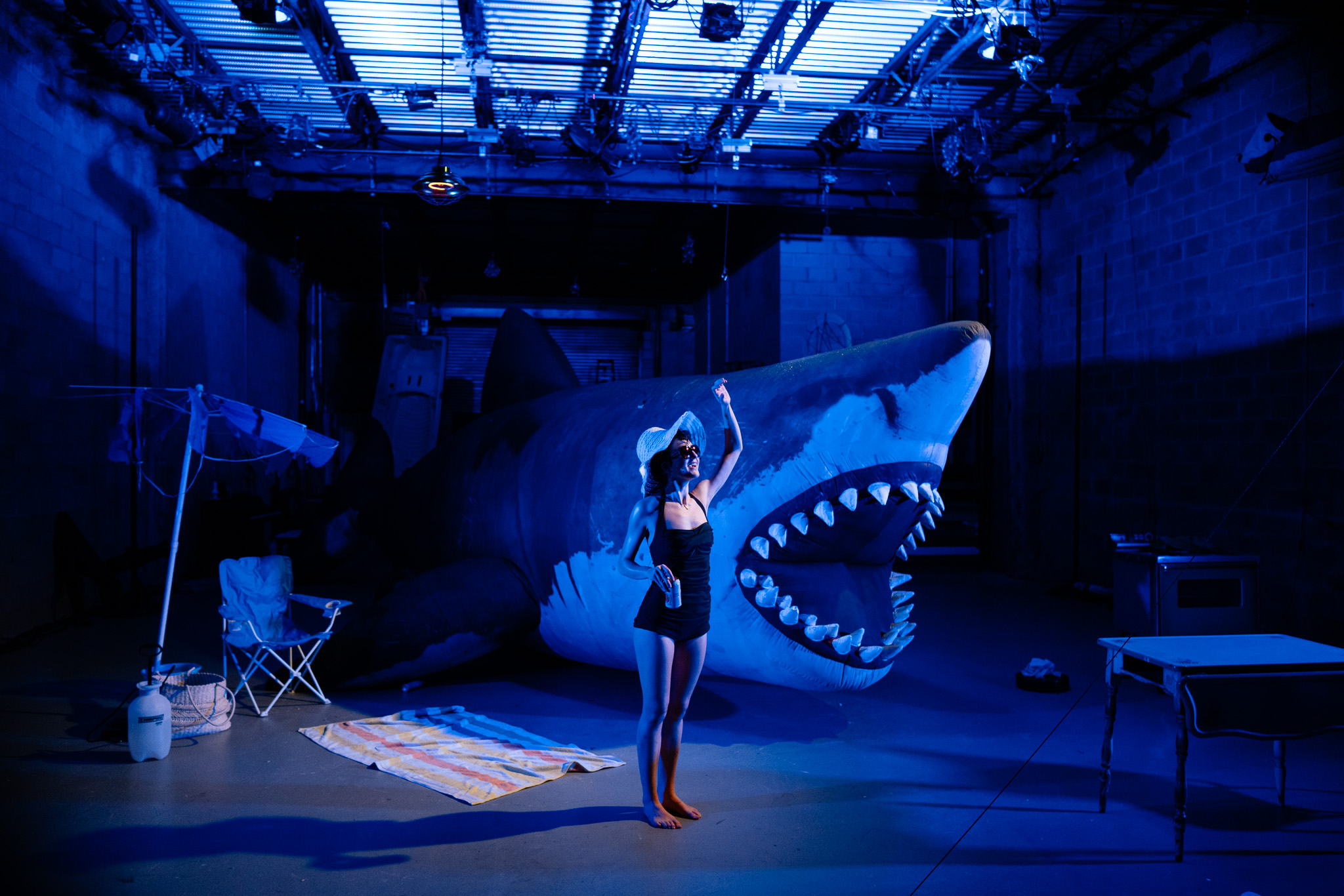
That there is a profound affinity between Ellen Brody and Woolf’s chapter is a foundational assumption of Time Passes (for Ellen Brody). The piece opens in darkness. A white ghost of light flits across the stage, then grows in intensity until one feels completely at sea, repeatedly caught and released by the beam of a lighthouse (lights by Abigail Sage). A spotlight flicks on and reveals performer Chloe Claudel, costumed in a Brody-esque 70’s-going-on-’50s-style house dress and blonde perm (costumes by Olivia Vaughn Hern) and perched atop a ladder reaching nearly to the warehouse ceiling. Claudel begins to recite “Time Passes” from the beginning with shrewd narratorial authority: “…‘It's almost too dark to see,’ said Andrew, coming up from the beach.” Claudel climbs down the ladder and gets busy in a tiny retro kitchen (spectacular spare set by Forest Entsminger) as a pile of grey nylon centerstage slowly and silently inflates into a massive, thirty-foot-long, ten-foot-tall Great White Shark. (The miniature plush shark and life-sized shark head hanging from the grid were evidently red herrings).
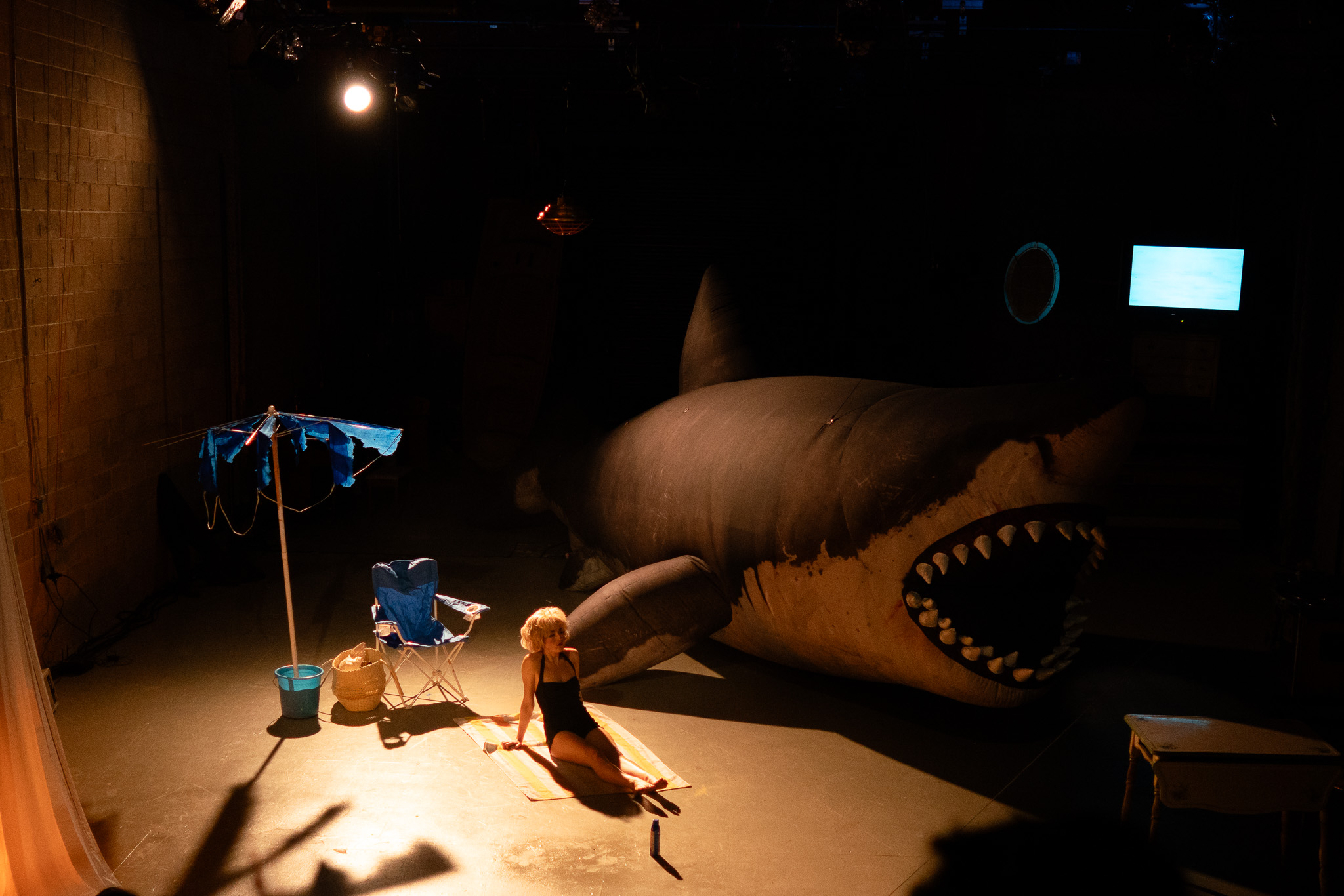
As the show continues, the melody of Claudel’s continued recitation of “Time Passes” and the bass line that is Ellen Brody come together less and less frequently. Claudel and co-director Mitchell Polonsky set “Time Passes” to a hackneyed “frustrated housewife” pastiche. As this play’s Ellen Brody, Claudel drinks her wine, spills coffee on purpose, and rage-butchers a chicken all to the incongruous tune of Woolf’s richly impersonal prose.
There are times when the play’s two sources clearly converge. Claudel speaks Woolf’s line, “there was a purplish stain upon the bland surface of the sea as if something had boiled and bled,” while onstage a television set shows a clip from Jaws of the bloody water after a shark attack. Time Passes (for Ellen Brody) aims to be associative, but too often flounders in literality.
“Time Passes” is a narrative interlude in which Woolf explores the impersonality of nature and the relativity of human experience. Jaws is a film about the triumph of man over (a personified, evil) nature. Time Passes (for Ellen Brody) is largely uninterested in interrogating this contradiction, with one arresting exception: the giant inflatable shark (who throughout the show Brody treats as if it’s her husband) has been suspended in the air and Claudel stands under it. Looking so small and staring upward at its weightless bulk, she speaks Woolf’s words, “Looking up, yet beholding nothing.”
If Ellen Brody can be found anywhere in To the Lighthouse, it’s not in “Time Passes.” But what about the story of the Fisherman’s Wife? One day a poor fisherman catches a wish-granting fish. After setting the fish free, the fisherman goes home to his wife who demands he go back and ask the fish to give her a nicer house. Again and again the dissatisfied wife sends him back to get more and more wishes granted until she asks to be made equal to God. Having gone too far, the fish takes all her wishes away. Dissatisfaction, the home, feeling caught, wishing, wifehood—there are the things that preoccupy Time Passes (for Ellen Brody). I’d love to see a future version of this piece with a melody that allowed these underlying concerns to sing. If wishes were fishes…