.jpg)
Not to get overly philosophical, but I’ve been ruminating on the idea that empty things are meant to be filled, generally speaking. Boxes, theaters, office buildings, stuff like that.
But also—nothing’s ever truly empty, except for maybe the vacuum of space. The object is only empty relative to the things it was intended to hold. A row of cubicles without its attendant workforce might be described as empty, even as it’s filled with the detritus of activity: scattered pencils, discarded coffee cups, chairs that have migrated away from their desks. To put it another way, something only becomes empty once we’ve decided that the things that it does contain are not worth accounting for. Air. Free time. Often, even people.
The abstract piece I want to hold onto something beautiful and empty, written and directed by Hillary Gao, elicited these abstract thoughts. Gao’s play centers one nameless Office Siren, spliced into four actors (Nikkie Samreth, Miranda Kang, Sam Xu, and Ring Yang). The Office Siren(s) move through an ASMR-laden fever dream, jumping from the tennis courts on the 333rd floor, to the SHEIN offices on the eighteenth floor, to the Atlantic Ocean floor—nature’s basement—plus the Hunger Games arena, and Qing Dynasty China (approximately—I want to hold… is actually referencing a popular Chinese historical drama set in that time period). All this teleportation is actualized through dialogue, lighting, and the occasional movement of three cubicle-core set pieces. A sleek-looking psychopomp called Stage (Isabel Ebeid) serves as a voyeur to Office Siren’s roving, while three specteres haunt her: her grandmother, her physical appearance, and her email inbox.

Office Siren’s only apparent job is to respond to a daily email to confirm that she is, in fact, sitting in her assigned chair. It's the pinnacle of meaninglessness. It made me want to take Office Siren by all eight of her hands and tell her, “It’s OK, Beloved. Just work from home.” Such an intervention probably wouldn’t have been effective, though; when describing her job, Office Siren 3 earnestly remarks that, “Without me, this whole company wouldn’t exist, so you could say everything hinges on this one email.” There’s a zero percent chance that this is true. More likely, she amounts to a rounding error, as it relates to the function of a company with 10,000 employees.
But that’s the beauty of emptiness; if nothing else, it’s full of potential. The job can become anything it needs to be, can fill any chasm created by Office Siren’s relationship with her grandmother, clearly taxed by distance and misaligned filial expectation.
I think that’s how I felt about the show itself—that it left me with spacious gaps to fill. I don’t have a relationship with ASMR, nor with “Get Ready With Me” videos. I can’t understand any dialect of spoken Chinese. None of these personal deficiencies preclude me from taking something from the play, but they each create an emptiness that I needed to fill. It was a task that I found difficult. Sometimes gratifyingly so, like when I noticed Stage’s varying approaches to translating Office Siren’s non-English dialogue (both Chinese and “Donkey”). Sometimes just confoundingly so; every so often, Office Siren would end an anecdote with a variation on “I don’t want to talk about this anymore,” leaving enigma in her wake.
In contrast, one element of the play that felt replete was the tennis. Office Siren, either as herself or as her grandmother, played a few points over the course of the play. Importantly, tennis does not have “garbage time”—empty time—like other sports do. You can’t afford to concede points; every single moment matters. And in the cacophony that is I want to hold onto something beautiful and empty, that’s the truth that I think could have taken up more space. Finding meaning in our lives is not something we can save for later, or off-load onto someone else.
When I sat down in my folding chair—yellow-green like a moldy, water-logged tennis ball—to watch PROFESSIONAL DEVELOPMENT, I wondered if I was messing with the vibe.
The vibe was built on letter-sized posters which read “Nothing is expected of you,” limp balloons stuck to an overhead projector from the early 2000s, and streamers cascading (precariously, suicidally, even) above a table which featured instant decaf coffee, Italian cookies, and napkins reading “PARTY” as if simply stating it made it so. The vibe was middle management purgatory. And we were all there together. Yet here I was, distanced from the collective, my notebook and pen signaling to everyone that I was a critic (derogatory), here to observe.
From my pretentious vantage point, multi-hypenate Michael Levinton and ensemble-based theatre company Little Lord, jointly credited as the conceivers and facilitators of the show, sought to prove that poignancy can emerge from a ritual as uninspired as the professional development session. The tools that they gave themselves to work with included trite platitudes pasted to the wall, trust-building exercises with vague parameters, Y2K technologies, dodgeballs in a box, and Mickey Mouse gloves. And the strategy they deployed was density.
There was a density represented by the physical body; the nine performers spent most of the show wearing sweatshirts with several name tags on them, insinuating that this professional development program has hosted many such groups of nine before, and perhaps all of those groups are in the room with us right now. And there was a density of form; over the course of the 75-minute performance, the performers moved through exercise after exercise. Sometimes that was learning how to gracefully receive feedback, sometimes it was deciding who would get to survive the unnatural disaster. Regardless, each exercise was undertaken with the aim of ameliorating some kind of professional or personal deficiency.

Continuing in the spirit of more-is-more, the production also made every possible reference to the trappings of a professional development session. No allusion was left unturned. The performers even donned clown makeup as they asked questions of varying existential significance. Yes, the corporate office is a circus tent, cue Entry of the Gladiators. (The clownery made me want to pour one out for Rosencrantz and Guildenstern, two Stoppardian-via-Shakespeare clowns killed by machinations above their pay grade.) PROFESSIONAL DEVELOPMENT felt like drinking water from a hose—technically successful, but alienating in its inefficiency.
Worse was a certain other betrayal. Upon entering the space, I believed that we, the audience, were a part of the world. We sat in the same folding chairs. We drank the same instant decaf. It wasn’t immediately apparent who was a player and who was a patron. But then a very performer-y voice crested above the general hum. The show started, the fourth wall went up, and the performers were now looking through us rather than at us.
It felt like the rules of engagement changed abruptly, like I’d been expelled from a space I’d just been invited to. On the bright side, my notebook and pen were waiting for me on the outside, and my concerns about ruining the vibe had been washed away—after all, I wasn’t actually there.
Post-unmooring, I anchored myself to the sensations of my physical body. The sight of the cookie crumbs littering my sweater. The vibration of my seat when a performer spoke into a mic during a presentation on the art of drafting a good email.
On an intellectual level, I understand the offerings that PROFESSIONAL DEVELOPMENT makes, the biggest of which being that even the corniest setting imaginable can be a place that brings us closer to ourselves. And even so, I left wondering, “But what does that have to do with me?”
In Da Clerb, We All F[redacted] – On down&out vol 2: crisis!
It got real in down&out vol. 2: crisis!, a stick up/crystal ball/mortuary/play (but certainly not a party) by Ife Olujobi, and directed by Garrett Allen.
First, we shuffled into Brooklyn Art Haus’ performance space, an oblong black box that featured raised platforms at each of the four cardinal directions. Then, actor Paris Alexander climbed up on one of those platforms—the one backgrounded by a digital clock that felt more like the countdown to the end of our lives—and the play began.
What followed were a series of scenes and monologues in a roughly alternating pattern. The club's attendees railed on about the pressing issues of our time, including but not limited to: ICE, homelessness, anti-Black police violence, mutual aid, transphobia, and “wiggas.” That last item appeared in a trio between Devanté Melton, Maya Margarita, and Maxwell Vice; in a play filled with opportunities to laugh (sometimes to keep from crying), I think these three delivered the funniest scene of the night.
But the trio’s tragi-comedy stylings were only prologue to the emotional fulcrum of down&out. In a later scene, Lindsay Rico eulogizes a loved one. For the briefest moment, I found myself ahead of the play—Diana Oh, an experimental theatre artist who passed away last year, came to mind moments before Rico said their name.
Up until that point, I’d assumed that the play was true only in the way that all theatreer is ultimately about something that’s probably happened to somebody, somewhere. Who among us hasn't felt like our community ran out of f[redacted] to give right when we got to the front of the line? Or had to be the one to give context to Friend A because Friend B is still too pissed about the situation to tell the story fairly?
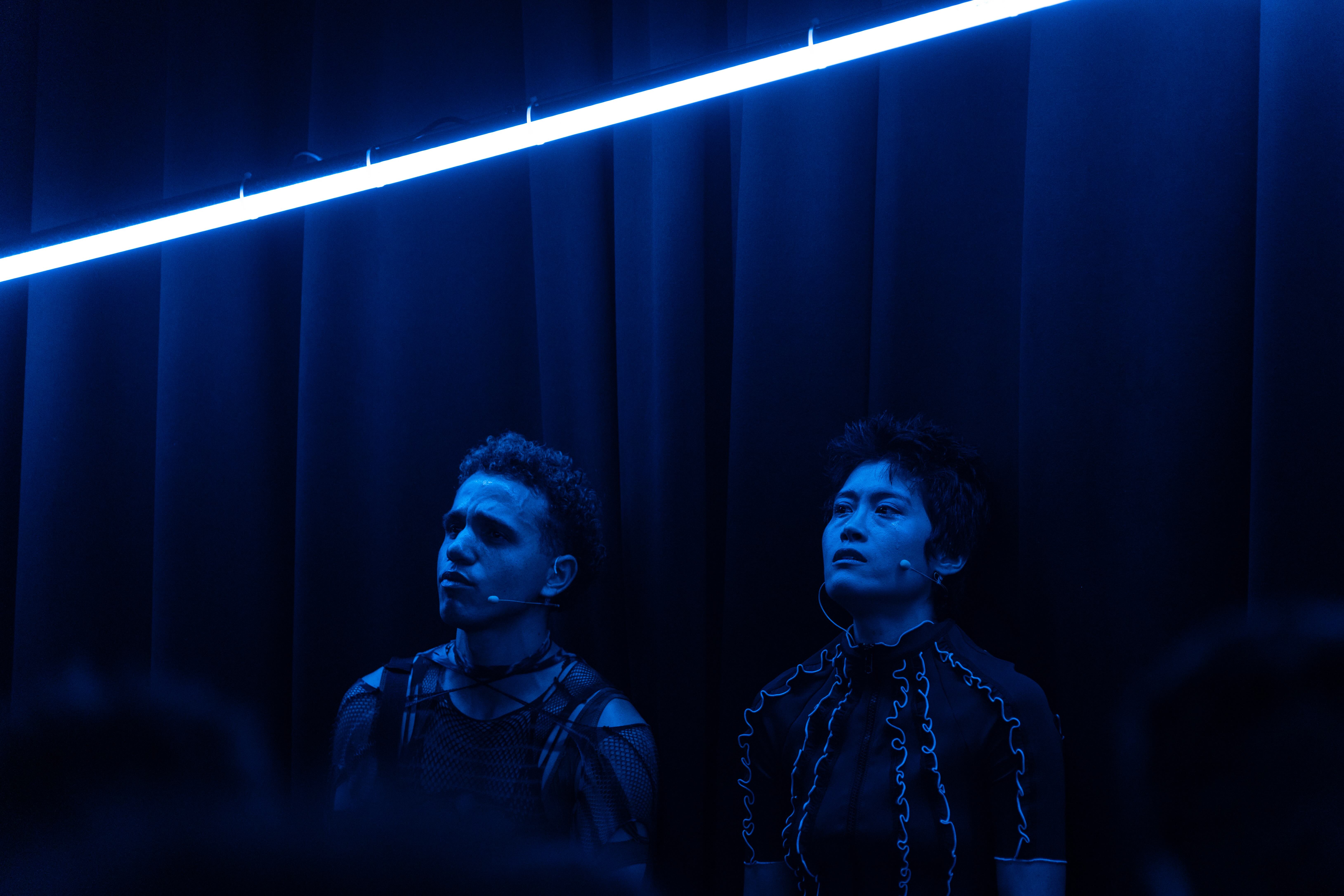
But this scene, centered on Rico, was clearly (auto)biographical. It was an encapsulation of someone’s actual grief for Diana Oh. Or, many people’s actual grief. And it wasn't grief mediated by distance—chronological, emotional, or otherwise. In that moment, the play achieved a different kind of liveness. Live because the performance was happening right then and there, and live because the event that the performance represents was also happening in that precise moment.
With my understanding of the play re-formed, I had to take everything seriously. Nothing I saw, nor anything I had already seen, could be discarded as the downstream consequence of a theatrical thought experiment or a bad trip. The theater is real, the club is real, our experiences at this very moment, in those very spaces, are real. And not only that, but they have been elevated to a position of investigation and spectacle—literally platformed at each cardinal direction.
Until the end. Unlike the majority of the play, the final scene took place on the ground with the audience. It was a conversation about where to go when the party’s over—for us, if not for everyone else. It was a prologue to the exact kinds of conversations we’d be having in fifteen minutes when the show was over.
And then the show was over.