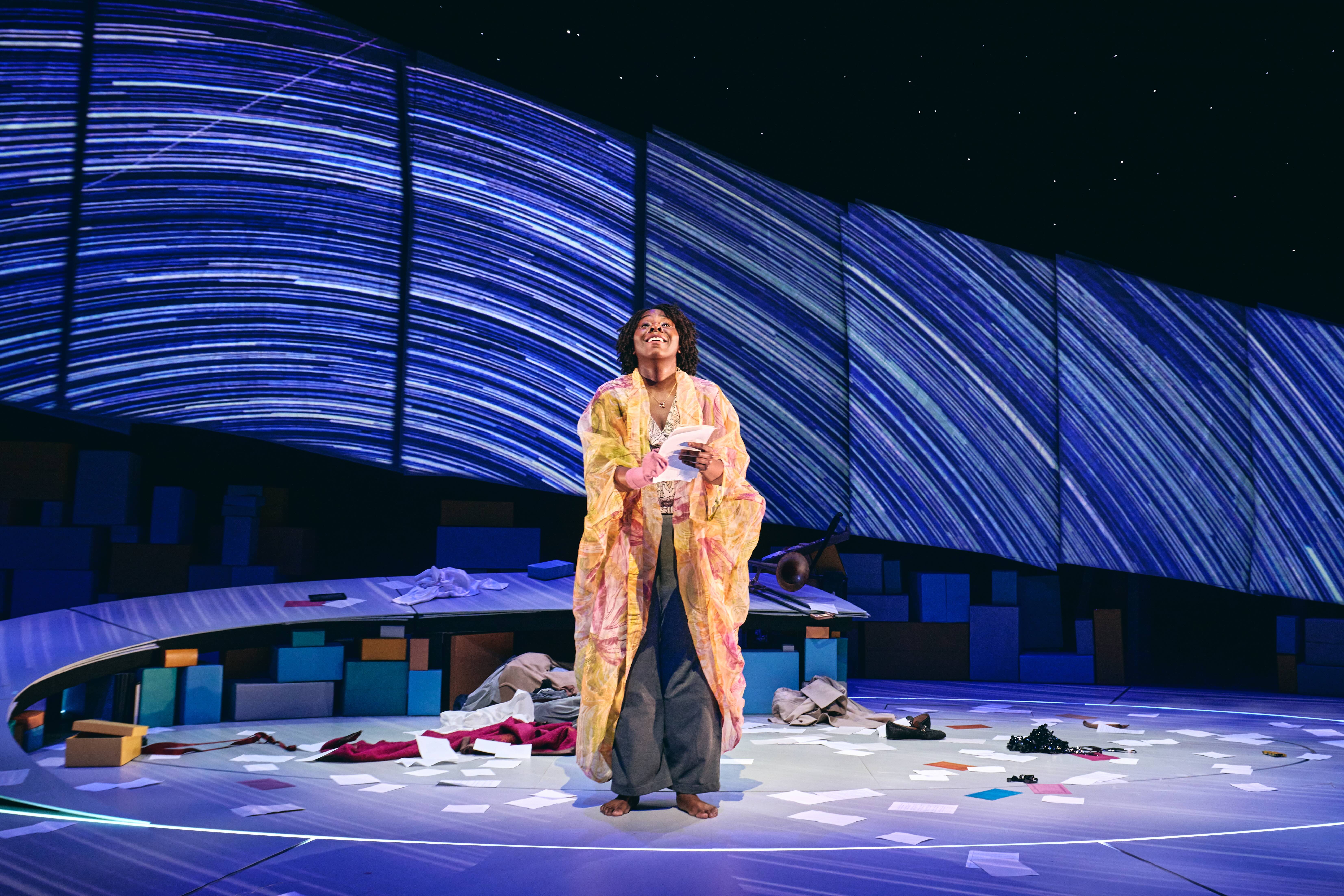

I genuinely believe that necessary media — good books, comfort shows, life-changing films — find you just when you need them. Unbeknownst to me, what I needed was weird-girl literature, but make it theater. Mfoniso Udofia’s creation stories and all the important importants found me and ultimately proved my theory true: it was everything I needed and more.1
When reviewing theater, I typically try to keep my head clear and open to any experience, good or bad, but I knew I was in for a great time well before the house of LCT3’s Claire Tow Theater even opened. An impeccably curated vibe greeted me as I entered: the song “Black Girl Magic” by Sampha the Great was playing, the signature cocktail was called the “Daily Affirmation,” and a kind showgoer complimented my natural hair.2 Honestly, I was delighted. What a thrill that the play itself also delivered.
Udofia’s play begins in a dream, washed in blue light. Onstage, a woman sleeps fitfully. Surrounded by stars, resonant voices, and a dancing figure draped in raffia (a fiber with both practical and spiritual uses made from a type of frond native to tropical regions of Africa), the audience is thrust into a world we don’t quite understand. Just as we begin to get our bearings, the sleeping figure wakes.
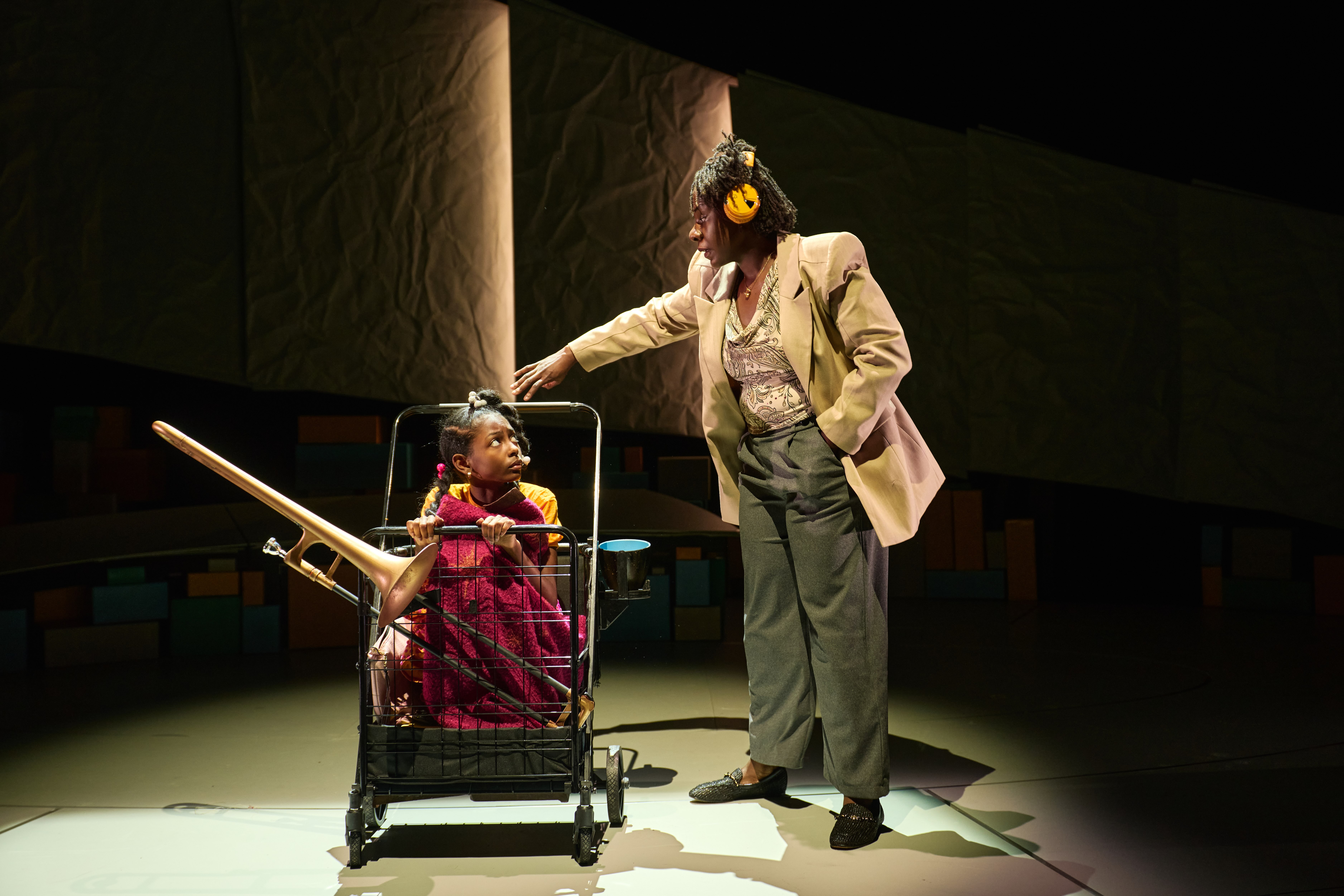
From there, we meet thegrownwoman (an inimitable Abigail C. Onwunali) — our protagonist who is in her fifth cycle of IVF (in vitro fertilization). The play follows the devolution of the thegrownwoman’s day as the grief she continually swallows becomes more impossible to hide. Narrating her character’s experience as she completes a rigorous morning routine, Onwunali cleverly plays with humor and lightness despite the increasingly evident physical and emotional pain thegrownwoman presses through. For a character whose brilliance leads to weighty expectations of perfection, Onwunali’s performance is admirably airy, filled with grace and precision. And creation stories is an emotionally and physically demanding 90 minutes on stage with no intermission, so what she accomplishes in this play is no small feat.
Evoking a similar feeling as the opening dream sequence, the audience is encouraged to sit with uncertainty when thegrownwoman, who works as an educator, moves from her doctor’s appointment to her classroom and begins her lecture on dramatic structure, exploring ideas from fairly standard to obscure. She deftly and cheerfully corrects us in a call-and-response portion of the lesson, celebrating the audience’s participation rather than perfection (and we certainly did not always have perfect answers). She explores ideas from Aristotle’s Poetics as well as the opposing ones, making arguments for both rigid dramatic structure with logical plotlines and the appeal of randomness as a tool to allow the audience to rely on their intuition for understanding.
We watch as thegrownwoman presses on through her chronic pain, IVF-induced distress, suffering relationships (she needs to call her mom and her homegirls3), and inhibited creativity with herculean optimism. But optimism addresses a symptom. It is not a cure. So we also watch as she spirals into a breakdown. Mirroring the character’s inner state, the structure of the play breaks into abstraction. It is a clear deviation from its previous Aristotelian cause-and-effect plot — a cheekily self-referential move considering that the play itself is now exemplifying both sides of the argument thegrownwoman’s lecture presented.
After outrightly ignoring littlegirl, the physical embodiment of her inner child who has been fighting for attention (played with spirit and precociousness by Savannah Commodore, an absolute star), the two finally embrace. And things get even wilder. We see the healing of physical wounds via sock puppets, five-star meals made in no time at all, a deus ex machina in the form of an imaginary friend named Mr. Cornell (portrayed by the lively and endlessly entertaining Donnetta Lavinia Grays), and infinite possibilities of futures and aspects of self written in scraps of paper – appropriate, for a playwright.
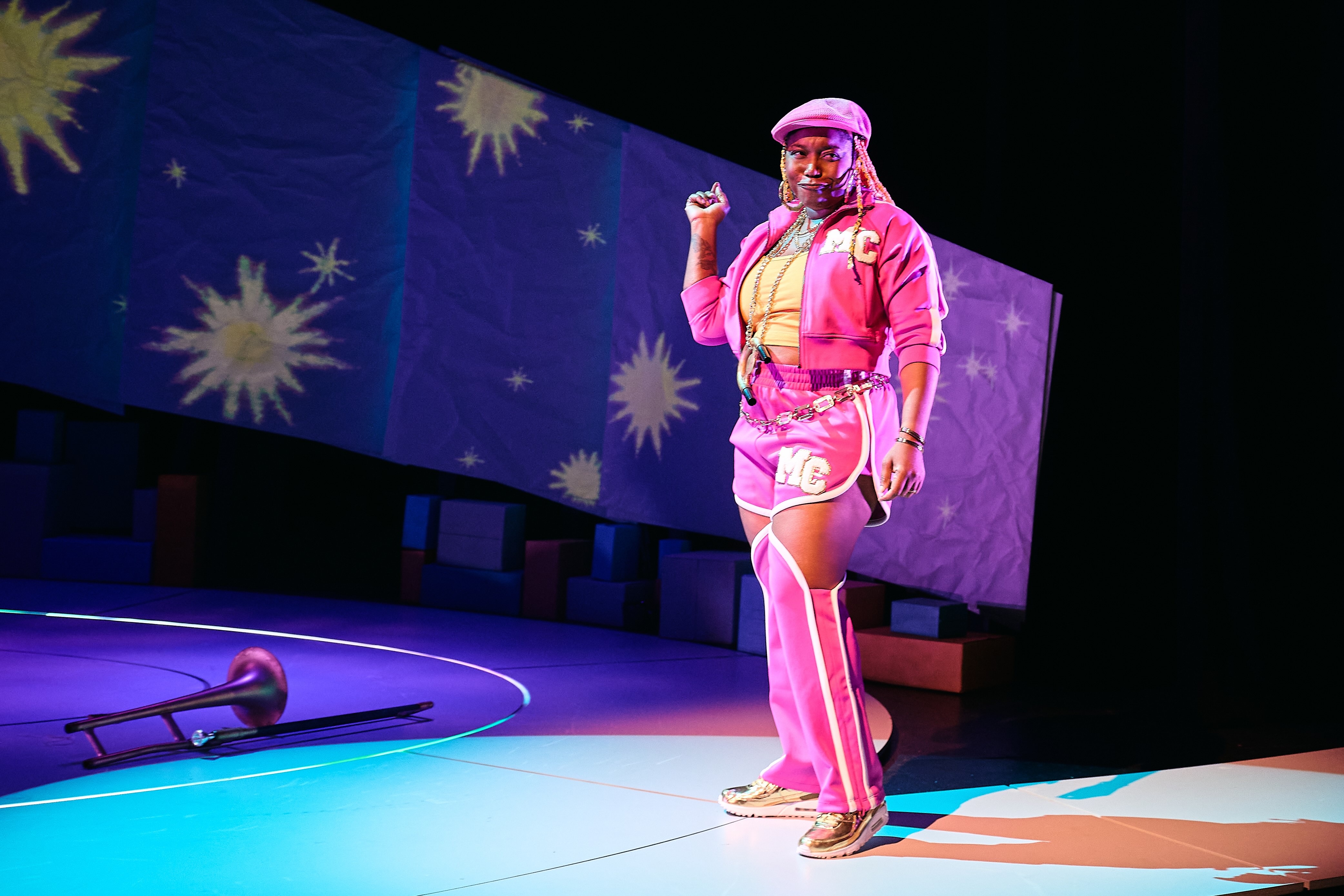
The messiness and playfulness of thegrownwoman, littlegirl, and Mr. Cornell reminds us that the perfection we strive for can be found when we give ourselves room to remember and indulge in what delights us. Seemingly obscure and nonsensical, Udofia commands the abstract to poke at something essential: when faced with unimaginable grief, with fear, with a crisis of faith or identity — how do we healthily “press on,” and what will we find on the other side? How do we face the fear of being seen in our own mess, and the possibility of being loved through it?
For the record, I cried through the last 30 minutes of the show. Now, I’m a Certified Crier so that may not mean much, but there were definitely more sniffles around me, so take it from them. We cried in devastation, in delight, in catharsis (thank you Aristotle, and also Udofia for the crash course).
The necessity of this play is not lost on me. There is currently so much to grieve, especially as Black women, for whom, as navigators of multiple identities, every violence feels deeply personal. On top of that, the ceaseless psychoemotional weight of navigating our personal worlds with “strength,” a baseline expectation of excellence, and imperturbability. In thegrownwoman’s case, several devastating rounds of IVF, and though there are no other characters outside of versions of herself, the implications of what it means to navigate the US Healthcare system are so present. It’s like, I, Too, Sing America but I, too, am perpetually this close to shouting “BRO, WHAT THE F*CK” in the office.4
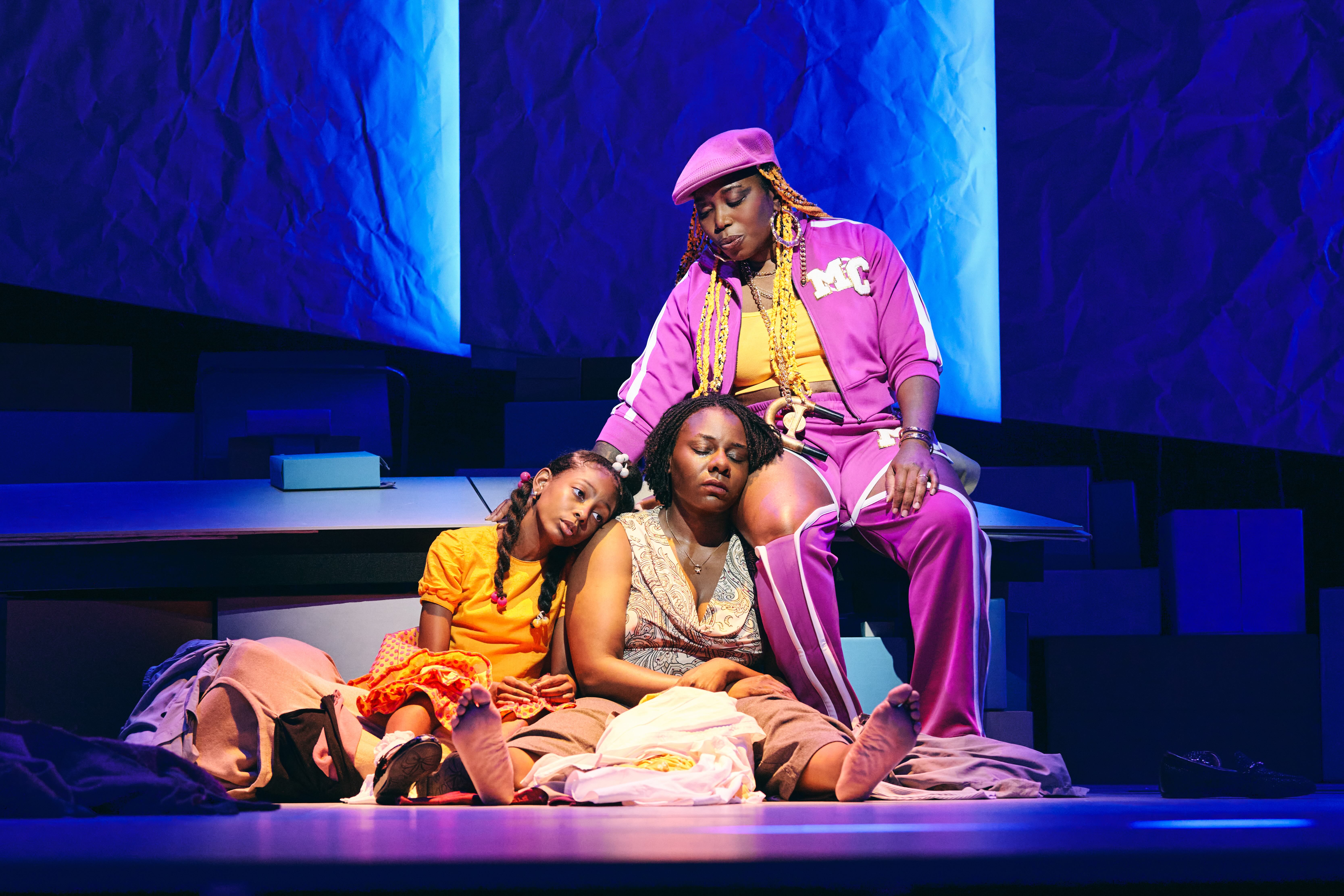
To be entirely clear, you don’t need to be a woman of color, a genius, or someone who’s gone through five rounds of IVF to relate to this play. We’ve all had our disappointments: careers that don’t look the way we planned, relationships that didn’t quite work, dreams that we never got to see fully realized — whether these results were in our control or not. Anyone who has missed out on the present for fear of the future. This play is not a guarantee that everything works out; there are no neat little bows here regarding the plot (sorry, Poetics!). It’s a panacea for people facing their limit, the very edge of their ability or perceptions of themselves or their lives, who must ask, “what next?” Maybe, with a little presence and play, there is delight to be had in finding out.
--
creation stories and all the important importants is running through November 1 at the Claire Tow Theater.