
I once declared, while visiting my cousin in London, that I’d go to Kensington and Hampstead Heath in one day. “That’s like saying you want to go to Ditmas Park for breakfast and Harlem for lunch,” my cousin, having already lived in the city for a decade, replied. Translated onto the contours of New York, my plans seemed outlandish. The 12.9 miles, according to Google Maps, couldn’t be traversed in a single day.
Years later, I made a commute of this length regularly, from Brooklyn to Upper Manhattan for graduate school. I’d grown up to fulfill the hopes of my younger self—in a vastly different context—leading to a valuable observation: the ability to do something still demands the effort of execution. One could have breakfast in Ditmas Park and then head to Harlem, but it’s an awful lot of labor to undertake.
This tension between current wants, past ambitions, and the overwhelming pull away from whimsy and towards responsibility — what fills the chasm between childhood and womanhood — is the thematic current of Mfoniso Udofia’s creation stories and all the important importants at Lincoln Center’s The Claire Tow Theater. The play follows a character named thegrownwoman, played by an astonishingly generous Abigail C. Onwunali, as she attempts another day as a single, overworked, late 30-something-year-old professor trying to get pregnant via IVF.
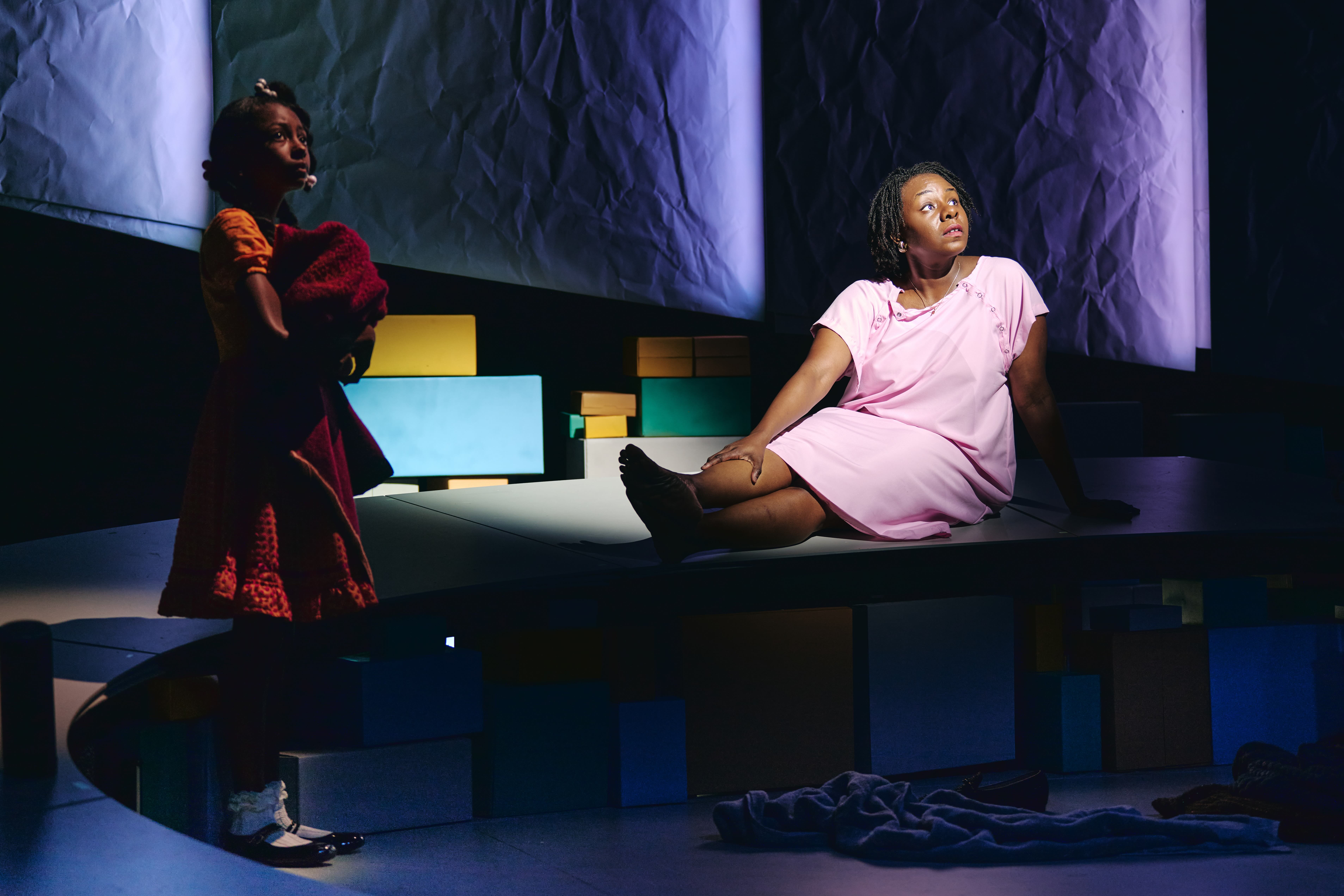
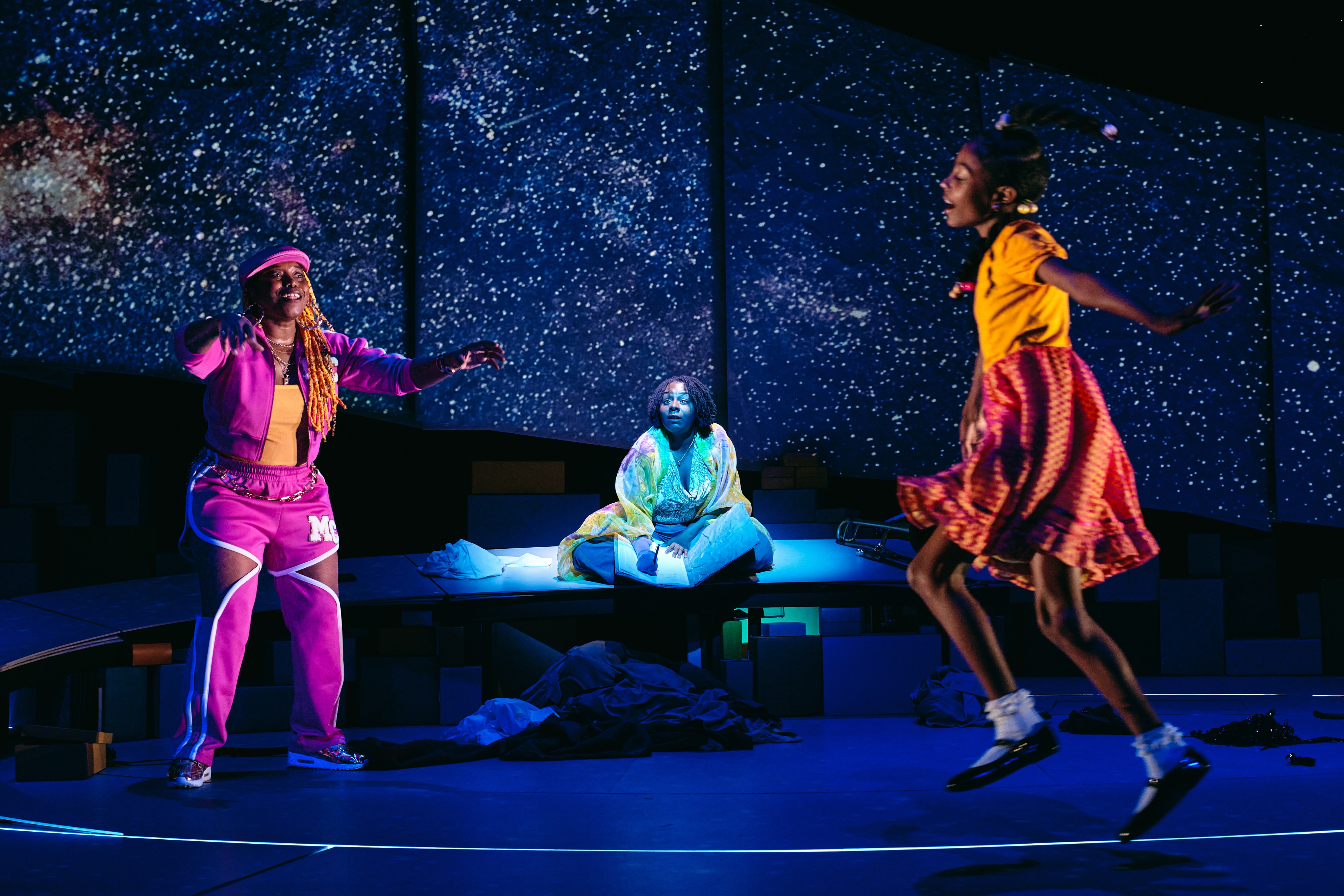
The play begins in duress. Against the backdrop of a milky cosmos (projection/scenic design by Katherine Freer), thegrownwoman is having a nightmare involving a character named raffia — the symbol appears to represent the Zangbeto, or the guardian of night for the Ogu people; Udofia is Nigerian-American — before being woken up at 5:30am in a New York apartment by an over-eager Alexa. She’s already behind, she tells us, narrating her immensely involved routine of morning pages, fertility-friendly workout videos, and breakfast. While thegrownwoman is offstage, showering, a small girl (Savannah Commodore) emerges from a pile of clothes (an oversight of thegrownwoman’s attempt at competence?). Unseen by thegrownwoman, this young character’s arrival is a sort of birth. The little girl appears confused by her present circumstances. Invisible to thegrownwoman, she observes the rest of older counterpart’s day which consists of a doctor’s appointment where she’s told the unlikeliness of a successful pregnancy, teaching a lecture on a Nigerian playwright whose radical narratives challenge traditional structural theory, and a confrontation with her department chair landing her in her office in a pit of despair, ensconced in misery. As thegrownwoman faces the enormity of her struggles, time breaks ceasing her relationship to the world as we’ve witnessed it heretofore: thegrownwoman stops narrating, and sees the little girl.
The most laudable quality of creation stories is its ability to palpably translate the claustrophobia of being spread thin. There were many times during the play where I thought about Solvej Balle’s series On The Calculation of Volume, in which a woman relives November 18 in perpetuity. Among many things, the busyness of thegrownwoman’s twenty-four hours shows the insane amount of activities and anxieties that can take place within a day’s timeframe, akin to my daily trudge to Morningside Heights. Udofia has done this perfectly, physicalized by Onwunali’s astounding magnanimity. Together, they show how exercise, reproduction, self-nourishment, and pedagogy are not only of equal importance, but part and parcel of the same life.
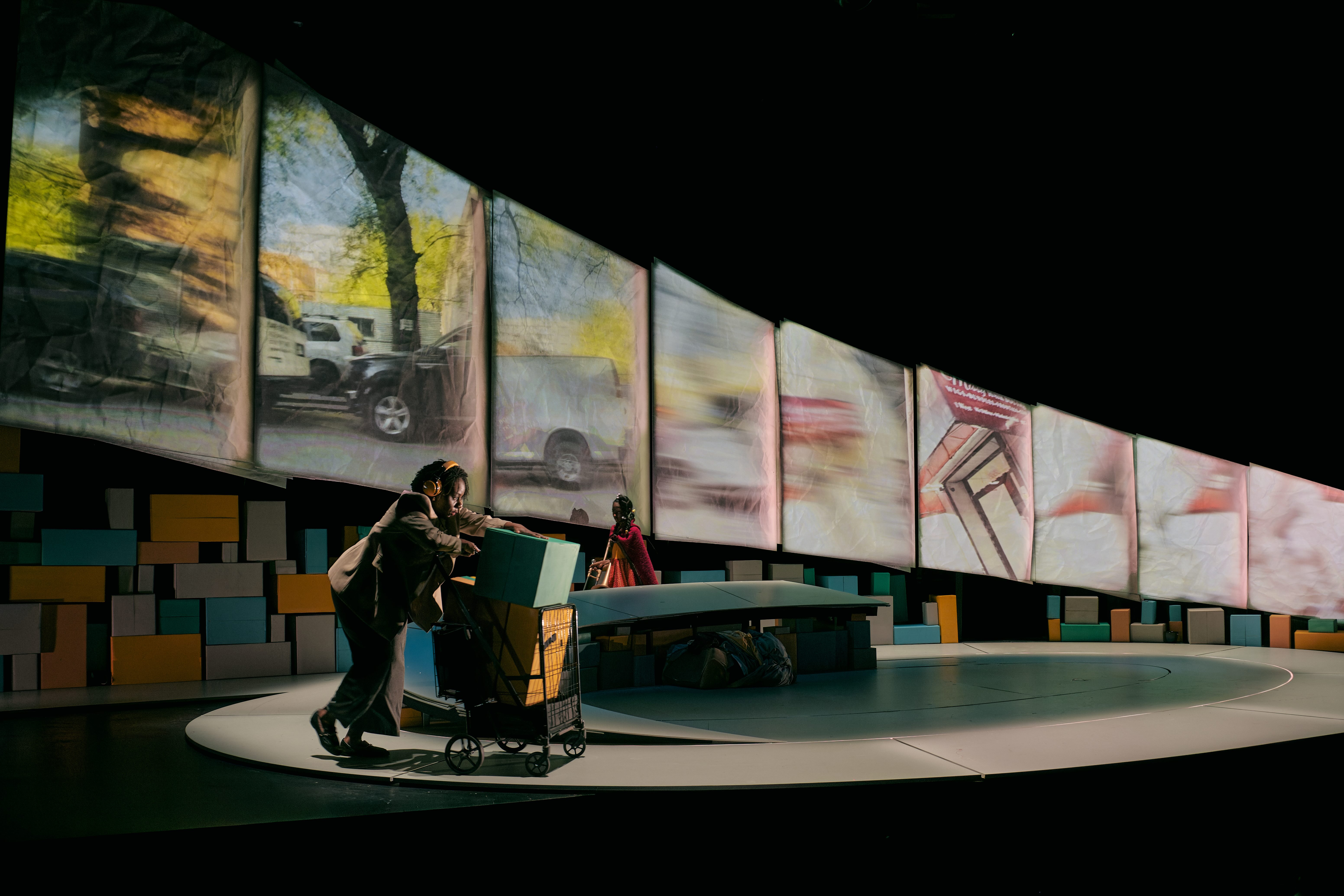
The telling was not only real but visceral. Characters move along scenic designer Jason Ardizzone-West’s circular, cyclical perimeter attempting to progress forward on a path that’s becoming increasingly steep. I watched the accumulation of want, desire, hope, and dread build as thegrownwoman traversed the stage with a push wagon in hand — at times with the little girl inside it, increasing her load both literally and figuratively. I, just as quickly, felt an accumulation of my own.
In creation stories, the majority of thegrownwoman’s narration is the recitation of stage directions, multiple dimensions of time exist at once, multiple acts of witness occur, there is the presence of an entire meta-plot betwixt thegrownwoman’s teaching and creation — the play demonstrates the very subject of her lecture — and there’s subtle references to thegrownwoman’s identity as a first-generation Nigerian-American. These devices, as well as the pagination of the play’s title and character names, appear to demonstrate Udofia’s ambitions. I believe she wants creation stories to be a play that challenges the very notion of the genre’s form, while putting on the page feelings and thoughts cleaved directly from her heart. The playwright’s motivation is understood, but when compared to more legible narratives about the anxiety of time passing, the suffering that comes from wanting to create, and the disproportionate effect this dynamic has on the reproductive body, the subsidiary components of Udofia’s story lack potency. While the secondary plot is honorably rendered, I clung to the primacy of the more evident story — a play about a very well-intentioned grown woman, who lives life in fear of stagnancy, contending with the possibility of loss and the violence of choice. It’s a story that I, a white woman, saw a lot of myself in. My guess is this wasn’t Udofia’s intention.
“The first stroke on a canvas,” says Picasso, often quoted by theatre director Anne Bogart, “is always a mistake.” The work is to fix the initial mistake. Udofia’s attempt to expand what can be rendered theatrically is surely possible. But the materialization of such an ambitious amorphous goal needs a bit more time to exert itself in order to become legible.
--
creation stories and all the important importants is running through November 1 at the Claire Tow Theater.