.jpeg)
In the book Create Dangerously: The Immigrant Artist at Work, author Edwidge Danticat asserts, “All artists, writers among them, have several stories — one might call them creation myths — that haunt and obsess them.” While Danticat is speaking to the risky and oppressive conditions from which immigrants create despite (or because) of, in creation stories and all the important importants Nigerian-American playwright Mfoniso Udofia crafts a new call to action (especially for first-generation, high-achieving, do-gooding Black women): create vulnerably.
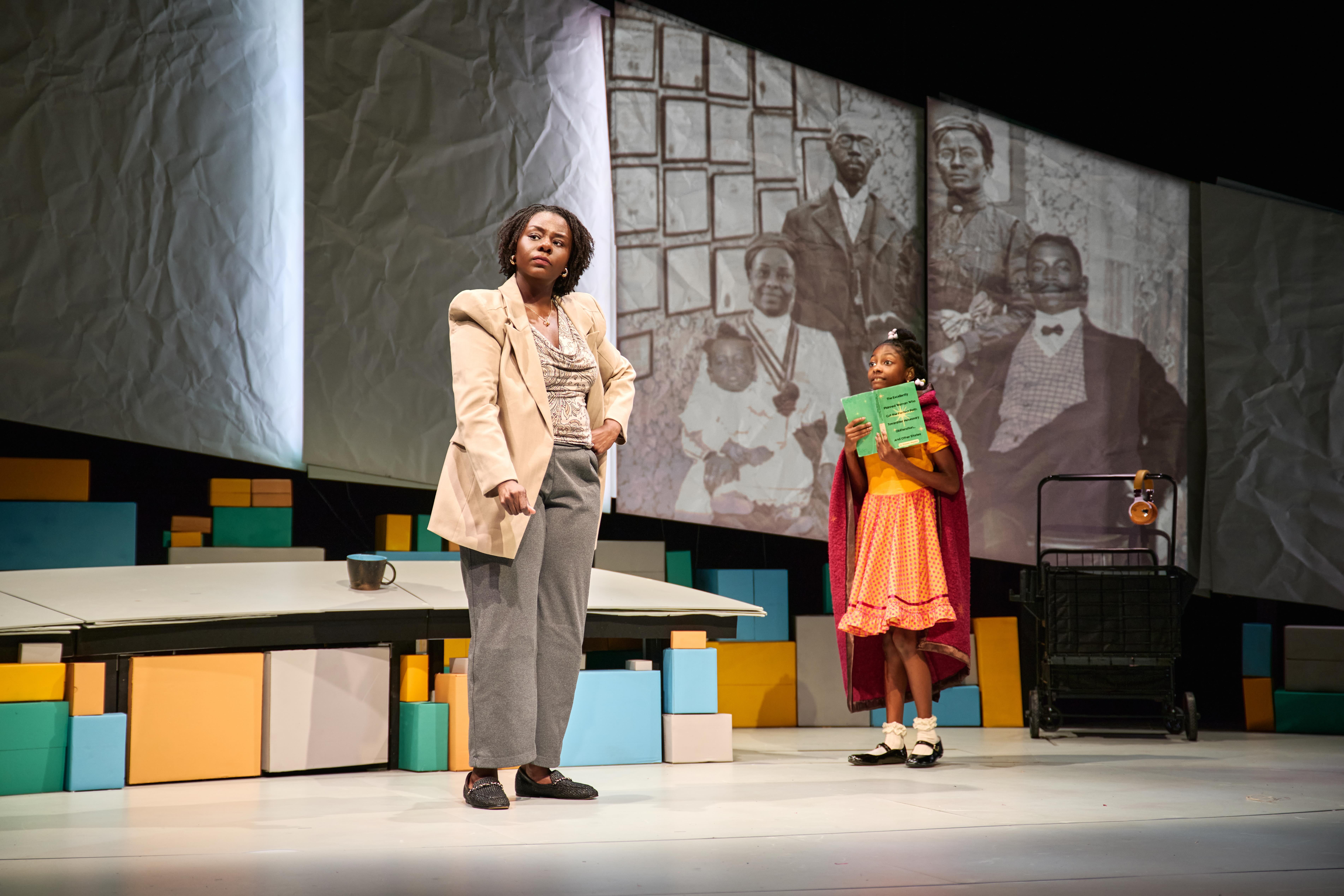
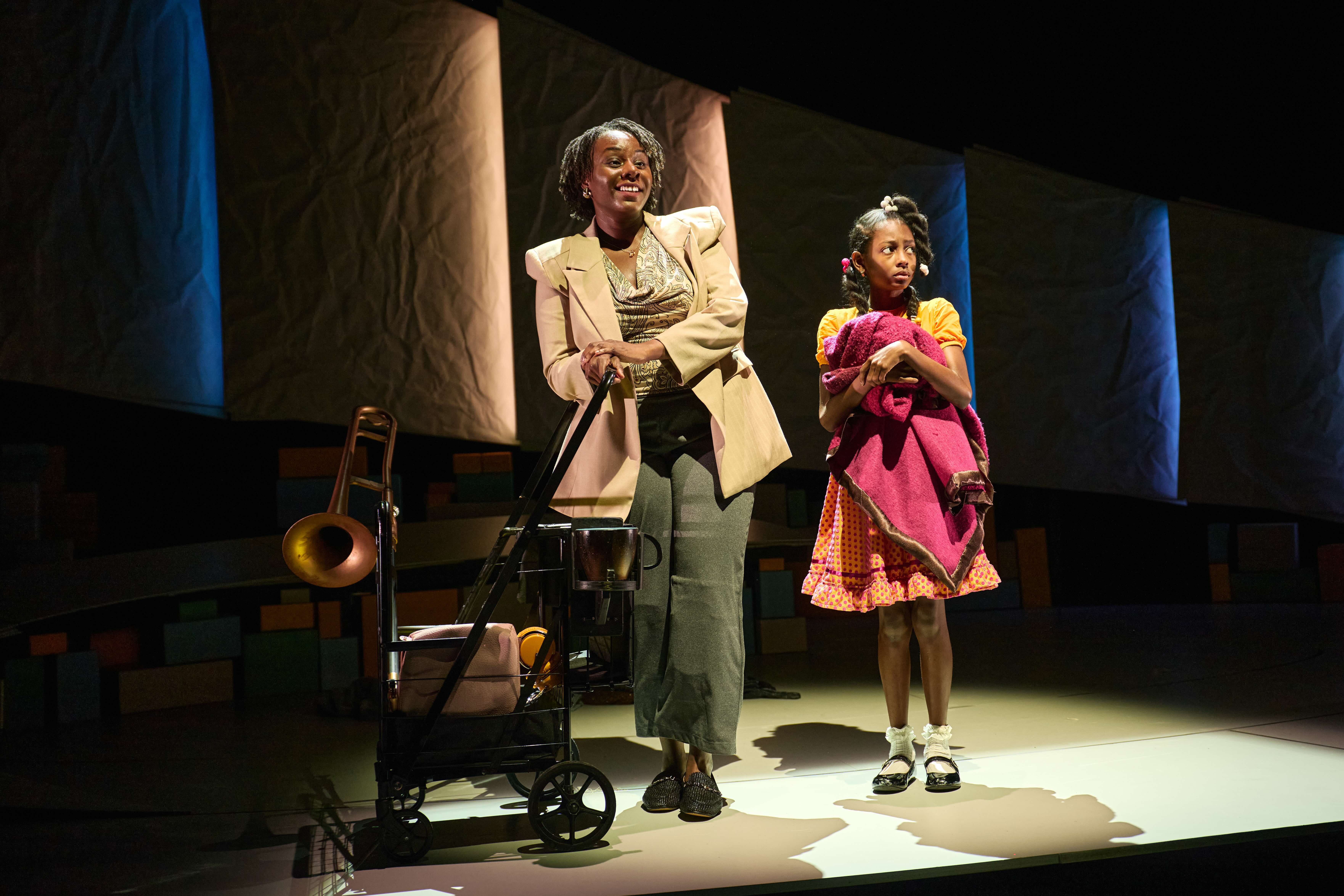
The play follows a day in the life of a hyper-organized woman — a character simply referred to as thegrownwoman (Abigail C. Onwunali) — who, from the moment she wakes, narrates her tightly scheduled day. Any human, but particularly any Black woman living in the age of self care and Zoom calls and doctors’ appointments (and, and, and), will recognize thegrownwoman’s attempt to strong-arm her day. And where there’s a will… the boundaries of a body can too often get in the way.
Despite her might, thegrownwoman cannot reach the single star she’s been reaching for — giving birth to a baby. It isn’t until she reaches the depth of her own grief and disappointment that her inner child (the Little Girl, played by Savannah Commodore) and her imagination (expressed as a swaggy horse) can swoop in to hold her, ultimately illuminating the other benefic plans the universe has in store. The play unfolds like its very own whimsical, diasporic, and heartbreaking fairytale filled with truths from the playwright's life.
ANDREA AMBAM: In your playwright’s note, you write: “this piece is incongruently fashioned from everything i am.” What does it feel like to have been writing this piece, first and foremost, for yourself and now giving that writing to others?
UDOFIA: I’m barely ready for the moment I’m in right now. So, to your question, I’m terrified. I’m petrified. This is the first time I have written something before fully feeling ready. I was writing this in the middle of asking myself a lot of the same questions that thegrownwoman was asking. “What does it mean to be good, exceptional?” “What does it mean to be a woman, a Black woman, a woman who wants to be a mother?” All of that was swirling. God, I had gone to doctors’ offices and realized the depth of that word “geriatric,” and asked myself what I had done with my time. …It was like I was writing myself into sight. The material of this play is myself.
It’s true that as I watched the play, the rawness of Udofia’s brilliant mind was on display as thegrownwoman’s day magnified the parallels between productivity and reproduction, creativity and procreation, dreaming and grieving. The style and form of the play mimic the very idea that a myth is unfolding. As we witness the frightening familiarity of thegrownwoman’s attempt to control and maximize her time, the presence of third-person narration makes way for plenty of laughs and a sometimes maddening redundancy. For Udofia, this is an intentional choice that speaks to the “internal scaffolding you have to do to get through your 24 hours.” In other words, “making the mental theatrical.”
UDOFIA: It started, again, with what was true. There’s a way in which I get up in the morning and I’m like, “Mfoniso, just make your bed…” And that self-talk helps, especially when you’re an efficient person or a woman who’s focused on trajectory. I think we all kind of do it. Like, “Just get out the door. Get out the door. Eat your food.” So I took the stuff of our day and just exploded it. For a while, those were all really just stage directions, and then I realized that those stage directions were me staging a life. And that was how I was God-ing — making myself God through the day.
It takes a mighty actor to embody the universe of emotion and action that thegrownwoman necessitates. Luckily, we live in a time where there are singular talents such as Onwunali, whose command of language and movement makes thegrownwoman relatable from her cheeky conversations with technology to the sunken depths of her grief.
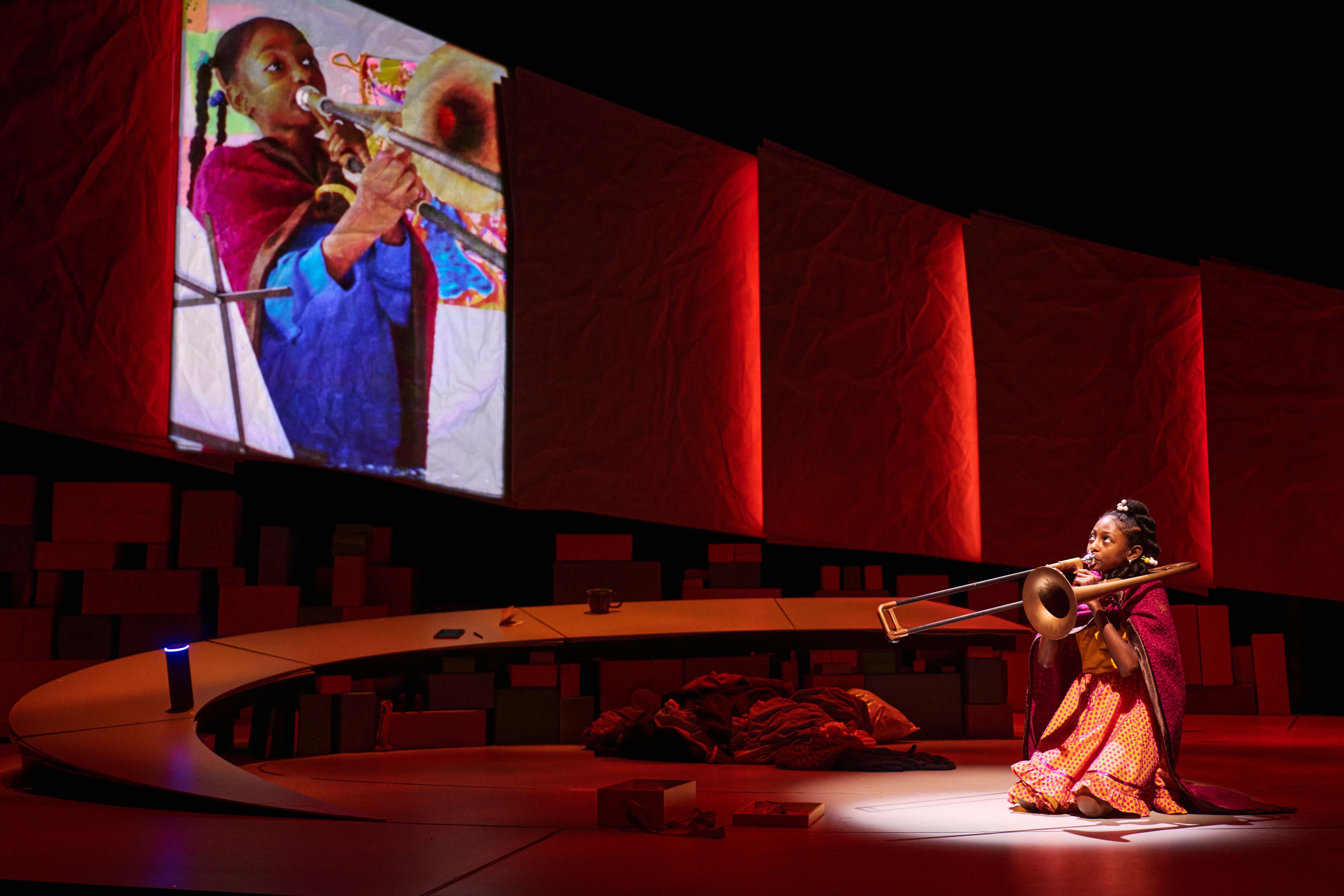
Commodore shines as the little girl, keeping lock step with thegrownwoman’s daily practice of running herself ragged. Her high voice and bouncy resilience provide a damning contrast to thegrownwoman. She captures a tender exasperation as we watch her attempt to slow her older self down enough to feel. As Udofia describes, the little girl, and her imaginary horse friend Mr. Cornell (dressed like a ‘90s hip hop artist and played by the charming and comedic Donetta Lavinia Grays), represent “ the parts of [thegrownwoman] that she could not terrorize into silence, could not beat down, couldn’t excommunicate. The parts of herself that she would have called useless ended up being quite important. They are the things that helped her be exactly where she’s at in grief.”
This play doesn’t just demand emotional gravitas; it also demands theatricality.
At a time when there are way too many good reasons to stay in the house, I’m always thrilled to witness theater that isn’t afraid to make its storytelling magic bold. We won’t beat the A.I. chickens doing the dougie or Paramount’s media monopoly without the preservation of our oldest storytelling method. In creation stories, theatricality is the engine.
Tamila Woodard’s direction is filled with stunning stage pictures that emphasize the multiple levels of meta-meaning-making taking place within creation stories. This production provides a heightened sense of exaggeration in every element from the spiral set by Jason Ardizzone-West to enlarged props by Nicole Rozanski. Even while leaning into the suspension of disbelief required, at times Woodard’s choices lacked a legible logic, such as when a prop would be made manifest versus when an action would be pantomined, randomly passing the ball to the audience to fill in the blanks. However, it is the movement direction (by Adesola Osakulumi) that proved most integral to this production. Amidst lively projections (by Kate Freer) and a thumping score (sound design by Bailey Trierweiler & Uptown Works), it is simply the shapes the actors make and the style in which their bodies move that effectively transport us from a quiet night in the bushes of Nigeria to the bustling streets of any major U.S. city, or help us to somatically keep up with thegrownwoman’s exhaustion via hunched backs and heavy steps.
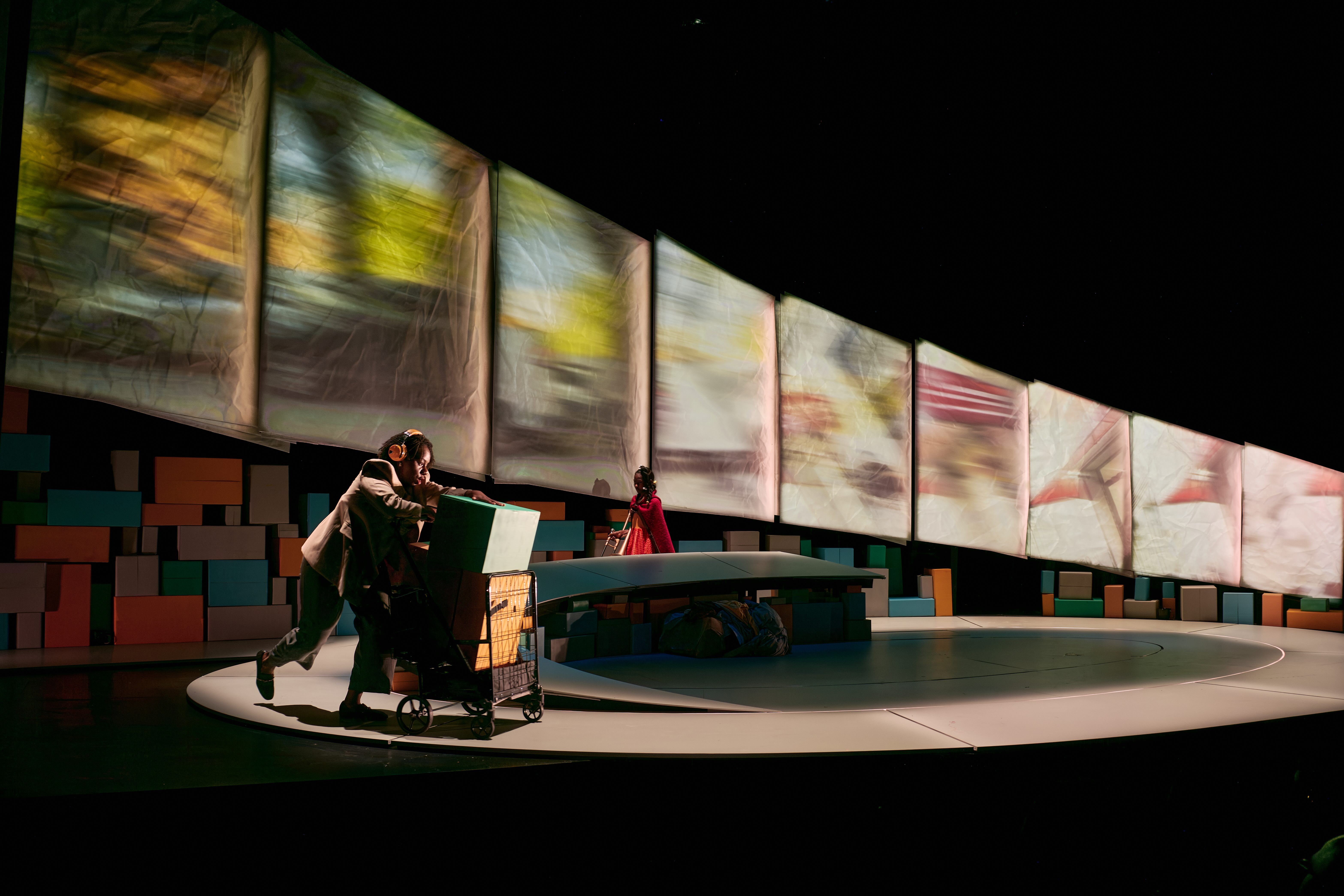
UDOFIA: Our designers are Gs. This collaboration has been so intense. I think we are all taking a breath now because the play is finally locked. We’re in that time of previews where we are all watching the same show. As opposed to the beginning of previews when you’re like, “Who knows? It might have a different ending tomorrow.” The costume department has to be in conversation with the sound department, which has to be in conversation with lighting. The departments cannot be separate, and from the moment LCT3 decided to produce the play, these heads had to come together in conversation and braid very, very quickly.
The strength of this collaboration peaks in the staging and presentation of the Raffia (a spirit deity), whose shaggy, larger-than-life presence on stage (embodied by Grays and Onwunali) will strike awe in you. In each appearance, the Raffia is the very manifestation of a masterful collaboration with costumes, movement, and sound as the eerie shaking of bells wake the Raffia’s presence. This is what playwright Udofia calls “indigenous Nigerian spirit work” at play.
In creation stories, the open wound of grief is a portal towards new dreams, so I couldn’t help but be reminded of the several family wakekeepings I’ve attended in the last two years, where the presence of this kind of Juju (masked spirit) will lead the whole room to bow their heads, avoiding any eye contact, in reverence of the spirit. This time, I was thankful to be tucked in the second-to-last row of the theater, where I could unabashedly gape at the cosmic and ancestral ritual unfolding before me.
In the book The Healing Wisdom of Africa, author and medicine man Malidome Patrice Somé, proclaims that Spirit and ritual are underused technologies in the West. He writes, “In my village there is only a thin line between the artist and the healer. In fact, there is no word in the Dagara language for art. The closest term would be the same word as sacred. …In the village, the ability to birth art is a sign of approval by the Spirit World.” Considering this, I must contradict myself and say, instead of theatricality, it is actually Spirit work that drives Udofia’s play.
When asked what kind of theatrical experiences she hopes creation stories can give birth to, the playwright's smile widens as she calls for a new wave of culturally-specific abstract theatermakers.
UDOFIA: I hope it makes way for a kind of rigorous disruption. For us to know enough of our history, to know enough of what makes a play “a play” — according to the people who have determined that — to then make decisions on how that play gets to be blown apart for the culture you are writing for.
As I sat in the theater among a sniffling audience, fighting back the river of tears rushing forth from my empathy of thegrownwoman’s journey and the self-reflection on the mistreatment of my (inner) little girl, I bore witness and testimony to the healing power of vulnerability and the medicinal potential of play, conjured by Mfoniso Udofia.
--
creation stories and all the important importants is running through November 1 at the Claire Tow Theater.