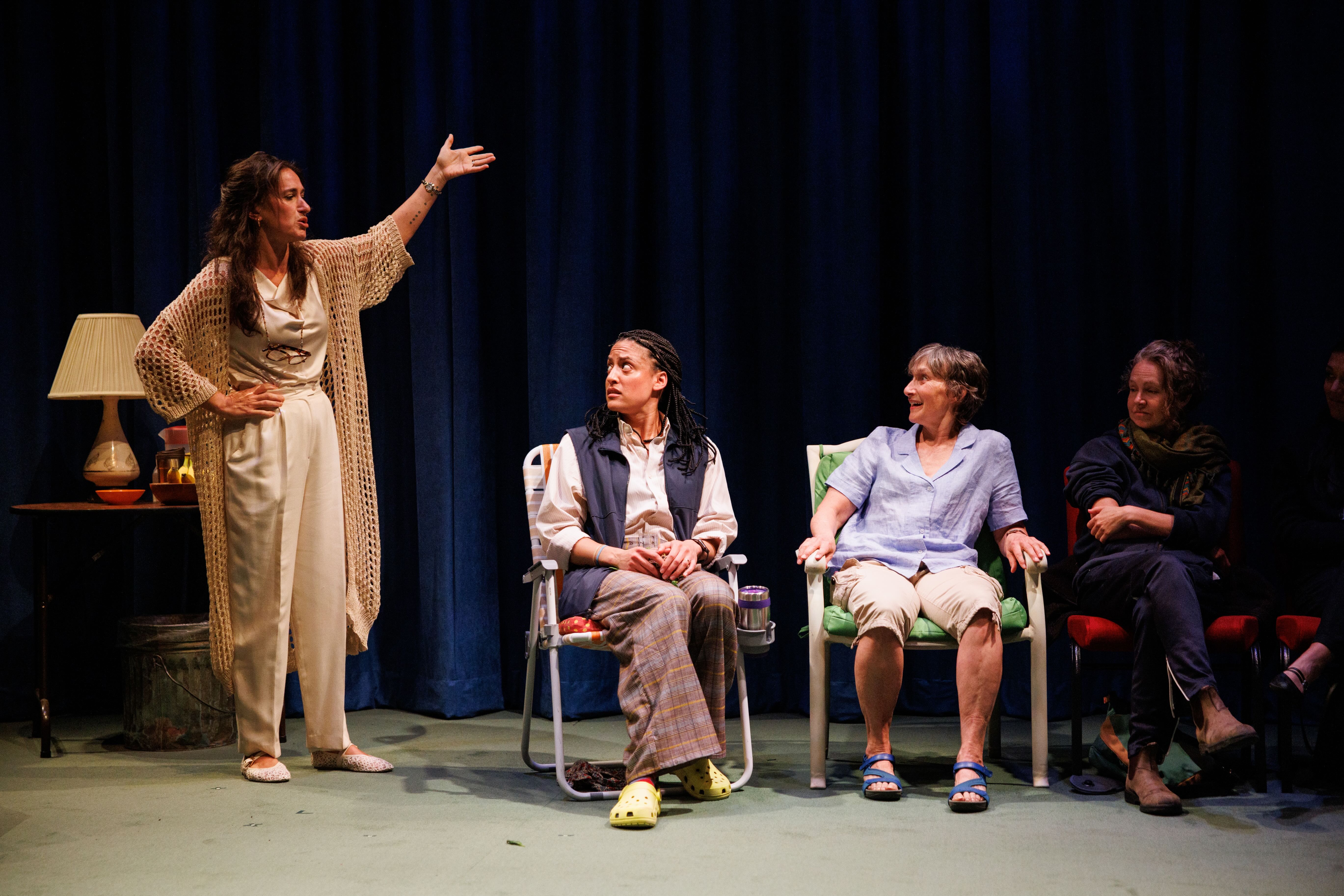

Playwright Julia May Jonas’ formal priorities were evident the moment I entered The Claire Tow Theater. Given the option to sit on stage, I was not surprised when the house lights stayed on, as Woman Among Women began. This is a production planned to push against spectacle.
As part of Jonas’ five-play cycle riffing upon “classic male experience plays”—the series also includes Eugene O’Neill’s Long Day’s Journey Into Night, Edward Albee’s Zoo Story, Sam Shepard’s True West, David Mamet’s American Buffalo—A Woman Among Women re-imagines of Arthur Miller’s 1946 play All My Sons. Here, Jonas has swapped the Joe Keller protagonist for a matriarch named Cleo and Ohio for Northampton, Massachusetts; though many narrative details and the primary location–a verdant backyard–remain the same. My date that evening even remarked on how striking the green carpeting of the Tow appeared.
In Jonas’ story, Cleo (Dee Pelletier) runs a women’s center in this progressive town. A licensed psychologist and a mother, she is the moral pillar and compass for her community. As characters filter on stage they greet Cleo and one another, their engagement offering a portrait of this town. Everyone seems to have some sort of connection to “The Center.” Sarah (Hannah Heller), a doctor and Cleo’s neighbor, is the head of The Center’s clinic. Cleo likes Sarah and her husband Lane (Drew Lewis), as well as her other neighbors, Christine (Brittany K Allen) and Tammy (Lucy Kaminsky), a lesbian couple. There appears to be a mutual air of affability and good-will, as if the demarcations of the nuclear family are mere placeholders. The town is a family of its own.
Cleo, we learn, has two daughters: Grace and Josephine, or Jo. Grace is in her mid-30s, lives at home, and works at The Center. Jo is in prison, a realization that coincides with the arrival of her husband Roy, a ploy that mirrors both Anne’s arrival in All My Sons and a standard of Aristotelian structure and 20th century plays: the arrival of a character introduces new information. Despite the seemingly tepid and jovial air of the town, Cleo’s maneuvering comes across as haunting, displayed perfectly in the plastered-on quality of Pelletier’s smile.
Perhaps because of how entrenched this town’s dynamics are, watching the play felt more like playing catch up than observing. The audience is slowly presented with clues and insight in order for the play’s central conflict to become apparent.
The revelation of Jo’s crime also shepherds in the formalistic change of A Woman Among Women. After moments of occasional audience interaction and participation—at one point Grace (Zoe Geltman) gracefully passes around a box of Dunkin Donut’s munchkins—the spectators on stage shift to the stage’s periphery while a set of a house’s exterior is moved forward. Finally, the house lights dim.
The transition towards proscenium staging—the formal expectation in presenting one of Miller’s works—shifts the timbre of the work. Jo is serving a 20-plus year prison sentence for nearly beating a man to death, but new evidence adds questions to her culpability. The majority of the town revels in this discovery, except for Cleo, remaining certain of her punishment. Might she have been involved in Cleo’s outburst? Sitting on her stoop, Cleo took on an almost patriarchal air, her stature evoking the feeling of a great man. I thought of Abraham Lincoln. After spending most of the evening searching for crossover, the Millerian influence became undeniable.
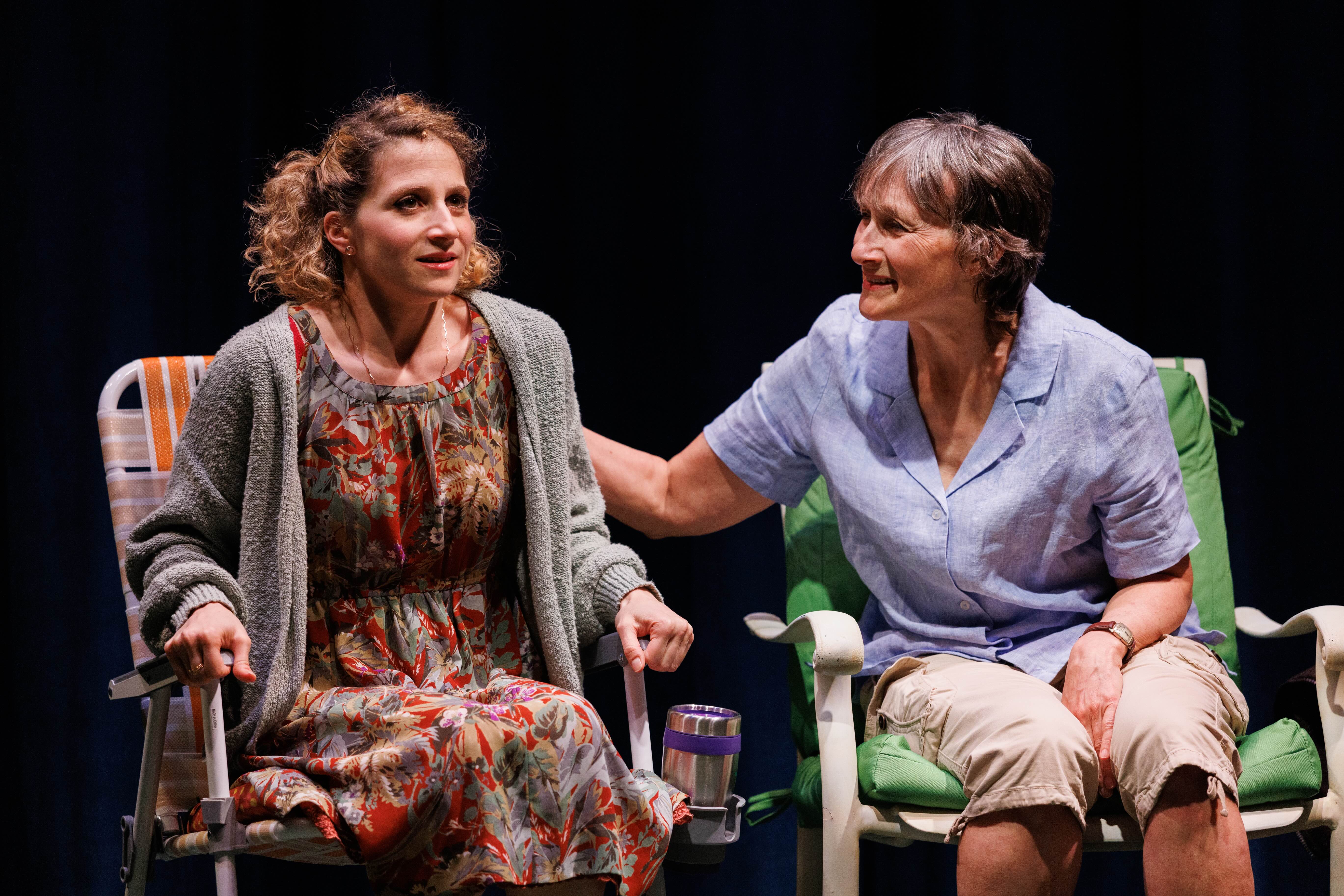
“I was also responding to that kind of idea of Americana,” Jonas told me earlier this week over Zoom. In particular, Miller’s examination of father-son legacy was of intrigue. But Jonas wants us to think about mothers and daughters. In Miller’s world, Keller chooses the individual family unity over the greater good of his community and country, but for Cleo– in choosing community over self– this is flipped. This turn wasn’t necessarily deliberate; Jonas told me her point was the intractable connection between women and motherhood. As an older “Boomer-ish” woman, Cleo’s legacy is likely to include her family. “To me it felt like this woman, or women of this age… no matter what happens on a social scale, their family legacy is the way that they will be remembered,” Jonas shared. It helps that Cleo’s work, as a psychologist and director of a community center, is easy to label as maternal. Much more than Jo, there is no dramatic difference between her family and others. The boundaries of Cleo’s responsibility are porous.
Jonas, who refers to Miller as a playwright of “moral authority,” said her other impulse for Woman was to write a play without the certainty of Keller’s villainousness. “I’m interested in things being really complicated,” she told me. However, while watching A Woman Among Women, I never gained the understanding needed for the conflict to appear complicated. This play’s foundational dedication to its conceptual framework caused the particularity of its offerings felt under-baked. What was this “Center?” Why does Cleo repeatedly refer to her basement? Who was Jo to these people before she disappeared?
Despite its ingenuity, which at times did really work—it was thrilling, for example, to see both a large cast and the male characters play minor roles—A Woman Among Women never penetrates its surface, instead shallowly plateauing as a contemporary retelling of Miller’s more searing work. Occasionally, the contemporary emphasis felt grating, like in an exchange between Cleo and Grace where Cleo mimics Grace’s perception of her parenting. The writing for an exchange between Cleo and Grace about Cleo’s parenting could have been lifted from a social media infographic about toxicity.
The question of what to do with such a canonical writer lurks at the sides of this project. When I asked Jonas how students of playwriting should use Miller, she suggested his material is best used as a place to bounce off of. “That's what the best work in any medium really does, I think.” Yet, I read All My Sons differently than Jonas.
I don’t think Miller’s play is about Keller’s villainy, but instead the horrible pain of confronting an erroneous worldview. Upon learning of his son’s death, Keller is forced to encounter the indistinguishability of his actions: he has caused the death of other peoples’ sons. That Joe is guilty is irrefutable, but in attending to his flaws so carefully, Miller grants us the opportunity to experience Keller’s downfall and its consequences alongside his characters. If there is a feeling of moral determinism in All My Sons, it’s worth noting that Miller’s plot came from a news story. The writing in this play retroactively fashions a psychology onto a criminal. Perhaps Keller is evil, but the tragedy is instead that this kind of evil and suffering exists at all. Miller transcends the particularities of his play’s action to posit a moral project of inquiry and empathy, placing us in the exact state of uncertainty and ambiguity—aporia as the Greeks called it— that Jonas seems to have been aiming for. Jonas’ engagement ends up feeling more in conversation with the formalistic assumptions of Miller’s work, where a play would never arrive at a proscenium view.
At the end of A Woman Among Women, Cleo is alone. Each cast member trickles off stage slowly, the same pace at which they entered. Cleo must face the consequences of her worldview, but without a declaration of what this is, it’s not exactly clear what’s being left.
--
‘A Woman Among Women’ runs at the Claire Tow Theatre at LCT3 through June 28th