
Arthur Miller’s All My Sons opens with a stricken-down tree stump. In typical Miller fashion, this tangible metaphor, presented through domestic drama and neighborhood conversations, symbolizes the family destruction to come. Julia May Jonas’s A Woman Among Women, which opened this month at Lincoln Center Theater after a 2024 run at the Bushwick Starr, is a direct answer to All My Sons, asking how the 1947 classic would be different if its salt-of-the-earth antihero were a woman. It’s one of five plays in Jonas’s All Long True American Stories cycle, which reimagines work of the American theatrical canon from a non-male perspective.
The week before the play’s premiere, I read All My Sons for the first time. As the lights went down at Lincoln Center’s Claire Tow Theater, it was immediately obvious that Jonas’s changes go beyond a simple gender switch. In All My Sons, Miller slowly reveals that husband and father Joe Keller has profited off World War II, the very conflict that killed his son. Jonas, by contrast, has given us the character of Cleo (Dee Pelletier), (Dee Pelletier), a psychotherapist with a platonic life partner and a daughter in prison for assault. Over the course of the female-led ensemble drama, we’ll come to find that this imprisonment may be the root of its own family secret. Both plays take place over a single day, as neighbors flit in and out of the central family’s backyard.
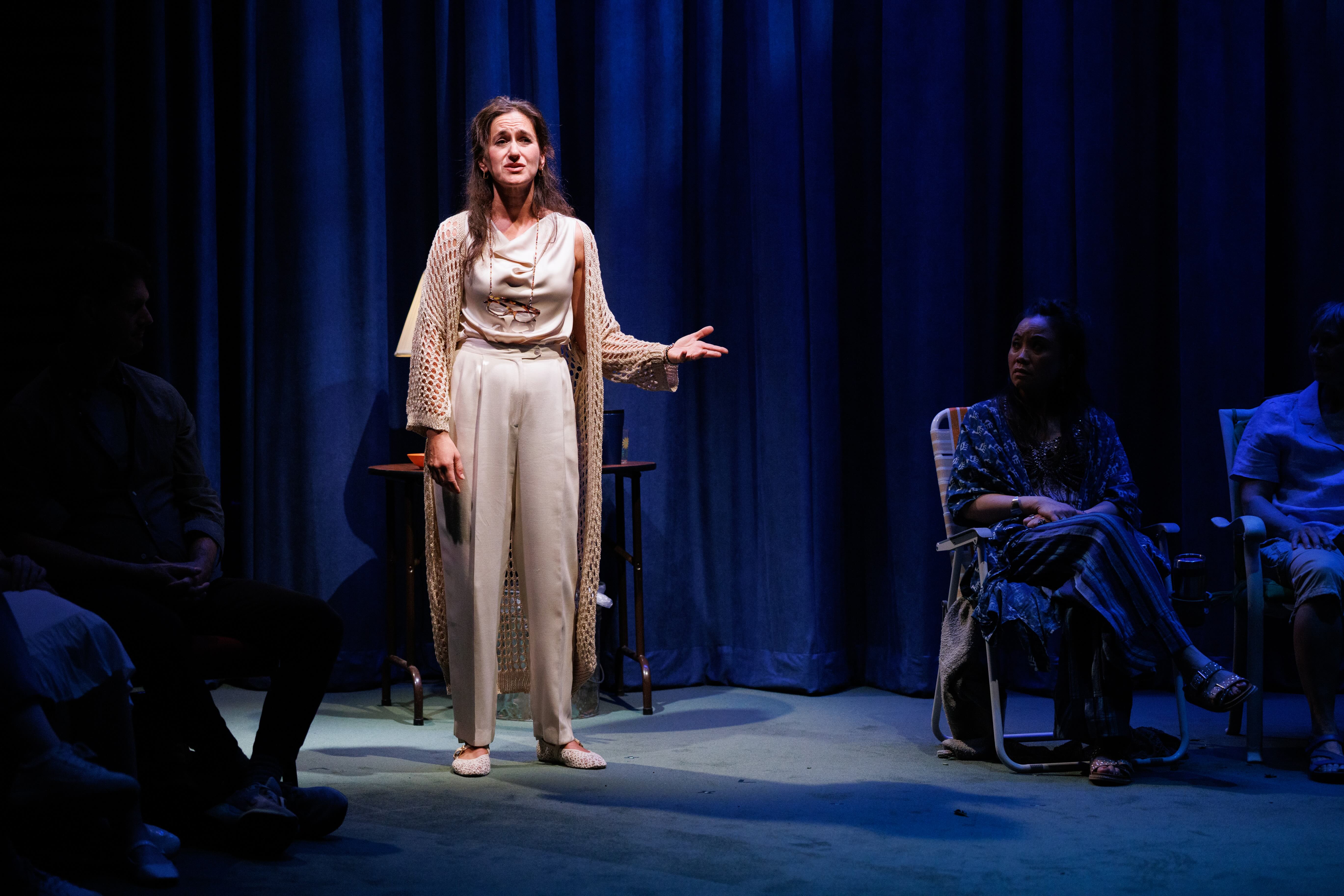
Very seldom do Jonas’s characters draw direct attention to their genders, and yet, the heightened female presence is consistently integrated into the show. In the show program, Jonas tells us that she is not trying to represent a vast notion of womanhood. Instead, she shines in specificity. Small details like a character’s cheap crochet cardigan (costume design by Wendy Yang) that keeps getting caught on the bushes aren’t saying anything about gender at large, but these details make it seem like the ordinary and unsentimental inconveniences of American women can have their own place in the canon.
To some extent, it feels unfair to refer so frequently back to Jonas’s patriarchal source text. But isn’t this what she wants from us? Jonas’s moments of originality shine as a result, not so much illustrating Miller’s shortcomings as highlighting Jonas’s skill. About midway through the show, she writes in a soliloquy, wholly disconnected from any of the family drama we’ve witnessed, completely divergent from All My Sons. The extraordinarily talented Hannah Heller, who plays Cleo’s doctor neighbor Sarah, begins by describing a doormat emblazoned with the phrase: “well-behaved women seldom make history.” Sarah’s monologue takes us through her tumultuous younger years, and she explains that the infamous motto is perhaps not the rallying cry so many have claimed. This, again, is another place that thousands of writers have slipped right into the trite—Jonas, instead, makes it revelatory. Sarah’s story isn’t exceptional, it isn’t representational: it’s real. And it’s the detail-laden, hyper-specific understanding of women that makes Jonas’s work so extraordinary.
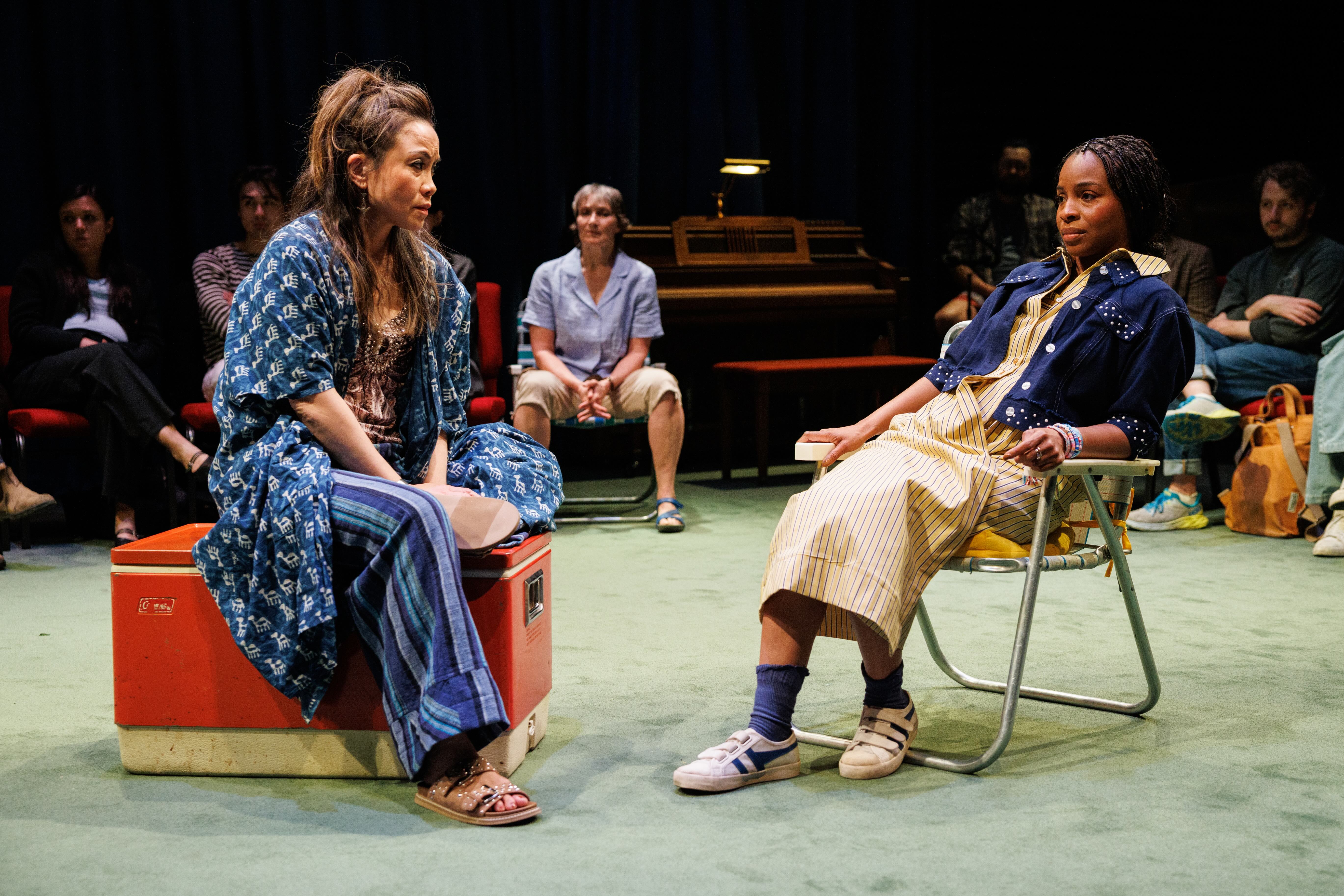
Jonas and director Sarah Cameron Hughes have democratized the setting of this play by arranging the audience all around the performers in a backyard setting of sorts, leaving several gaps in the circle of the first row. Characters plop down in foldable lawn chairs all around, bringing the audience into their stories with “can-you-believe-it” style gestures. At times, it’s easy to forget who’s supposed to be on stage at a given point in time: actors blend so seamlessly with the audience that if one isn’t in your direct line of sight, they become part of the crowd. (No doubt much of this naturalism is due to the superb quality of A Woman Among Women’s casting, which features the best ensemble I’ve seen in a long while). In other shows, this would seem gimmicky. Here, it’s a strength, breaking down the invisible barrier between the performer and us. Only during the final scene, when the stage and audience are reverted back to a traditional proscenium setup, do we realize just how much we’ve lost.
This set transition is covered by an interactive music sequence (composed by Brian Cavanagh-Strong), one of many musical moments Jonas has also written into the script. Drew Lewis—one of the play’s multi-talented cast members who doubles as actor and musician—directs the audience to percuss one of three different beats out with our hands. (I focused so hard on mine that it was hard to hear the sonic whole.) Sitting there, hands moving in time, I couldn’t help but wonder what the artistic motivation was for the interactive instrumentation. There are no such musical sequences in All My Sons—singing almost seems counter to Keller’s masculine character—and each song was newly surprising. Many of the other musical scenes began with a two-note pluck by Lucy Kaminsky on the piano, followed by a mystifying harmonic echoing of Cleo’s words (at one point: “obesity/opioids/lung cancer”). Jonas has written such an everyday, grounded American story. But the ethereal and character-breaking backing vocals take us out of it.
Miller describes Joe Keller as “a man among men.” We instantly know what that means—the solid, salt-of-the-earth type of fellow that sits on a porch in every American small town. In this undertaking, Jonas set out to investigate what a “woman among women” would look like. Where All My Sons’s title is a nod to the family secret that severs ties in the third act, A Woman Among Women cares much more about investigating the person who kept it. I now have an idea of who a woman among women is. Arthur Miller does not.
--
‘A Woman Among Women’ runs at the Claire Tow Theatre at LCT3 through June 28.