
The last time I had a real neighborhood community, it was during the pandemic. I’d adopted a puppy, and most of my non-family interactions that year took place with said puppy—masked, six feet apart at Hidden Park in Albuquerque, New Mexico. Tucked within a block of homes, the park is bordered by backyards and is a great place to let your dog off leash. Our nightly walks became a performance of sorts, complete with a recurring cast:
HERO: Black dog with silky fur. Very slobbery. 50% of his diet is sticks. We are concerned about the state of his stomach.
LEWIS: Hero’s dad. He and my dad can spend an hour walking the dogs in circles while they talk about sports.
CHRISTINE and GREG: Friends/neighbors. Christine is a L&D nurse who makes great chocolate chip cookies. Greg is a memoirist who spent the pandemic building a writing shed in his backyard.
WINNIE: Golden retriever. Will say hi over the fence. A good girl.
MUKESH and ANISHA: A younger couple from LA. Filmmakers. Frequenters of the park, but don’t have a dog. I think my parents have a crush on them.
SABINE: Great Pyrenees. Lives in one of the backyards along Hidden Park. I’m teaching her French.
When boiled down to character descriptions, any normal community transforms into an eclectic ensemble. There are fewer (read: zero) dogs in Julia May Jonas’s A Woman Among Women, the playwright’s feminist adaptation of Arthur Miller’s All My Sons, but it is a play about an eclectic bunch—a woman, her many neighbors, and the shared space they find themselves in.
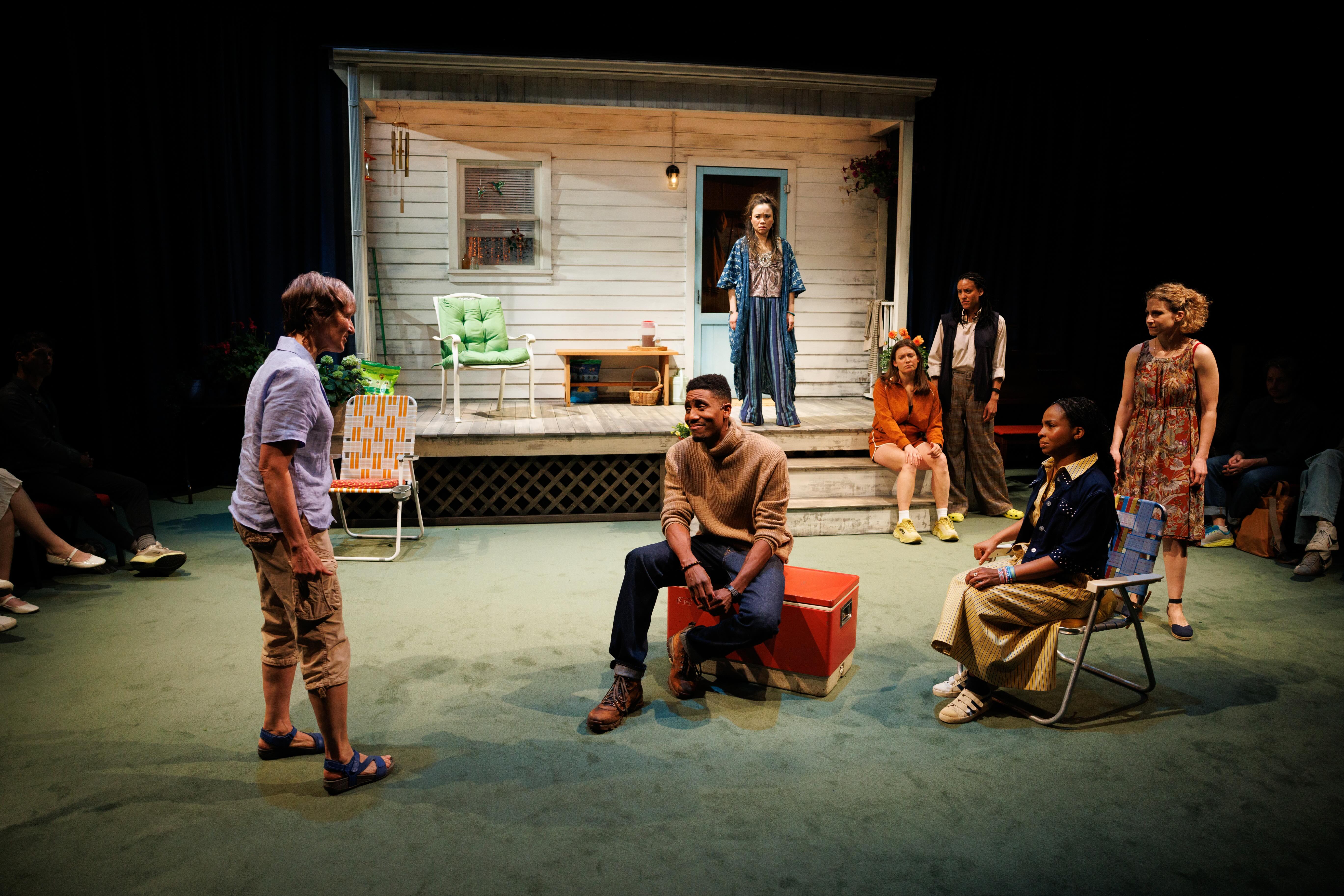
Jonas’s play centers on Cleo (a self-assured Dee Pelletier), the founder of a women’s health center in Northampton, MA, and the matriarch of her small, liberal community. Cleo’s husband is dead. One of her daughters, Jo (who never appears onstage in the play), is a convicted felon. And the other, Grace (Zoë Geltman), is just kind of needy. So Cleo’s gone ahead and found an additional family, and spends her free time holding court for them in her backyard. Neighbors drop in uninvited, and for the most part, she welcomes them, ready to offer her guests anything from a banana to an Arnold Palmer at a moment’s notice. The neighbors' opinions on Jo’s incarceration are less welcome; to Cleo, no new evidence can change the fact that her daughter committed a crime.
Realized by scenic designer Brittany Vasta in LCT3’s Claire Tow Theatre, Cleo’s backyard is simple but inviting, featuring grass-like cozy green carpeting, a big red cooler, and plush chairs for a few lucky audience members forming a curving border around a central playing space. The script notes that “this backyard is represented by a circle of chairs that resembles a group therapy circle or recovery meeting,” and it also calls to mind the kind of Quaker meeting space where someone might just feel compelled to confess something shocking. (While I’ve never been to a Quaker meeting, I have watched Fleabag.)
It is immediately clear that Jonas and Vasta mean for this to be a space where performers and patrons are in community with each other. The house lights stay on, performers address the audience directly, and in certain moments, even invite them to more actively participate in the piece. It’s a nice sentiment from Jonas, who writes that “theater, no matter how naturalistic, is an agreement between the performers and the audience.”
Walking into the play, I was prepared for a story about family, about finding connection on a grassy lawn. What I didn’t realize is that the piece is also a bit of a collage, blending disparate stylistic elements and characters into an unexpected theatrical patchwork. For the most part, Jonas and director Sarah Cameron Hughes steer away from spectacle, so when the performers suddenly begin singing their lines, or neighbor Sarah (Hannah Heller) converts the play into a group therapy session in order to share what’s on her mind, it’s surprising. In more than one moment, performers don bonnets and skirts as an homage to the Johannesberghs (presumably early settlers of Northampton), who died of consumption down the road from Cleo’s.
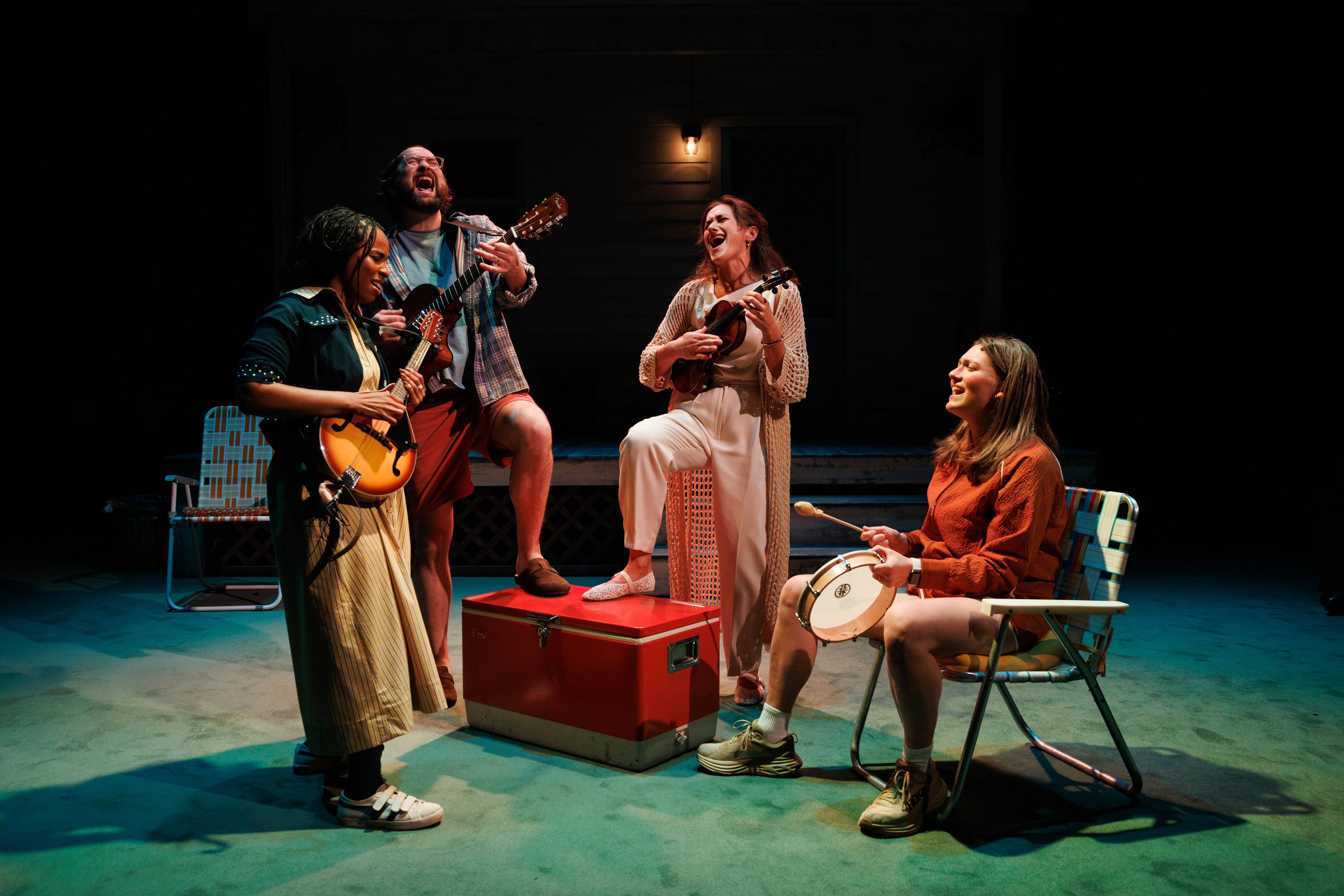
There’s a whimsy to these stylistic interludes, but an inscrutability too. I found myself so wrapped in trying to figure out *why* certain things were happening, and how they connected to the central story, that I couldn’t focus on that main plot itself. Changes in form or aesthetic (costumes are by Wendy Yang) can be a fun break from routine; I would have given anything for my neighbors to don bonnets and sing back in 2020. Jonas’s act of breaking up her plot with these shifts successfully disrupts the Classic American Play, the morality play, the living room drama, in a satisfying manner, but it’s hard to tell how much this serves the story, if at all.
Thankfully, when it works, it really works. As the play enters its final scenes, Cleo’s neighbor Lane (Drew Lewis) guides the audience in clapping out a beat (“Do you want to try out this - This new rhythm-y pattern-y thing-y I got?”). While the audience claps, the performers clear the space. The curtains on the back wall of the theater part and out rolls a fully realized version of Cleo’s back porch. The intent is clear: we have descended into naturalism. It’s clever and striking, and while it doesn’t quite justify some of the more unexpected earlier moments, it makes for a deeply satisfying way to launch into the play’s biggest revelation.
The scene feels real in a way the rest of the play doesn’t. For me, Hidden Park was an oasis, a break from the monotony of being stuck inside my childhood home, and more importantly, my nightly chance to be around other people. In A Woman Among Women, when Cleo's backyard is at its most realistic, it is also at its most dangerous. Yet, it also suddenly becomes familiar. “This could be your neighbor’s backyard,” Jonas seems to suggest. “This could be your community.” And if these are real people, perhaps we should welcome them, faults and all.
--
‘A Woman Among Women’ runs at the Claire Tow Theatre at LCT3 through June 28.