“I’m not you, I’m me, Nanay. And I just wanna be my own person and make my own choices. Can you please understand that?”
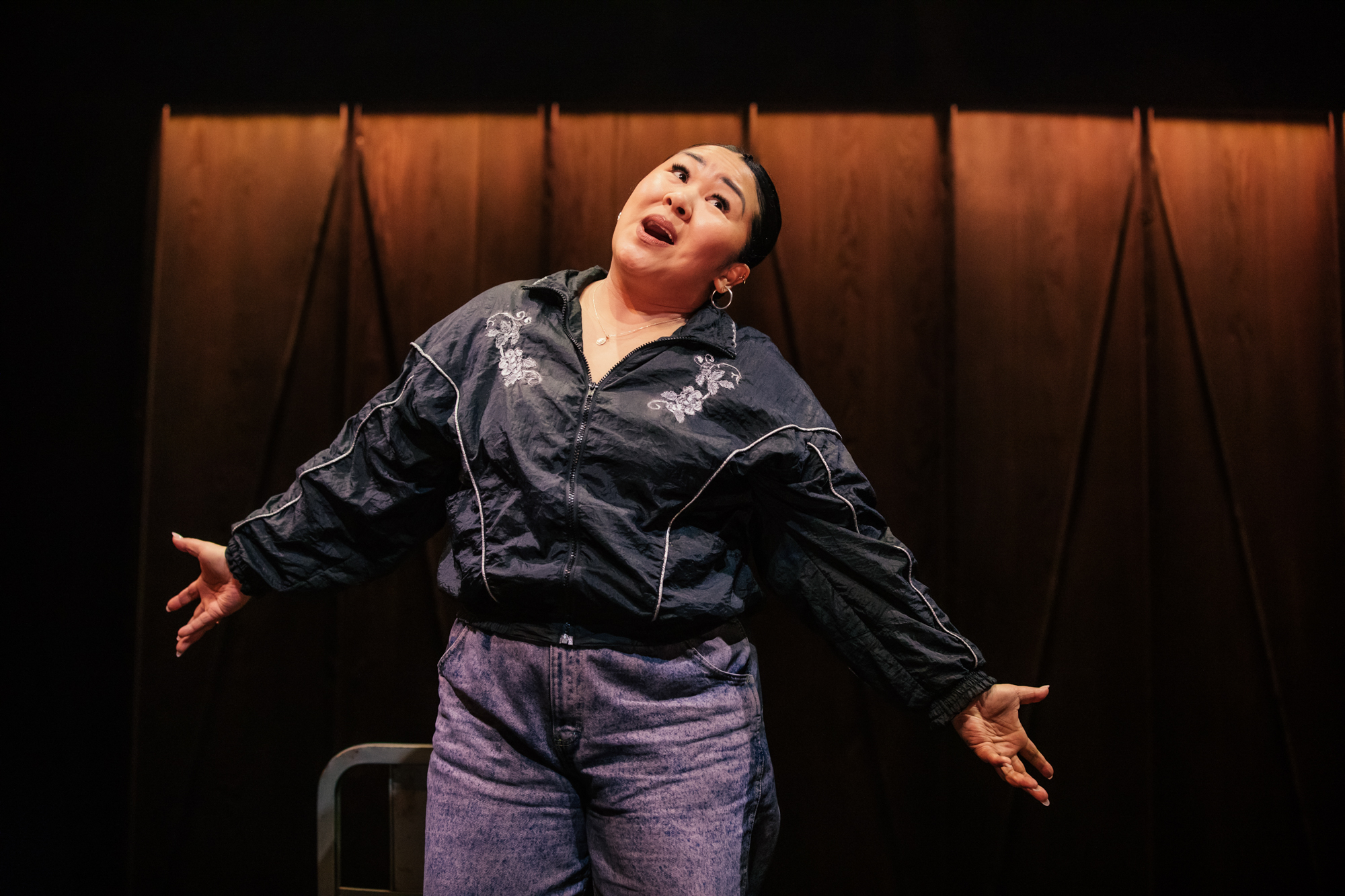
Sara Porkalob says this line while masterfully portraying her real mother in Dragon Mama — an action-packed and poignant coming-of-age tale. The creator-performer also plays 27 other deftly drawn characters in this exceptional solo show, the second play in her Dragon Cycle — a trilogy of works about Sara’s Filipina American family. Each play is built around a female protagonist of a different generation. Delicately crafted and deliciously cinematic, Dragon Mama applauds the quiet heroism of forging onward despite one’s circumstances, and the seemingly small acts of generosity from others that oftentimes only become clear in hindsight. Like its theatrical predecessor, Dragon Mama is a thrilling account of self-actualization, one that had me at the edge of my seat — laughing out loud, wiping away tears, and even dancing along to its throwback soundtrack.
In form and design, this second installment of the trilogy is drastically different from the first, Dragon Lady. In September 2024, Sara starred in the Los Angeles premiere of Dragon Lady at the Geffen’s Gil Cates Theater, a 512-seat proscenium house that was ornately outfitted like a swanky lounge: velvet seats, lush greenery, and a scintillating chandelier — all framed by a dragon scale-covered structure. That two-act cabaret centered on Maria Porkalob, Sr., who fired up her karaoke machine and recounted her younger days as a lounge singer at a gangster-controlled nightclub in Manila to her granddaughter, Sara. For the majority of the production, Maria addressed the audience directly as if they were Sara, and interspersed her hilarious and heartbreaking anecdotes with karaoke tracks (original songs Sara performed with a three-piece band). I thoroughly enjoyed Dragon Lady at the Geffen and have been anticipating its follow-up ever since.
Eighteen months later, Sara decidedly delivers the local premiere of Dragon Mama at the Geffen’s Audrey Skirball Kenis Theater, with just 138 seats surrounding the square-shaped thrust stage. The configuration accentuates the text’s intimacy and immediacy. Dragon Mama opens in medias res, dropping audiences into the action without formal narrative framing or explicit introduction to any of the 28 characters Sara plays throughout the piece. (It’s easy to jump in with her, as there’s enough exposition to refresh any Dragon Lady attendees or catch up anyone unfamiliar with that show).
The two-act sequel — directed by Andrew Russell who also helmed Dragon Lady — now zooms in on Maria Porkalob, Jr., the oldest of five siblings (and therefore, their default babysitter) in a family that’s lacking in funds but loaded in love. Despite her humble upbringing in a trailer park in Bremerton, WA, the junior Maria relishes hitting teenage milestones — falling in love, experimenting with hair color, standing up to bullies and discovering the portable Walkman. Such moments are accentuated by nostalgic needle drops like Sade’s “Kiss of Life,” Mary J. Blige’s “Real Love,” Salt-N-Pepa “Push It,” and Mariah Carey’s “Always Be My Baby.” Sara’s in-character cover of Whitney Houston’s “I Have Nothing” — complete with a disco ball and a slight costume change — is a particular Act Two highlight.
As in Dragon Lady, Sara swiftly switches between characters through smart shifts in posture, voice, mannerisms, and facial expressions, and introduces new scenes and locations via subtle lighting design and sound effects. One moment, her physical comedy had me laughing out loud as Maria put a neighborhood menace in a headlock while her little sister Lilly got her revenge; the next moment, her vivid delivery instantly transported me back to my own teen years as Maria is told she must again stay home to care for her siblings.
It is all the more impressive that Sara so thoroughly embodies characters of all different ages, genders, and personalities while still remaining in the same outfit — a track jacket, gray jeans and high-top sneakers (costume design by Sarah Lindsley) — and performing scenes that take place across Hawaii, Washington, and Alaska using only a single prop of a metal chair. And the audience’s newfound proximity to Sara as she does this — and the ability to see your fellow theatergoers also having emotional reactions to her plot reveals and character revelations — enriches the experience in a way a proscenium house might not.

Though she did the same with her grandmother’s tale, I find it sublime how Sara can share her mother’s journey of filial duty and self-discovery with such a profound empathy, one free of judgment or scolding in even her most rock-bottom moments. And though the two-hour production unfolds at a fast pace, her script is both lean and meaty, with no second wasted and no retelling ever rushed. Each heavy moment is given its gravitas, without ever dwelling on a downtrodden beat for sentimentality’s sake.
And bravo to Sara and her director for breaking the fourth wall during a difficult moment involving her grandmother’s self-harm and emotional distress in the face of her family’s eviction. She addresses the room as herself, describes the hard-to-watch events, and ushers viewers back into the world of the play. By refusing to reenact that for groups of strangers night after night, the decision keeps the piece out of “trauma porn” territory and reminds the theater of the artist’s ultimate authority in how her family’s history shall be shared with contemporary audiences. I was astounded by how this section was handled with such dignity and agency — a luxury not always afforded to stories depicting people of color or people experiencing poverty.
Onstage, there’s a pause after Maria makes that aforementioned assertion to be her own person and make her own choices. “Ok, Maria, my first born, you can be your own person,” her mother tells her. “I see you.” Thanks to Sara’s brilliant Dragon Mama, I too can say the same.
--
Dragon Mama is running at the Geffen Playhouse in Los Angeles through April 12.