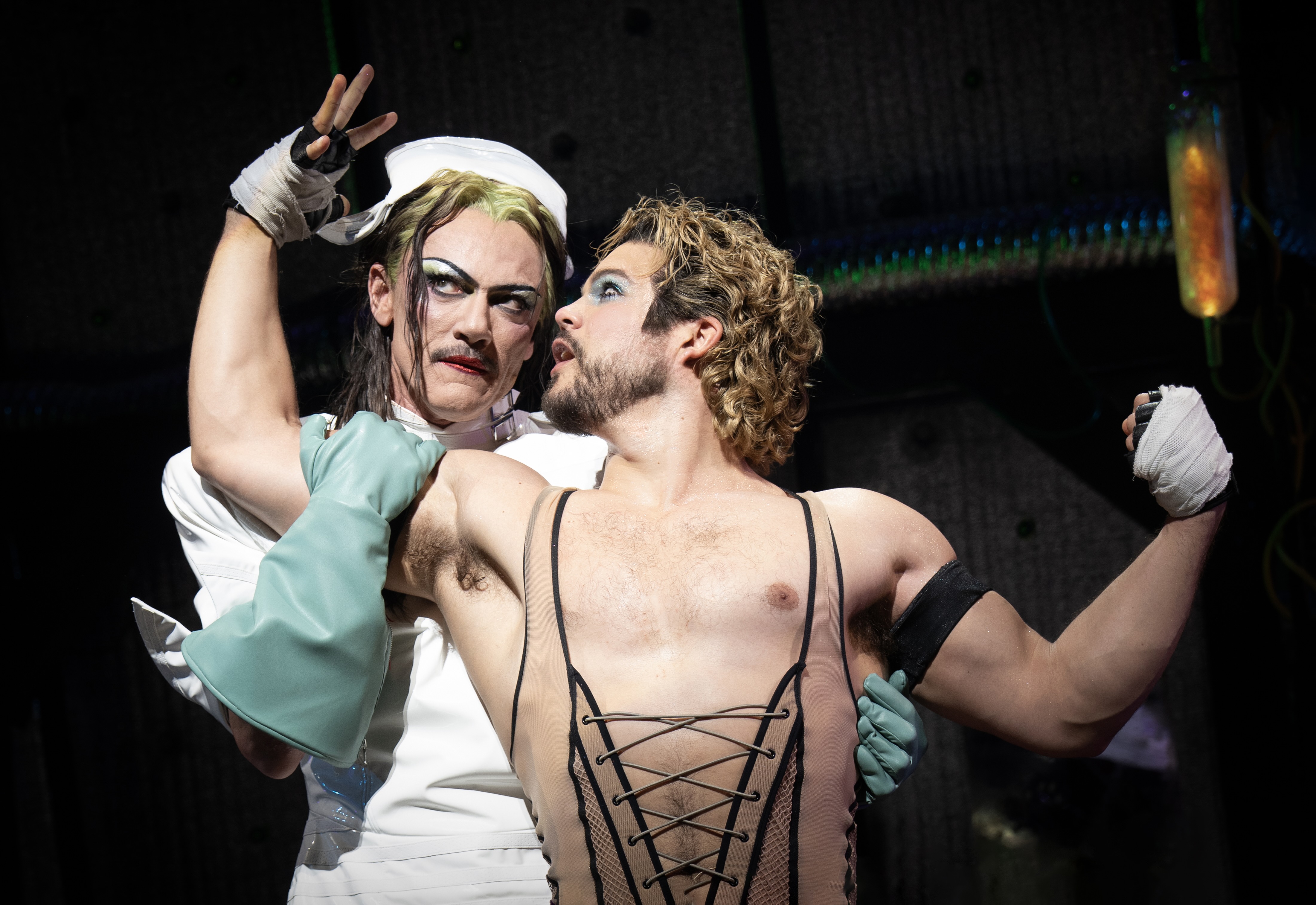

The Rocky Horror Show tells the tale of straight-laced normies Brad and Janet, who wander upon a castle and encounter alien mad scientist Dr. Frank-N-Furter. Frank introduces them to a radical version of sexual and gender fluidity—one that rocks their world. But there are deeper levels to this musical. With the character of Frank-N-Furter, Rocky Horror also tells the story of a gender nonconforming outsider who doesn’t fit in and is traveling around the universe trying to find a place where they can happily be themself, where they can express and explore their desires and their gender freely. Director Sam Pinkleton’s revival adequately captures the musical’s surface-level plot of sexual exploration, but by focusing almost exclusively on camp, it at best fails and at worst ignores what’s underneath, thereby eliminating the text’s trans allegory.1
A program note by Scott Ellis describes the musical, which originally debuted in 1973, as “a fantastical world of B-movies, sci-fi, and sexual liberation,” with no mention of gender. Ellis continues to say: “it goes without saying that right now feels like a good time to dive into this delectable world.” With acceptance of queer people plummeting and transphobia (including anti-trans legislation and violence against trans people) on the rise, now is indeed a great time to highlight queerness and transness on a Broadway stage. Too bad this production doesn’t fully manage that as wholeheartedly as it could have.
The core issues lie in who the production centers—its star, Luke Evans—and who (and what) it does not. Evans is best known for macho man roles in the Fast & Furious and The Hobbit franchises and for playing Gaston in the live-action The Beauty and the Beast. He’s classically handsome, has a muscular physique, and has a fairly run-of-the-mill fashion aesthetic, frequently appearing in well-tailored suits. The decision by the powers that be at Roundabout Theatre Company to cast Evans, a cisgender gay man who is considered conventionally masculine, as Frank-N-Furter is a disappointing, confusing, and political choice. I don’t see the point in doing a production of Rocky Horror in 2026, amid the ongoing erasure of and violence against trans people, with a cis actor playing Frank-N-Furter.
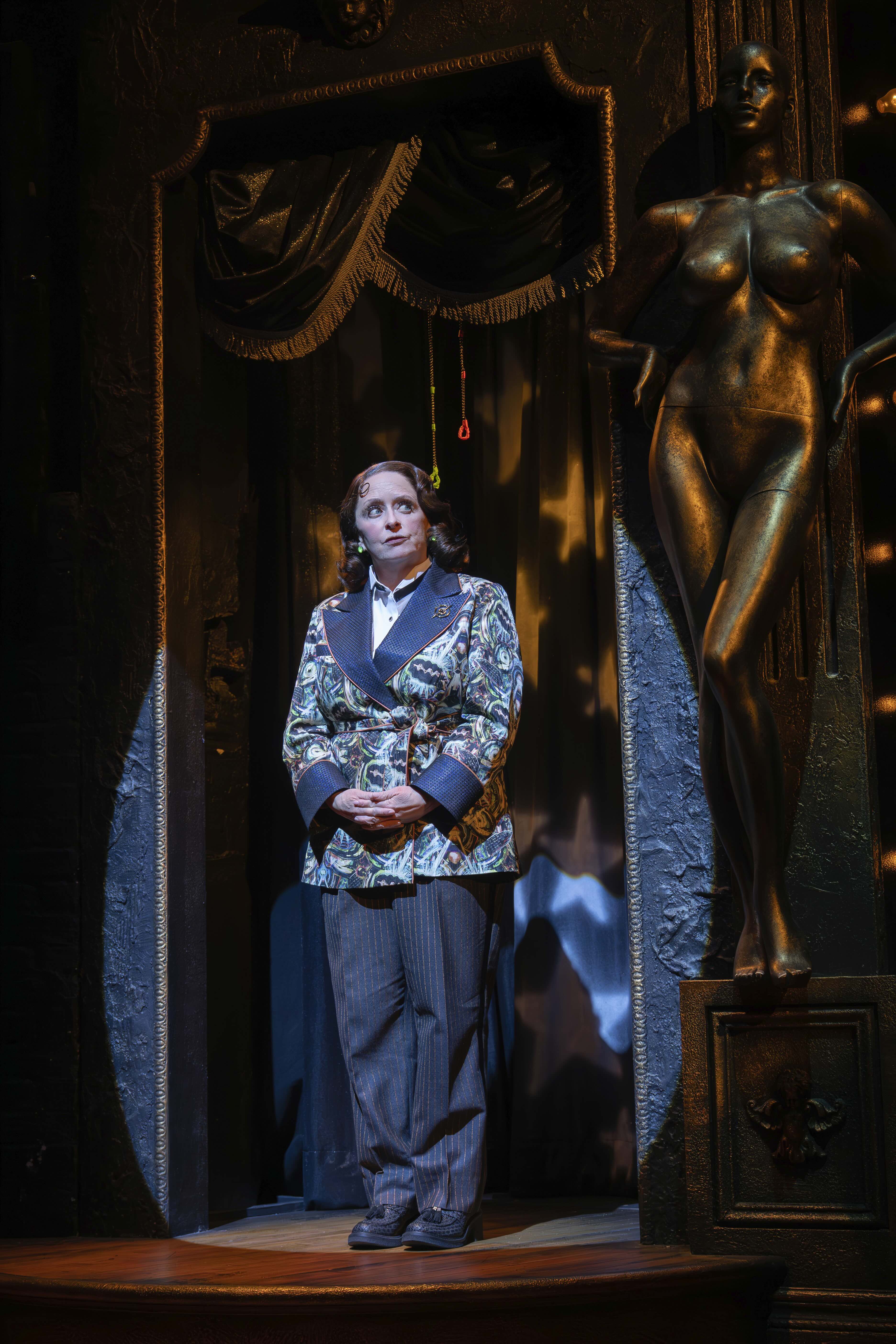
It’s important to note that there are trans/nonbinary people in the cast, including Michaela Jaé Rodriguez (as Columbia) as well as some of the ensemble Phantoms, and that the revival plays with gender in the chorus and with the casting of Amber Gray as the ostensibly male butler Riff-Raff (the role Rocky Horror writer-director-actor Richard O’Brien played originally). But even with all this, the production, by having Evans play Frank-N-Furter, still frustratingly puts cis-ness center stage, quite literally.
In 2016, the TV remake starred Laverne Cox as Frank-N-Furter; even Fox, the network on which it aired, cared enough to cast a trans actor. In 2023, the Central Square Theatre in Cambridge, MA put on a trans-centric production, where most of the cast and crew members were trans. This Broadway revival, however, is unwilling to commit to authentic, trans-empowering casting for the role of Frank. This is a worrying backslide, potentially caving in to the conservative anti-trans fervor, and comes across as an act of cowardice. If we are to do a revival of Rocky Horror in our current political climate, the production should have embraced Frank’s transness and the role unquestionably should have gone to a trans actor.
As a character, Frank presents a compelling portrayal of gender nonconformity. Created by O’Brien, who described himself as transgender, as a “third sex” in between male and female (in his words, he’s “70% male, 30% female”), the character has become an infamous icon of gender fluidity. Frank, almost immediately upon entering, declares “I’m not much of a man,” adding “I’m just a sweet Transvestite from Transsexual, Transylvania.” 2 The character has variously been considered trans, nonbinary, genderqueer, and a cross-dresser. Evans treats “Sweet Transvesite” as a purely sexual song: he savors and gesticulates with each articulation of “transvestite,” fondling his nipples and leather harness-clad pecs, but seems to cower slightly and swallow each instance of “transsexual,” almost avoiding the word. In a later song, Frank sings:
Whatever happened to Fay Wray?
That delicate satin draped frame
As it clung to her thigh
How I started to cry
‘Cause I wanted to be dressed just the same.
This narrates a phenomenon well-known to trans people of seeing a gender embodiment and painfully yearning for it. Onstage, the lyrics are eclipsed by Evans’s dramatic entrance from the rafters on the legendary Studio 54 moon with a cocaine spoon, and the moment is drowned out by the crowd’s cheers.
Rocky Horror draws on the mad scientist trope, specifically Mary Shelley’s Frankenstein, a text which has very often been taken up by trans people. Here, our Victor figure creates not a monster, but a perfect specimen of stereotypical masculinity, blond and muscular, named Rocky. In this, we can see trans resonance galore, with this creation showcasing the desire to create an idealized gender embodiment. Likewise, there’s a seriousness to Rocky choosing Janet, the “normal” girl, as his preferred sexual partner over the gender nonconforming Frank. However, Evans plays this crucial moment of rejection mostly for laughs.
In retaliation, Frank uses an invention, the Sonic Trans-ducer, to capture Janet, Rocky, Brad, and scientist Dr. Scott3 and force them to perform in a floor show. In the film, this quartet is transformed into clones of Frank in matching fishnets and black lingerie (we might even call this forcible transition). This revival does not follow suit: Rocky doesn’t change costume, Janet merely swaps her existing lingerie for a black set with a neon boa, Dr. Scott tears away slacks to reveal stockings, and Brad simply dons a collar and leash. The entire message of the floor show costuming (by David I. Reynoso) has shifted, eliminating the gender element in favor of making the show exclusively about sexual liberation, a trend for the production overall.
Frank is certainly not a perfect trans character, a role model, or even “good representation” by almost any metric (and some trans people denounce the character and film as irretrievably problematic). Frank is decidedly a villain, commits countless crimes (murder, sexual assault, holding characters hostage), and in the end is killed off. Many of the transphobic tropes of 20th century film abound–and yet, Frank is still a pioneer of transness on stage and screen, a revolutionary character who boldly and openly flaunts the gender binary. It’s a shame that this aspect of the character has been smoothed over in this revival.
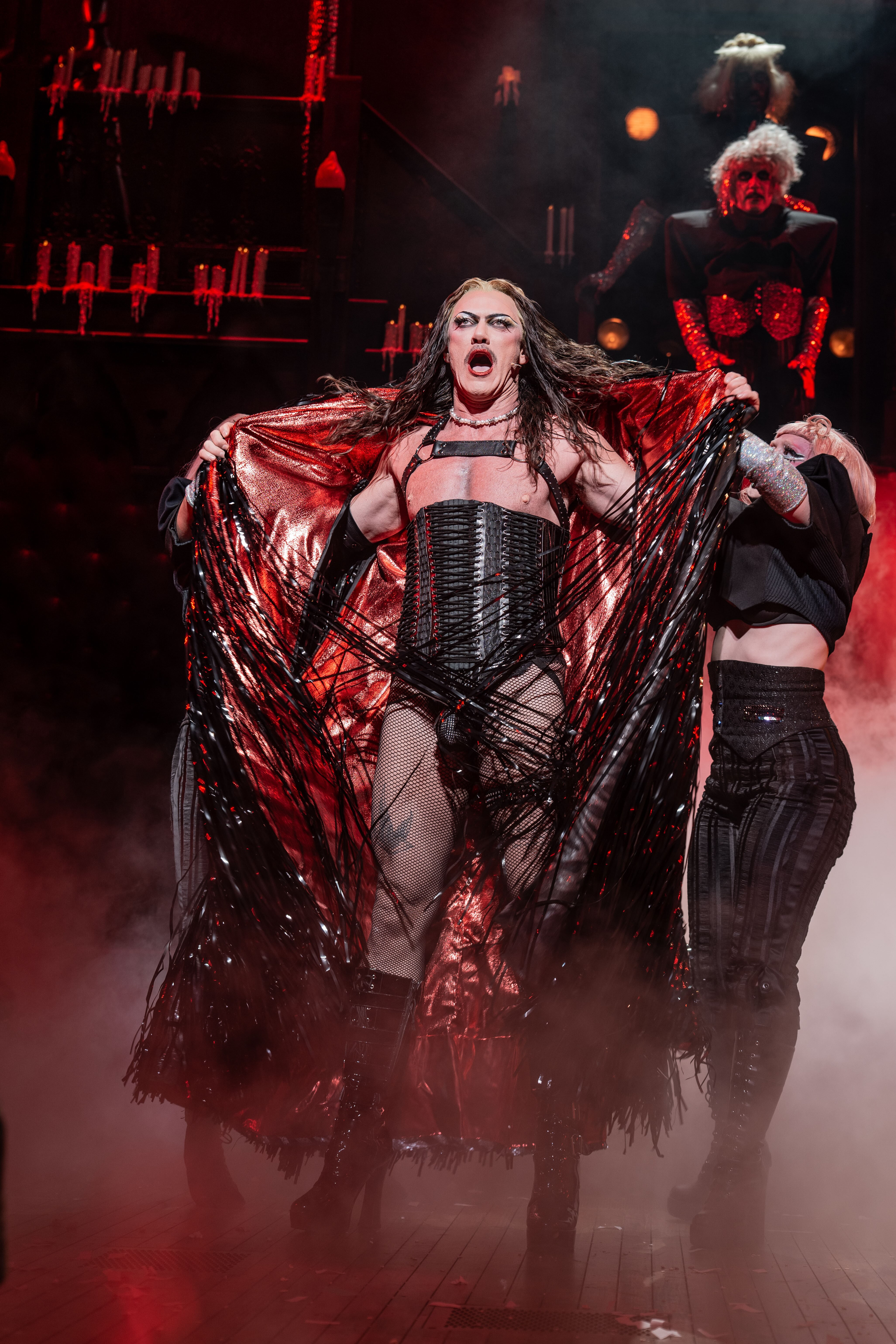
A major refrain of the show (quoted on the new merchandise and lowered down on stage in large neon lights) put forth by Frank, is “Don’t dream it, be it.” Though I have to ask, in this production, what exactly is the “it” we are meant to “be”? Horny? Sexy? Campy? “Queer,” in the general sense? The line is a trans mantra that encourages us to not merely dream of being our true selves, whatever gender that may mean, but that we should do it and be it. Frank sings the line and the ensemble joins in, spreading this gospel of self-acceptance and self-actualization. It’s a rousing message, and a radical one, especially for 1973. Cheesy as it may be, I can’t help but be moved by it, thinking of myself and all the other trans people out there hearing that reminder to not just dream of the gender we feel and want, but to be it, to embody it, to embrace it. Evans performs the song with gusto, but he can’t possibly fully relate to the intense pathos it holds for trans people, so his rendition comes across a bit hollow and generic.
Watching Evans sing the line, I felt hurt and betrayed and even angry that this beautiful trans message is being diluted so heavily that it is now devoid of any specific or grounded gender context. I wanted so much more from this Rocky Horror Show and left feeling unsure why the revival was staged at all. As I walked out of the theater, I thought about how meaningful a trans actor performing Frank-N-Furter on Broadway right now would be and what a political statement it would make. For now, I guess I’ll just have to dream it.
Footnotes:
1 I acknowledge I am taking Rocky Horror more seriously than, perhaps, it seems to invite. It is, admittedly, a ridiculous, kitchy, sometimes nonsensical spoof. But the role of the critic is to take art seriously–to evaluate and contextualize, of course, but also to read closely, to analyze deeply, to examine, to scrutinize, to nitpick even. The category of camp, which Rocky Horror so famously epitomizes, does not inherently negate, discourage, or render moot all critique. Camp deserves critical engagement, too. As such, Rocky Horror is not immune to critique simply because it is campy; just because it may not take itself seriously does not mean that we cannot or should not take it seriously.
2 The terminology in Rocky Horror is understandably outdated–it’s from the 70s after all. This production doesn’t update the language (which is fine, it respects the original and lets it stand) but also makes no attempt to contextualize or explain the language for a modern audience, like with a program insert.
3 Harvey Guillén plays Eddie and Dr. Scott, who uses a wheelchair. In a well-intentioned but clumsy fix, they have cut the disability element and instead occasionally have Guillén sit in a wheeled office chair. It would have been much preferable if, instead of erasing the presence of Dr. Scott’s disability, they cast a disabled actor who uses a wheelchair for the role (even if that meant not double casting with Eddie).
--
The Rocky Horror Show is produced by Roundabout Theatre Company and is currently running on Broadway at Studio 54 through November 29, 2026.