
In 2007, a video went viral. Colloquially known as ‘2 Girls 1 Cup,’ the video was a trailer for an hour-long shock porn film called ‘Hungry Bitches,’ directed by Marco Antônio Fiorito. Despite and/or because of its graphic nature, the film blew up, inspiring a slew of ‘reaction videos’ on the then-new website, YouTube. It became a game for viewers—see how long you can last before you’re too grossed out. Or, concerningly, too turned on.
Playwright Eliya Smith had never seen the video, yet her interest in it is the basis for her new show Two Girls, now playing at the Cherry Lane Theater. Performed by Chloe Claudel (who also co-directs with Mitchell Polonsky) and Juliana Sass, Two Girls is a piece of verbatim or documentary theater, largely consisting of interviews Eliya Smith conducted with young men regarding their impressions and experiences of the videos.
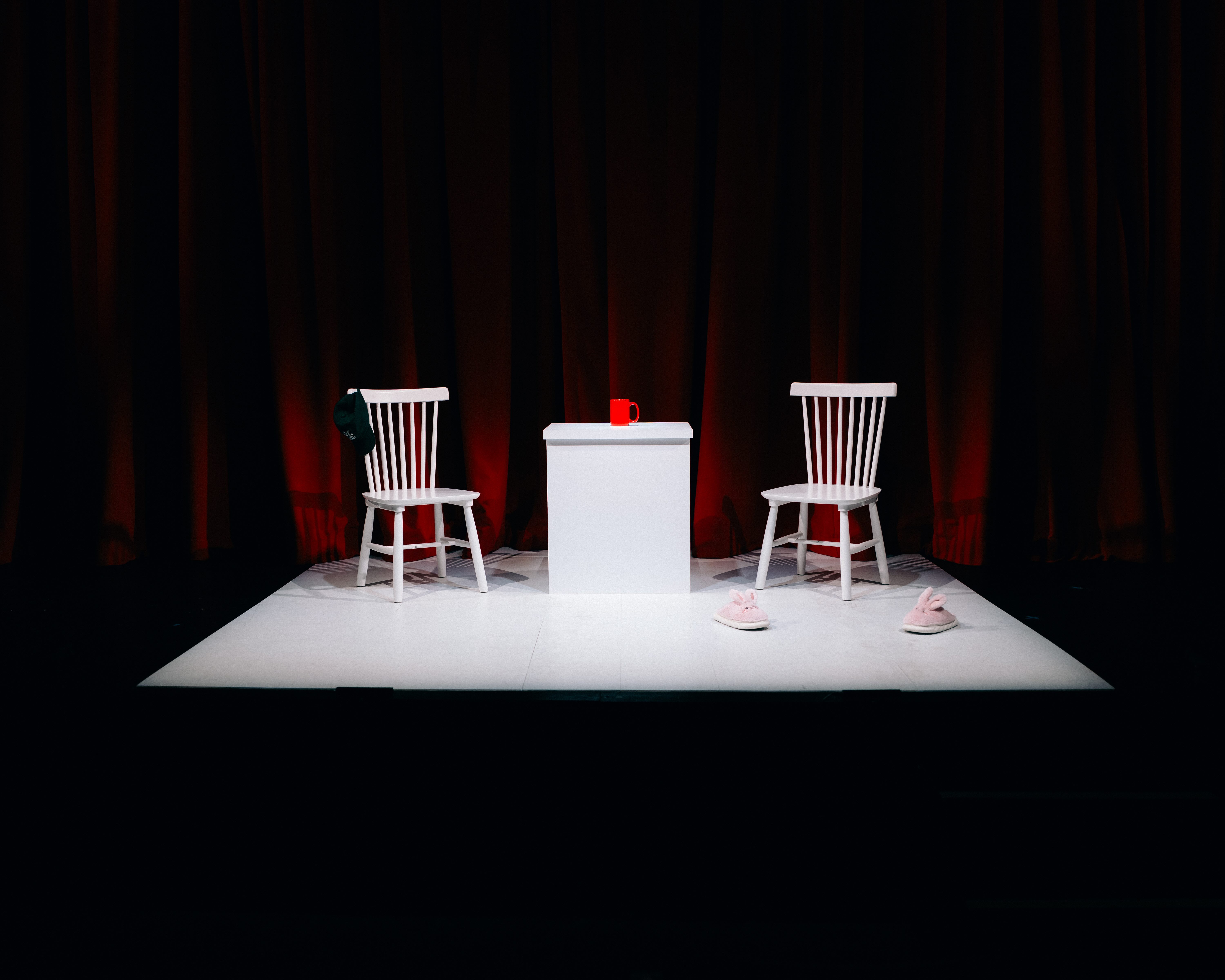
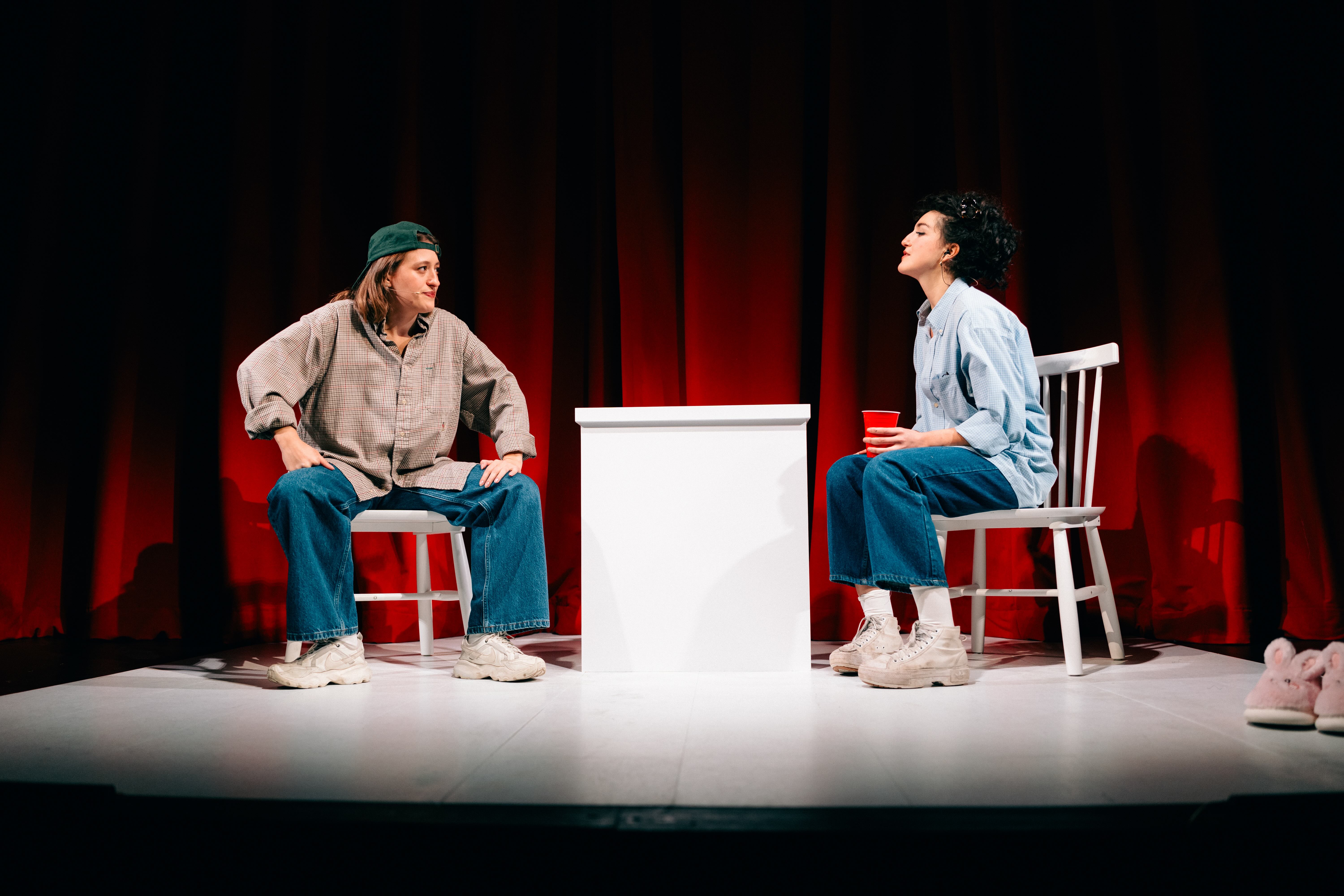
The piece clocks in at just an hour and sees Claudel and Sass take turns playing Smith and her anonymous interviewees. Seated on sterile white chairs at a sterile white table, (scenic design is by Forest Entsminger) Claudel and Sass signify their characters with simple shifts in physical performances and by swapping out props, most notably an ever-changing cup. Because while all of the men Smith interviewed know the video, no two recollections of that crucial prop are the same. Was it a solo cup? A glass? A mug? Accounts may vary.
Those familiar with Eliya Smith’s recent works like Dad Don’t Read This and Grief Camp have probably noticed the specific interest she has in female adolescence. How do young women spend their time? What captures their attention? How do they navigate desire or disgust? So perhaps it should not come as a surprise that she turned to this infamous video—perhaps the first major instance of aughts-age viral horror—as inspiration for her latest work. It seemed only fitting, then, that we two girls—one fully Generation Z; the other, a Zillenial who sits squarely on the cusp—matched Eliya Smith’s curiosity with some critical curiosity of our own.
Emily:
I’ve never seen the video. I was in 3rd or 4th grade when it came out, and the most taboo topic that ever even reached my elementary school social circle was the sex scene in Breaking Dawn. Therefore, I approached Two Girls much the same way I imagine Smith approached her ‘2 Girls 1 Cup’ interviews; with curiosity, trepidation, and dry amusement. There was a buzzy excitement running through the audience at Cherry Lane from the start, a sense that we were going to get to hear something scandalous. Largely, Two Girls delivered; in each ‘interview’ there would come a line or gesture that incited gasps and laughter. This is certainly a credit to Claudel and Sass, who each had a good sense of comedic timing. And it doesn’t hurt that what Smith had recorded in her conversations was often ridiculous.
It is fascinating to see a piece of verbatim theater about something that so many people from my generation remember. I’m familiar with the story of Matthew Shepard but that is because of Tectonic Theater Project’s seminal play, The Laramie Project, not because I read about his death in the news in 1998. By contrast, some of my peers probably did know about ‘2 Girls 1 Cup,’ and had even watched the video if they had unsupervised access to a computer. My impression of verbatim theater is that playwrights turn to it because they find a very specific research question compelling and because sometimes what real people say is more impactful/shocking/specific than an imagined dialogue. The challenge then is to arrange that language into a drama.
“It definitely has an arc. It’s like, you know, it’s, it’s told like a story” one interviewee says of the video. As played by Claudel, Eliya’s response seems skeptical. Simultaneously, I wondered about the arc of Two Girls–where can you go in a play that is just conversations about porn? Smith’s answer is an examination of how society responds to women’s bodies. What do men find attractive and what do they find disgusting, and where do those lines blur? When do women find their own bodies disgusting, or something they’d like to divorce themselves from? Those reflections were relatable and vulnerable, and while I couldn’t quite justify how they connected to the first 2/3 of the play, I could tie them to my own life. I am stuck with my body, like it or not. So are Smith and Claudel and Sass, even if the latter two are allowed to perform and embody others.
Two Girls never feels overtly theatrical, but it’s engaging. The language is colloquial and familiar, even when Smith’s questions or the men’s responses become more academic or clinical. It’s understandably awkward for the men to talk about the contents of the video–even I don’t want to say what happens in it–and that’s amusing in and of itself. As portrayed by Claudel and Sass the men–actually, no, let’s call them boys–are such familiar stereotypes. They are boys I know, boys I went to school with, and it’s fun to watch them squirm as you laugh in shock. Afterwards, Brittani and I talked about whether the piece could have been a podcast, or a piece for Audible Theater. It’s hard to say definitively. While Two Girls doesn’t ever totally necessitate the medium it’s presented in, one of the best parts of the piece is that you’re hearing it communally.
Brittani:
It feels important to mention that I have seen the original video, but the details are hazy. I don’t remember whether I sought it out on my own as part of some late-night curiosity or if I watched it among a mass of horrified others at a sleepover party. Ironically, like many of the men quoted in Smith’s verbatim experiment, I couldn’t tell you the shape or color of the cup. Instead, there are flashes of recollection that have remained sticky over the nearly two decades—a shock of pink fabric that adorned one of the girls, the ricochet of bodily waste that came out of another—nightmarish haunts from an otherwise sanitized childhood.
The gore and shock of this video cannot be overstated. In researching Fiorito’s work here and in other adult films, I came across kink terminology I never imagined needed a name: scat fetishes, coprophagy (the act of consuming feces), emetophilia (pleasure from vomit). Who knew entire fields of study existed around such offal impulses?
The shock of these themes is enough to lure the curious, but, like Smith’s play itself, it isn’t enough to hold us. When I told my similarly-aged friends that I was seeing a play based on ‘2 Girls, 1 Cup,’ they shuddered in disbelief. But Smith is investigating human engrossment more than human excrement. Two Girls is a thought experiment about attention—what captures it, what capitalizes on it, the science of memory.
For the majority of the show, the character version of playwright Eliya Smith prods her interview subjects with questions about discovery: “Do you remember what the women looked like?,” “Do you remember what people were saying about it?”, “Hearing about this video, was it arousing to you?” It’s both an investigation into the circumstances of an unbelievable video, and an anthropological examination of the circumstances of the person who chose to watch it. That’s all worth its weight in ponderance, but it’s hardly enough to coalesce Two Girls into a fully satisfying theatrical event.
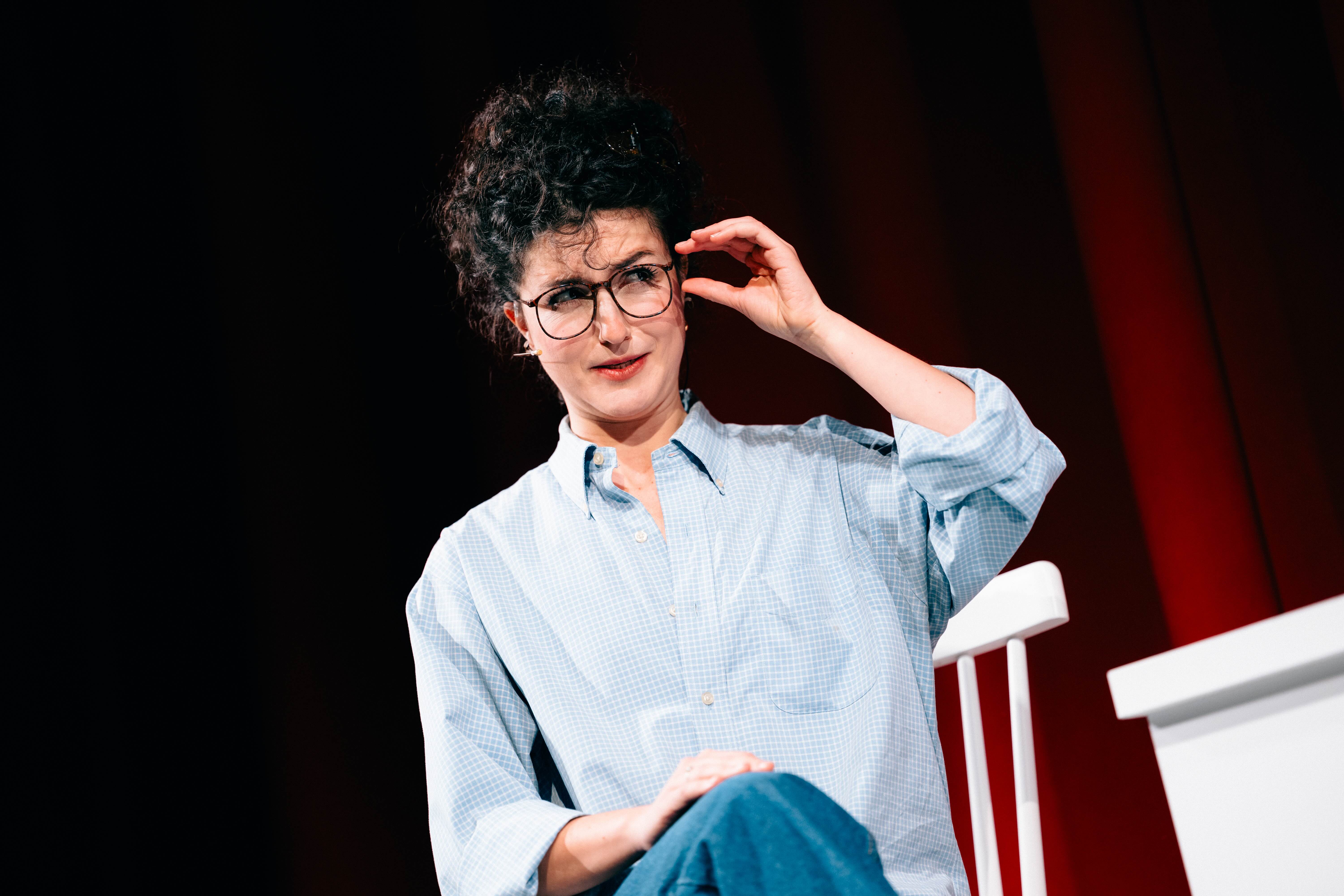
There is an upside though: the show’s two-hander format (a poo de deux?) tethers our enjoyment of the piece to the quality of the actors carrying us through its 60-minute runtime. Blessedly, Claudel and Sass are up to the task, morphing into both interviewer and interviewees with deft skill. Dressed by costume designer Alicia J. Austin in dad buttonups, blue jeans, and old sneakers—a kind of everyman boyfit—they move us through the interrogations with funny, artful shifts in posture and intonation. Even while dealing with some of the most grotesque subject matter I’ve seen discussed on a stage, the two are so grounded that they calm our eked-out nerves and command our attention. They also handle the major, late-in-the-play shift with commendable ease.
Smith gets to a point in the play where she seems to tire of her own narrative structure. The podcast-style question-and-answer rhythm repeated up to this point falls away and Smith shoves Two Girls into new dramatic terrain. A curtain peels back to reveal the crucial organs of any white-appliance NYC apartment: a refrigerator, small oven, etc. It’s a quick, unexpected transition, but one that shifts us into a new domestic setting. The character version of Eliya appears to be in her home, interviewing her roommate named Caitlyn. The verbatim act continues, but rather than questioning subjects about poop and vomit, Eliya is talking to her friend about a different kind of body horror: cancerous tumors.
As the two talk about their relationships to their unruly masses, their breasts, and their mothers, Two Girls becomes a more reflective play—a pensive meditation on having a rebellious body and knowing you must live with the same vessel forever. There is some tragically beautiful dialogue here, plus a comedically ill-timed interruption from a canvassing Greenpeace worker. But there still isn’t enough meat or revelation to make for a convincing ending. Instead, it reads as a last-ditch attempt to inject some physiological poetry into a play that’s not strong enough to support such gravitas.
--
Two Girls was written by Eliya Smith, co-created in partnership with The Goat Exchange, and is currently running at The Cherry Lane Theatre through November 2026.