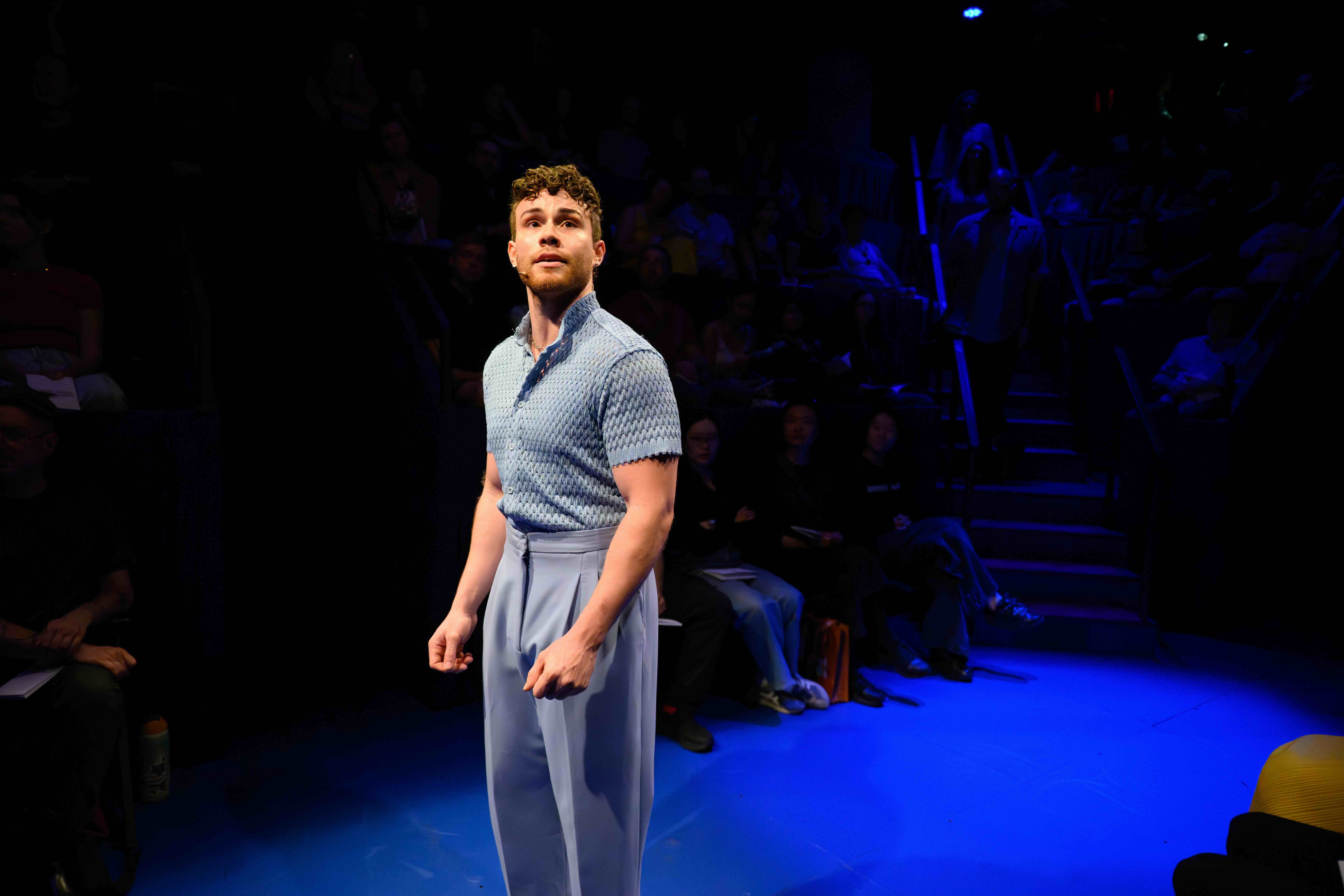

Oratorio for Living Things is, officially speaking, a musical ritual. Conceived and written by Obie-winning composer Heather Christian, the piece blends choral music, scientific meditation, and theatrical ceremony to explore the conditions of being alive: our cells, our cosmic origins, the small ecstasies and devastations that accumulate in a body over time. At Signature Theatre, director Lee Sunday Evans abandons the idea of a traditional stage entirely—seating is arranged in islands that rise in soft tiers around a central glowing sphere designed by Krit Robinson. Performers slip between platforms, aisles, and corners, often appearing inches from your shoulder. You don’t watch from a distance; you’re held inside a moving constellation of bodies. The piece has been called everything from a concert-style oratorio to an immersive choral event, but none of those labels capture how it behaves in the room—a presence with the pressure of a force, uninterested in category altogether.
There are works that ask to be judged; this is not one of them. I’m still not sure whether it is “good” or “bad,” and I distrust anyone who claims certainty. What I do know is that I was moved —my breath rearranged, my thoughts slowed, and my sense of time, my lifelong obsession with encountering something like livable time, felt suddenly possible. Few performances attempt to alter one’s internal tempo; fewer succeed. But this one did, by guiding me into a patient attention —into duration as something to be felt rather than measured.
The space itself begins to reorganize you. Because the singers are dispersed across platforms and aisles, sound doesn’t arrive head-on—it circulates. A phrase might bloom from a trio perched high on a riser and then be answered by a single voice emerging a few feet behind you, the harmony drifting through the room like a change in weather. Your attention gathers automatically, not only because the show demands it, but because the room keeps reshaping what you’re able to hear—pulling your focus toward whatever voice or vibration rises next. Every moment arrives layered: joy with pain, aspiration with grief, the life you’ve lived pressed against the life you still long for. Time doesn’t simply pass—it begins pooling, widening into something briefly, miraculously inhabitable. It’s the closest I’ve come, in a theatre, to feeling time widen rather than rush.
Christian’s composition moves between scales—cellular division, ancient starlight—without slipping into pedantry. It dissolves the line between scientific and spiritual, suggesting that being alive means belonging simultaneously to the infinitesimal and the infinite. The score holds that duality: chant-like repetitions, blues-tinged edges, gospel-weighted crescendos, and passages sung in Latin that give the text a ritual opacity. What’s striking is how seamlessly the piece invites you into this oscillation. You don’t shift from cell to cosmos; the work simply expands around you, reminding you that your body already contains both.
The piece avoids narrative in any conventional sense. Instead, it builds through accumulation— sound layered onto gesture, gesture onto light, light onto breath. A singer’s exhale becomes the seed of a harmony; a rhythmic pattern resurfaces minutes later with a new emotional charge; a warm shift in lighting alters the temperature of the entire room. The show reminds you that story
is only one way of surviving time. Music, repetition, and collective breath are others. Even the costumes—muted blues and greys with small, glowing accents—seem designed to fold individual bodies into a single, vibrating field. Though I’m usually allergic to overly spiritualized
language around theatre, there is something undeniably ritualistic happening here: a loosening of the self into a wider chorus.
We live in a moment where time feels both endangered and exhausted. Everything clamors for it; nothing sustains it. What astonished me about Oratorio is that it sustains time not by tightening its grip but by loosening it. The work quiets the mind until the hour expands. At some point, I lost track of duration completely—forty minutes, two hours, impossible to say (the runtime is ninety minutes with no intermission). It felt like stepping out of the calendar and into something tender, strange, and spacious.
Doubt surfaced—was it too earnest, too celestial? But the work absorbed that skepticism and asked me to stay with it. A wobble formed between confusion and awe, and I realized that wobble is the threshold where real attention begins. Most performances rely on certainty. This one relies on permeability—your willingness to be changed without being convinced.
A single rhythm passed through the room. Time gathered into something briefly livable.
Walking out of the theatre, the city felt louder, faster, back to its old tricks. But I had been inside something that slowed me down. Something that touched the part of me that has always been searching for livable time. And maybe that’s the only metric worth using. Not whether a production succeeds or fails, but whether it alters you—just slightly, just enough.
And while I still cannot tell you if the show is “good,” what I can tell you is that it was alive. It carried a pulse. It believed in itself—not in the self-important, over-theorized narcissism that plagues so much experimental performance, but in something simpler: the human voice, the body’s capacity to become an instrument, the fragile miracle of strangers gathering in temporary harmony.
Oratorio for Living Things did that for me. I don’t know what else to call it except art.
‘Oratorio for Living Things’ ran through November 23, 2025 at Signature Theatre Company. Production Photo by Ben Arons.