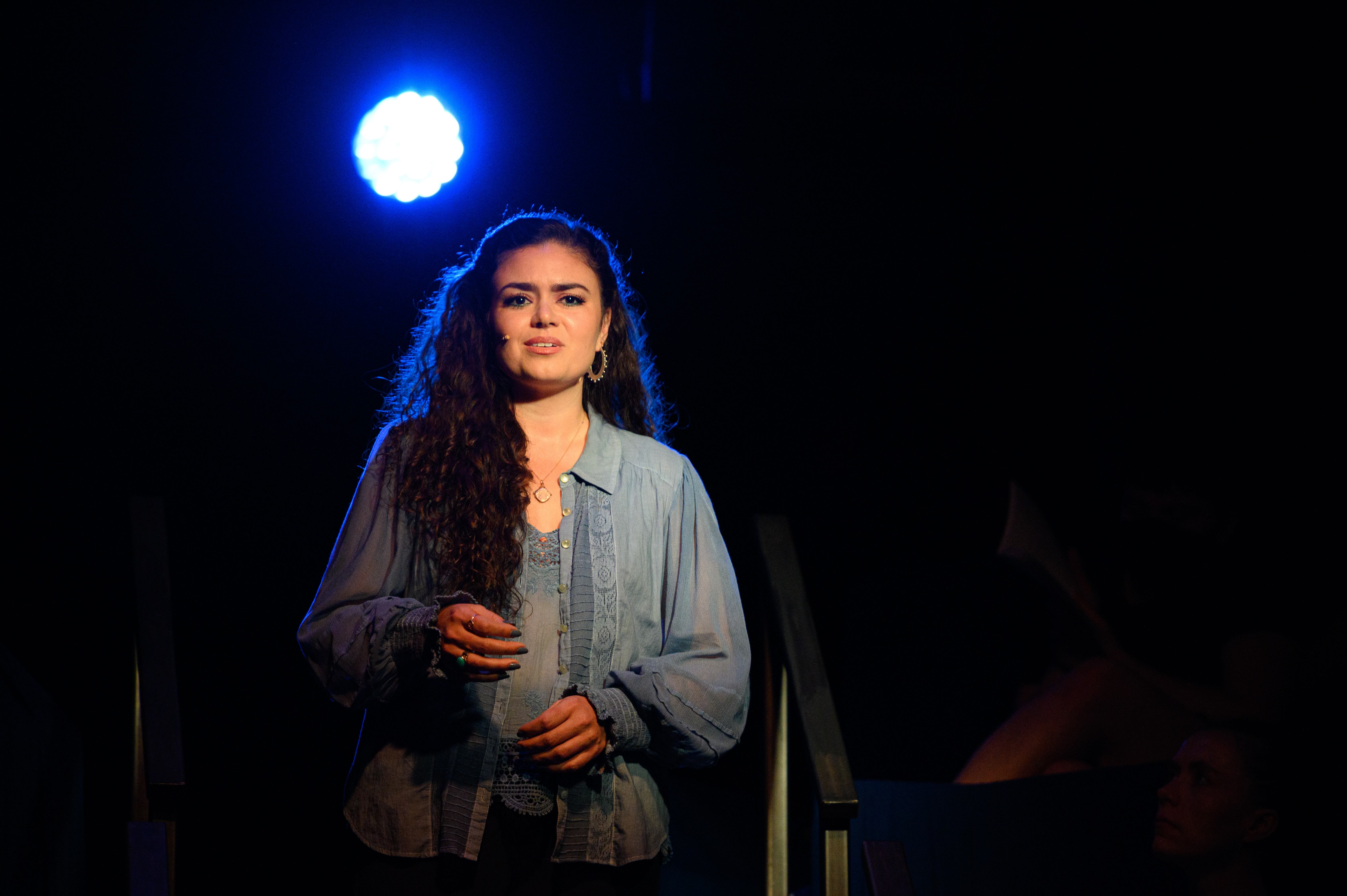

Am I in church or a theater? Or did I somehow get transported to an alternate dimension? These questions wouldn’t leave my mind following the first few songs of Heather Christian’s Oratorio for Living Things. Just recently finishing its run at Signature Theater Company on November 23rd, what some might label a strange work of art, may to others be exactly the lively revelation of life that they have been searching for. In reality, it’s a convoluted message and production that sits somewhere in between all of that.
Soon after the lights dim, a glowing ball descends from the middle of the room and various actors creep out from the underbelly of the in-the-round theater. Then suddenly, music and chanting begin, not in English but in Latin, as more performers climb down steps and out of doorways, ending up in the center playing space where this glowing object remained. But the more time spent sitting there listening to the echoes of music and seeing flashes of various colors and people, the more confusing the stage’s atmosphere became.
The oratorio is situated in a theater space that automatically functions as an abnormality compared to traditional theatrical spaces. The room stands in almost a spider-web shape with steps connecting the center stage to aisles that trace walkways for the actors. Though not the most accessible of seating units, this set-up allows for a constant flow of people that matches beautifully with the content of the show.
This fluidity is further perpetuated by the actors’ singing and the accompaniment. The first portion of the musical is sung almost completely in Latin, but this doesn’t prevent the actors from communicating messages to the audience. Everything that they do is purposeful and what they may not communicate through lyrics they transmit through their tone, pitch, facial expression, and movement–elevating the performance as a whole.
Upon initial inspection it's hard to see where this music connects to an actual story, but every song within the musical still had its own arc that–according to the program–all connected back to the relativity of time, space, and life. Memory, thoughts, the future, the afterlife–these themes all blended together in this nuanced version of storytelling, ultimately establishing the otherworldly nature and content of the musical.
In every attentive moment, there hangs another string in tying the story into a more cohesive thread, particularly by utilizing personal stories in relation to time. At one point, they even sing about how long one might spend opening tupperware in their lifetime–a whopping 40 minutes. This moment, among the other familiar memories featured in the song, felt like a grounding piece amidst the chaos and blinking lights, allowing the audience to take a step back and absorb the constantly evolving music whose sound is reminiscent of a church choir or even the first few notes sung in Beyonce’s Cowboy Carter album.
Unlike listening to a pre-recorded album however, actually attending a show is very different, and in this case the quick-paced complicated musical sections left almost no time for anyone to be able to pause and consider what was happening. The actors were constantly overlapping each other’s words, switching between languages, and hustling up and down the aisles–making it so that every moment you almost felt like you were drowning in your own attempt at comprehension.
Altogether, the plot exists more as a bunch of sticky notes on a fridge–all there, but messy to the point you miss the message in at least half of them. When you first receive the program, there’s a message inside from Heather Christian herself giving a preview of an oratorio and elaborating
upon the contents of the show. Without reading this slip, it would be extremely difficult to understand what message she was trying to present to the audience. This was clear as the show went on because people visibly either became enraptured and enthused by the music or indifferent to the entire thing due to a lack of understanding.
Though many parts of the experience united the audience–including at the end when everyone is asked to stand together–much of the unity was based in collective confusion. This among the various other unusual sections of the show may decrease its value in the eyes of many, but if you re-interpret it as experimental theater and are willing to maintain an open mind, Oratorio for Living Things might be worth the experience, even if you won’t understand most of it.
‘Oratorio for Living Things’ ran through November 23, 2025 at Signature Theatre Company