
It might surprise a potential spectator of Oratorio for Living Things that they’ve signed up to watch an hour-and-a-half long ritual about time, with about a third of the production in Latin. However, don’t let this information be a limitation. The show is not creating a barrier. Rather, it is wearing its heart on its sleeve and inviting you to play with it. Once you accept Oratorio, you are invited into a masterful look at the Anthropocene that is as much fun as it is reflective and asks how we can earn a better future for ourselves.
Oratorio is told in three parts: quantum time, human time, and cosmic time. According to a letter from the creator Heather Christian, it takes us through life at a molecular level to small human memory to understanding time’s nature through “collision and violence”. Through the three-act structure, the production brings the audience from the birth of the universe to the death of our star, and along the way, we see bedtimes, breakups, and births.
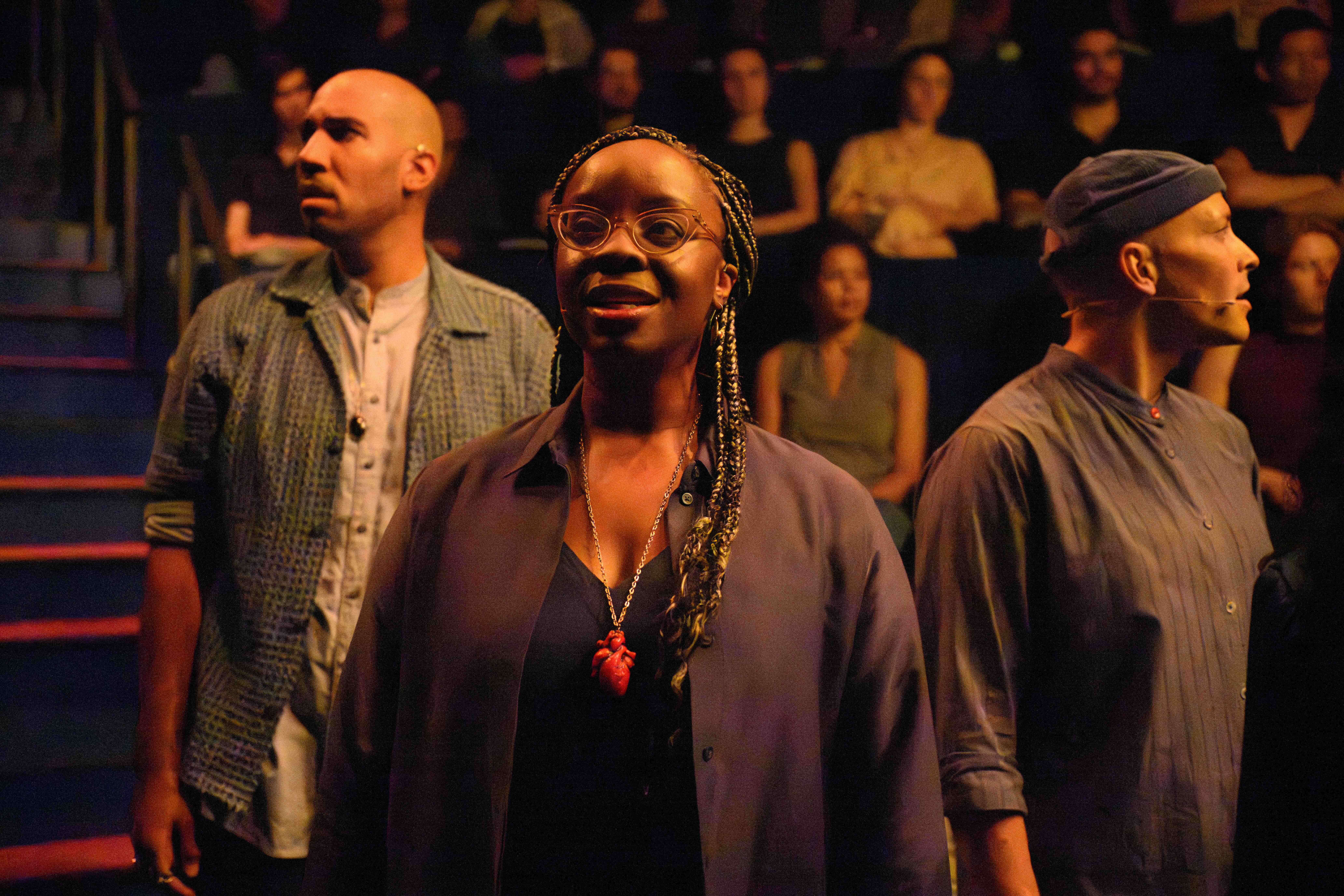
The audience is not inconsequential to this experience. The actual theater of Oratorio is in the round, a small place that seats a little under 200 people. While there is a small center section acting as a stage, the actors just as often use the stairs, turning the entire theatre into their play space. It means that at some point, every audience member is in an intimate relationship with the production. An intimacy that increases with the actor’s constant eye contact with each other and the audience. It can be a bit daunting and vulnerable, but the show handles it with care. The overwhelmed feeling fades, and what’s left is safety - to be vulnerable and to have as much fun as the cast.
In one engaging moment of the show, the actors pace the stage reciting estimates of a person’s time. Each actor’s voice overlays everyone else’s describing time ranging between the mundane “sixteen days trying to remember what you were about to say” to the melancholic “four days and two hours preparing for the worst.” As the cast drags you into the familiar eye contact, you start to reflect on the way your time is spent. Is it worth it, and if it is not are you willing to change anything? It’s a moment that demonstrates the best of Oratorio’s intimacy, where you can’t help but stop, reflect, and resonate with fellow audience members.
Oratorio’s costume designer, Marion Talan de la Rosa, makes the decision to put the actors in simple clothing with easy-to-see microphones, almost making the cast look like youth pastors. However, true to Oratorio there is no sense of the lecture or condescension. Rather, it invokes the best of the youth pastor, one who invites you to be safe and childish in a holy space.
Sometimes it’s hard to understand what’s going on in Oratorio. Mainly because it can be difficult to hear the words. The production starts in Latin, and even when it’s in English, entire sections overlap. Often, some snippets can be picked up when actors are close enough, when enough actors are saying the same thing at the same time, or during a solo.
One resolution for this problem is to utilize the songbook being sold at the bar, or scan the QR code for the same book and have it on your phone. Another solution is to accept it. Look at the beautiful stage picture shaped by the dynamic lighting, embrace the clarity of the emotions on the actors faces, and allow Heather Christian’s emotive music – every crescendo of the colliding voices and every ethereal solo - to wash over you. Feel the questions that Christian is asking as much as you might hear them and provide your answers through the swaying of your body, tapping of your feet, and making your own eye contact with the performers. This experience is still understanding Oratorio.
Oratorio for Living Things is an experimental theatre piece that is mourning, revering, and reimagining the entire history of the universe. In doing so, in its short run time it strips off layers of cynicism that allows for a deliberate ignorance of the way humanity is also part of the history of the universe. What’s left in its place is thoughts on what a better future might look like, and how humanity can finally earn that next step.
‘Oratorio for Living Things’ ran through November 23, 2025 at Signature Theatre Company. Production Photo by Ben Arons.