When most people think of the word “oratorio,” an antiquated, ecclesiastical piece probably comes to mind—Handel’s Messiah, for instance. Does this historic art form even have a place in an era where we’re less likely than ever to express devotion to anything, always lost in the brutal monotony of our day-to-day lives? Heather Christian would say yes. Her Oratorio for Living Things is a monumental testament to humanity, science, and life itself, demonstrating how infinitesimal our time on earth truly is. She proclaims that our ability to grow and spark so much change in only the span of a cosmic millisecond is a miracle in itself worth venerating. Though watching this show may spark existential dread and uncertainty in some viewers, she suggests that our impermanent, inconsequential natures could be a cause for celebration instead of fear.
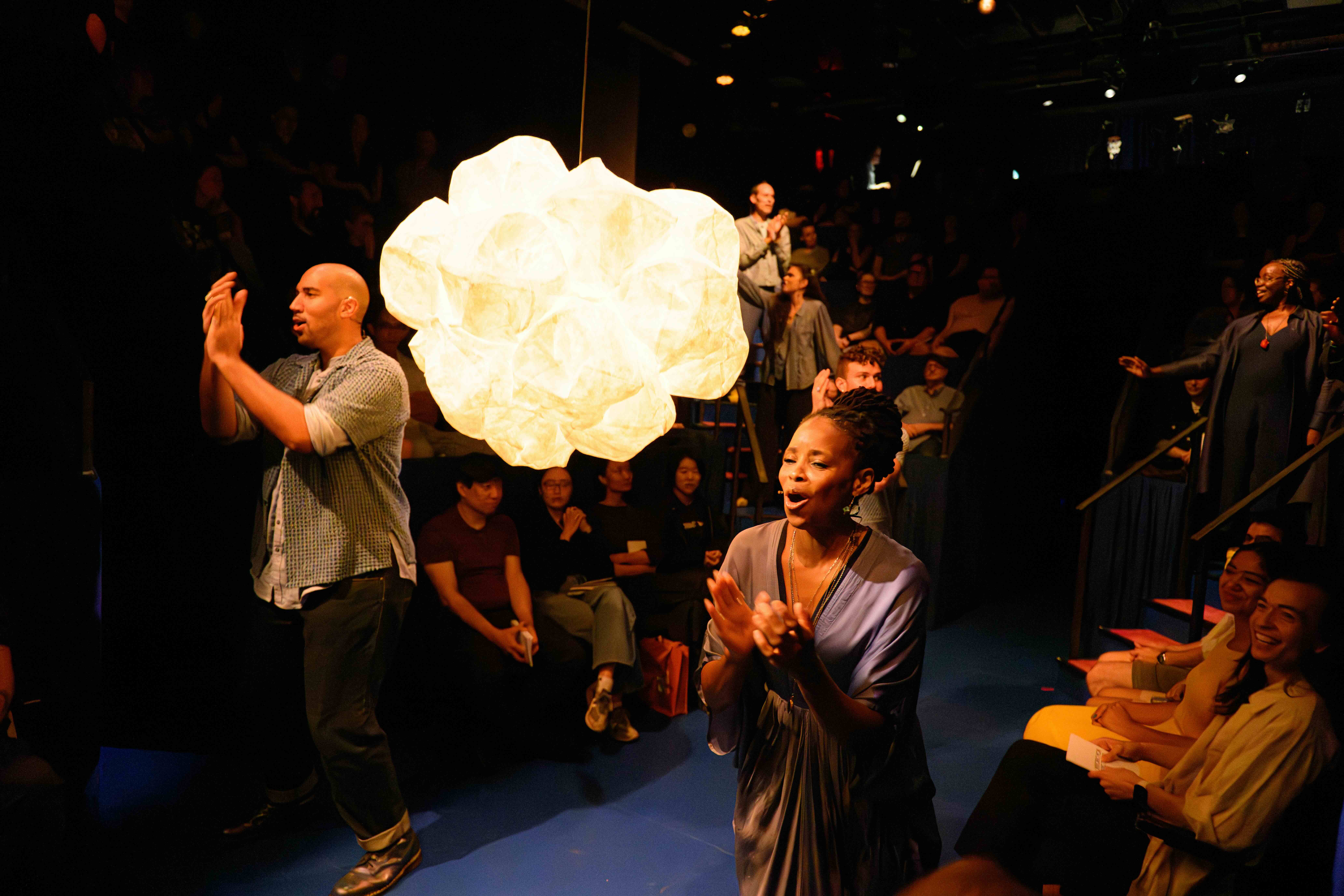
The production team and performers alike succeed at making the audience of Oratorio feel extremely vulnerable at times. Firstly, there’s an overwhelming sense of claustrophobia that you experience inside a space as intimate as scenic, environmental, and original artwork designer Krit Robinson’s compact, in-the-round style seating. The floor of the arena is barely larger than the size of a walk-in closet, so I wondered if it would fit all twelve actors. However, it didn’t have to, as director Lee Sunday Evans stages much of the action on the aisles and stairs in between rows of audience members. The performers break the fourth wall for almost the entirety of the show, often directing their statements towards individual viewers. The nearly constant eye contact felt like the actors could see straight into my soul—Brian Flores’ particularly intense glare implied that he somehow knew every terrible thing I had ever done and was now imparting judgment upon me for it. The rest of the actors make similarly effective choices to illustrate Christian’s various intellectual, emotional, and spiritual ideas.
It would do Oratorio for Living Things a disservice not to mention Christian’s incredible musical compositions. Though the show has some numbers reminiscent of classical orchestrations, many of the sweeping melodies are more firmly rooted in the style of contemporary musical theatre. The rhythms and harmonies are so complex at times that even Sondheim would shudder at their sheer technical difficulty. Additionally, the language shifts to and from Latin so subtly that I almost forgot that I don’t understand it outside of religious contexts. The cast sings as a group for the majority of the runtime, but they all have such intricate, highly individualized vocal parts that it is impossible to catch every lyric. It seems that Christian intends for the viewer to get lost in the noise, demonstrating the limitations of human understanding, especially regarding our knowledge of one another.
Márion Talán de la Rosa’s blue and red costumes match the colors of the set itself, giving everything a sense of aesthetic harmony. The variety of outfits, from polo shirts to fitted suits to billowing skirts, suggests the events of Christian’s piece take place across many points in history—showing that the parts of the human experience she highlights aren’t exclusive to twenty-first-century audiences, but all those who came before us as well. Furthermore, the lighting, curated by Jeanette Oi-Suk Yew, transitions from yellow to red to black-and-white based on the emotional quality of the music. Krit Robinson’s scenic design includes a glowing, spherical orb, the function of which is never revealed, but the performers seem to solemnly revere it. It appears at different points to represent the sun, a deity, or a beating heart; however, given the vast subject matter of “the quantum, the human, [and] the cosmic” that Christian covers in Oratorio, this set piece could easily embody all three at once.
“Evolution isn’t presentable because it requires so much failure,” announces performer Carla Duren at Oratorio for Living Things’s climax. It isn’t always comprehensible either. We’ll never completely know how or why we got here, but does it even matter? We’re alive, which is another indescribable miracle we get to behold every day. The actors sing about how we spend such long periods of our lives doing menial tasks like “washing [our] hands” or “giving bad directions to strangers,” all while worrying about the millions of things we do not and cannot know. When I was watching the show, I seemed to lose my sense of time. Had it been minutes or hours since I first sat down? Either way, I didn’t mind. Locking eyes with the performers as they paced around the arena, I felt like I was truly living in the present for the first time in a while.
‘Oratorio for Living Things’ ran through November 23, 2025 at Signature Theatre Company