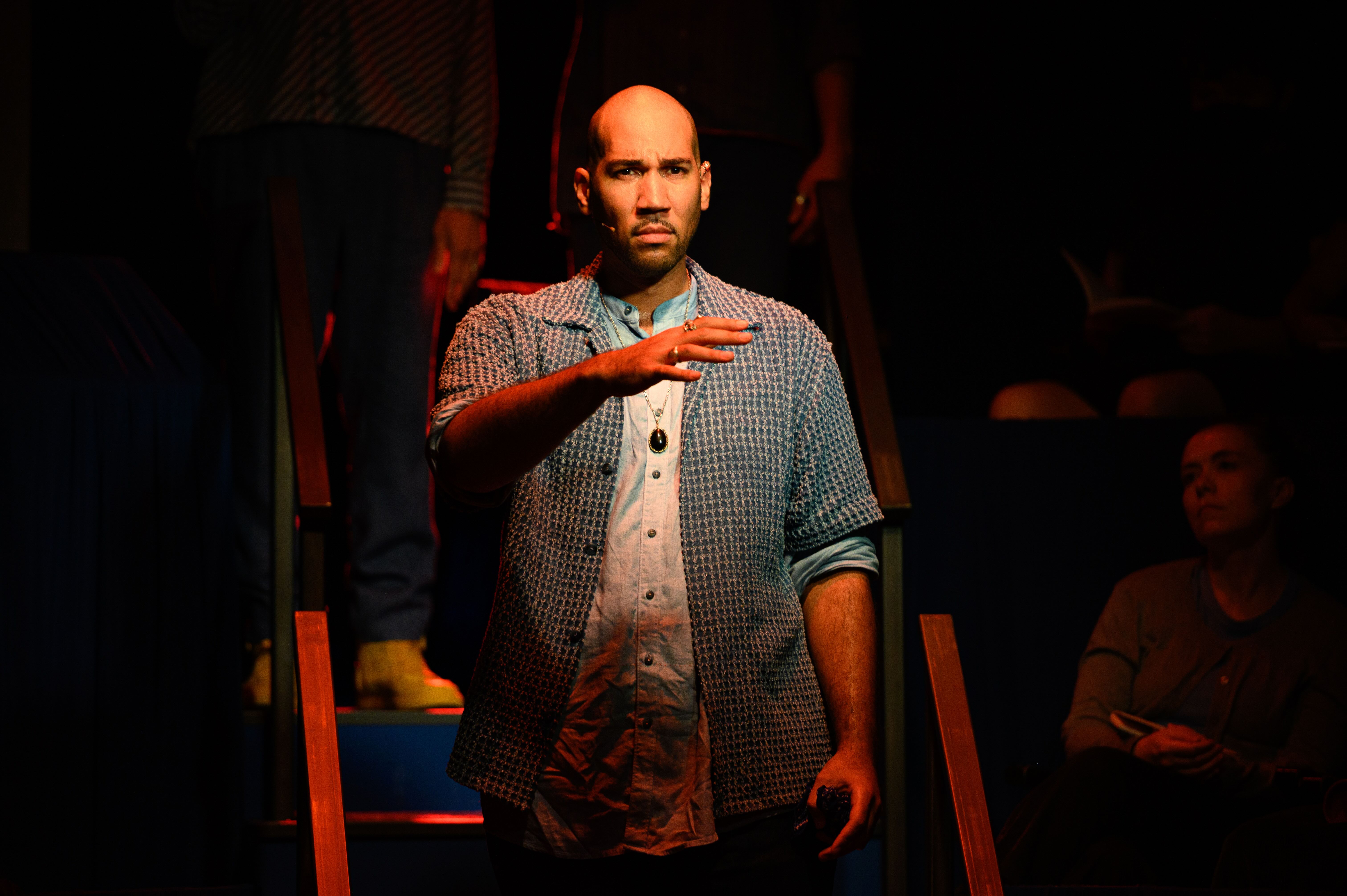

Before entering the theatre for Oratorio for Living Things, the audience is greeted with a letter from Heather Christian. She writes, “An Oratorio is a religious-adjacent music service that is, at its core, rumination on a subject or theme the composer (in this case, me) has decided is ‘holy?’ Tonight, this holy thing is Time.” The letter prefaces the performance, yet it soon becomes clear that the ninety minutes that follow are not something that can be captured in words; they are meant to be lived, experienced, and felt. The three acts grapple with this idea of time; at the quantum, human and finally cosmic scale. The letter also alerts us that a third of the oratorio is in Latin. If this seems daunting, don’t worry, Christian assures. “You do not need a degree in astrophysics, antique languages or microbiology to ‘get’ this piece.”
The theatre is small and intimate with a single set piece: a puffy white orb which descends at the beginning and then slowly rises back up out of the way. The show begins, one voice pierces the silence, and soon the rest of the cast joins in. The performers stare into our eyes as they sing. I’m mildly uncomfortable, as are many other audience members who are easy to spot thanks to the in-the-round configuration of the theatre. Yet this intimacy is thematically appropriate; everything about the experience is meant to connect on various levels.
The movement, costumes by Márion Talán de la Rosa, and set and environmental design by Krit Robinson are minimal and intentional, allowing the music to take center stage. This is by no means a critique; the melodies are complex and stunning, and the vocal performances are outstanding. Director Lee Sunday Evans certainly understands the impact of letting the music speak for itself. The degree of technical musical talent is a feat alone. Seamlessly switching between a capella — sometimes clapping or stomping to provide their own percussion, to being backed up by the musicians, the show is almost entirely sung through. The lighting by Jeanette Oi-Suk Yew is striking and particularly trippy when the cast (and audience) are lit up so that everyone appears in black and white.
The cast is a strong ensemble, in the truest meaning of the word. Everyone is featured, everyone is a part of a bigger whole. At times it is just one singer carrying the story; other times, more voices intertwine, sometimes mid-phrase, trading lines seamlessly, as if the song itself is being passed from person to person. Individually the singers have unique, rich voices, so their ability to blend with one another to create such a cohesive sound is a testament to their musical abilities and the sound design by Nick Kourtides.
It takes an act of concerted concentration to follow the stories, and not just because much of it is in Latin. The actors often sing different things at once, making it impossible to follow more than one voice at a time. The voices fill the entire space enveloping us in music that at times is so beautiful that I truly do feel like I’m having a spiritual experience. The parts I understand are alternately, and sometimes simultaneously, amusing, bizarre, or deeply profound.
Some moments stand out vividly. A song built from fragments of our daily lives—seventy-three minutes finding the keys to your car, thirty-two days and seven hours deciding not to call someone back, thirteen seconds of true bliss, and one minute of missed high fives—elicits laughter from the audience and emerges as a highlight. When we think about the passage of time, we rarely notice the small moments that slip by unnoticed. Yet, as the lyrics aptly point out, they accumulate. The song serves as a reminder—or perhaps an invitation—to pay attention to the meaning tucked inside these seemingly forgettable experiences. Still, the most thrilling parts of the performance are not driven by words at all, but by the music itself. It is here that the true power of the piece reveals itself, showing that music alone can evoke emotions words often cannot.
In her remarks, Christian concludes that this piece is “made to engage with you at whatever level you'd like to do so.” And I know I missed plenty; this is the kind of performance you could watch a hundred times and still uncover something new. When the words elude me, the music pulls me back in. Even if I understood none of it, I would stay for the singing and the orchestrations alone. Christian notes that Latin is the language shared by science and religion, but I’d argue that music is the most universal language of all—something this performance makes crystalline clear.
‘Oratorio for Living Things’ ran through November 23, 2025 at Signature Theatre Company