
Following the old couple in front of me blindly through the lobby of the Signature Theater, the journey proved to be just as theatrical as the play itself. We were transported from what seemed like a hotel waiting room, to the industrial backstage with blue lights surrounding, to then a last small entry way into this petite amphitheater, that was likewise glowing with a bright indigo. This moment of transportation I make as the last instance of soundness, right before the world of Latin indoctrination and cultish hippies took over.
Oratorio For Living Things is a musical written by Heather Christian, directed by Lee Sunday Evans, and ultimately deals with the relationship humankind has with time versus the way our universe is considered with it. It aimed to transport the audience members into a state of existentialism, to realize the cracks in the sidewalks and the aging trees surrounding them. However, all I could discern were people dressed like the Eriudite faction from Divergent, dancing around a West Elm lamp.
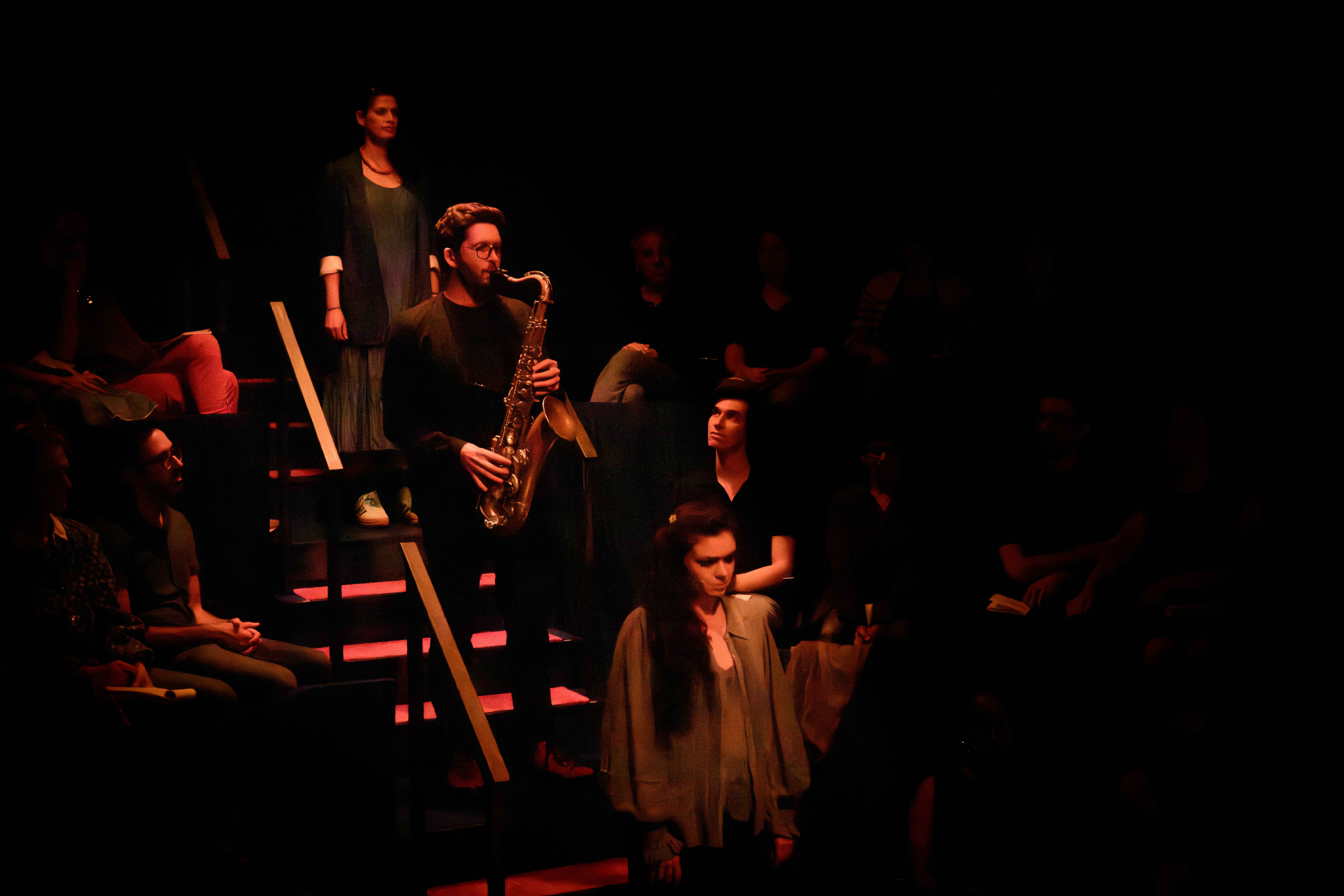
The play began in a sense of calmness, with the actors just walking on stage, not drawing much attention to themselves, to the extent that conversations around me were still chattering on. Immediately, a small paper lamp dropped from the ceiling, and became the center piece of the performance. The lighting throughout the play was a significant element in bridging the gap between performer and audience (lighting design is by Jeanette Oi-Suk Yew). Sequentially, it involved various numbers, dancing throughout the space, up and down the stairs, where lyrics questioned origin, existence, and the universe. As small as the theater was, it allowed for a true intimacy to be created, where one could see every drop of sweat lining the actors' faces. The various colored lights utilized throughout intensified this, where shadows or red, blue, or yellow, moved under the cheekbones, or glazed their hair, which added to the intention of that number, whether that was vigor or softness. I found myself stuck in prolonged eye contact with many of the performers, something I hadn't truly experienced in theater before. This served as a mirror into myself, to humanly engage with this performance.
“Building DNA via Ticker Tape of Time Spent” was perhaps the most enrapturing number, where the actors were in constant synchronization in their singing, dancing, and even facial expressions. They were enunciating over each other, measurements of time we spend in the irrelevant: four hours looking for scissors, fourteen months looking for your phone, twenty seven hours typing
“sorry for my delay in response”, just to name a few. This, I felt, was Heather Christian’s strongest moment, that secured what she ultimately intended to provoke. It did not require translation or much deeper thought; instead was comical and painfully true, making it evermore moving. It convinced me, in this moment, to fully admire the work and consider it as true art. However, I simultaneously found fault with the length to which it took us to get here. This number should have been prioritized more throughout the play, especially over the numbers ridden with Latin prose. “Building DNA via Ticker Tape of Time Spent” had a high-hearted and dystopian feel, forcing the audience into a newer perspective outside themselves; to think about the everyday through the lens of the cosmic, which is extremely jarring yet important.
Heather Christian and Lee Sunday Evans’s intention was well understood, to live life like the experience of the play: shared, interconnected, and aware of the celestial. During the very end of the play, the actors, in a complete PBS Kids tone, asked us to stand and take a moment of recognition. Like Sesame Street begs its five year old audience to ‘reduce reuse and recycle.’ However, it effectively made me consider the inherent violence involved with getting me to that very seat. I attempted to embrace this as much as I could, however soon realized that I was holding my notebook at an angle so that the old man across from me could see the illustrations I drew of him sleeping. Ultimately, this core message that Christian and Evans were urging was strung out for too long, and the reaction they were looking for could have easily been achieved in an hour.
‘Oratorio for Living Things’ ran through November 23, 2025 at Signature Theatre Company. Production Photo by Ben Arons.