Heather Christian’s Oratorio for Living Things, directed by Lee Sunday Evans at Signature Theatre Company, is less a piece of theater and more a lived, breathing encounter with sound, time, and human presence. I walked in with only the vaguest sense of what an “oratorio” even was and walked out not knowing what to do with any of it. What follows isn’t a neat interpretation or a tidy review, but a reflection on what it felt like to sit inside something so unclassifiable—and to try to make meaning from it afterward.
space
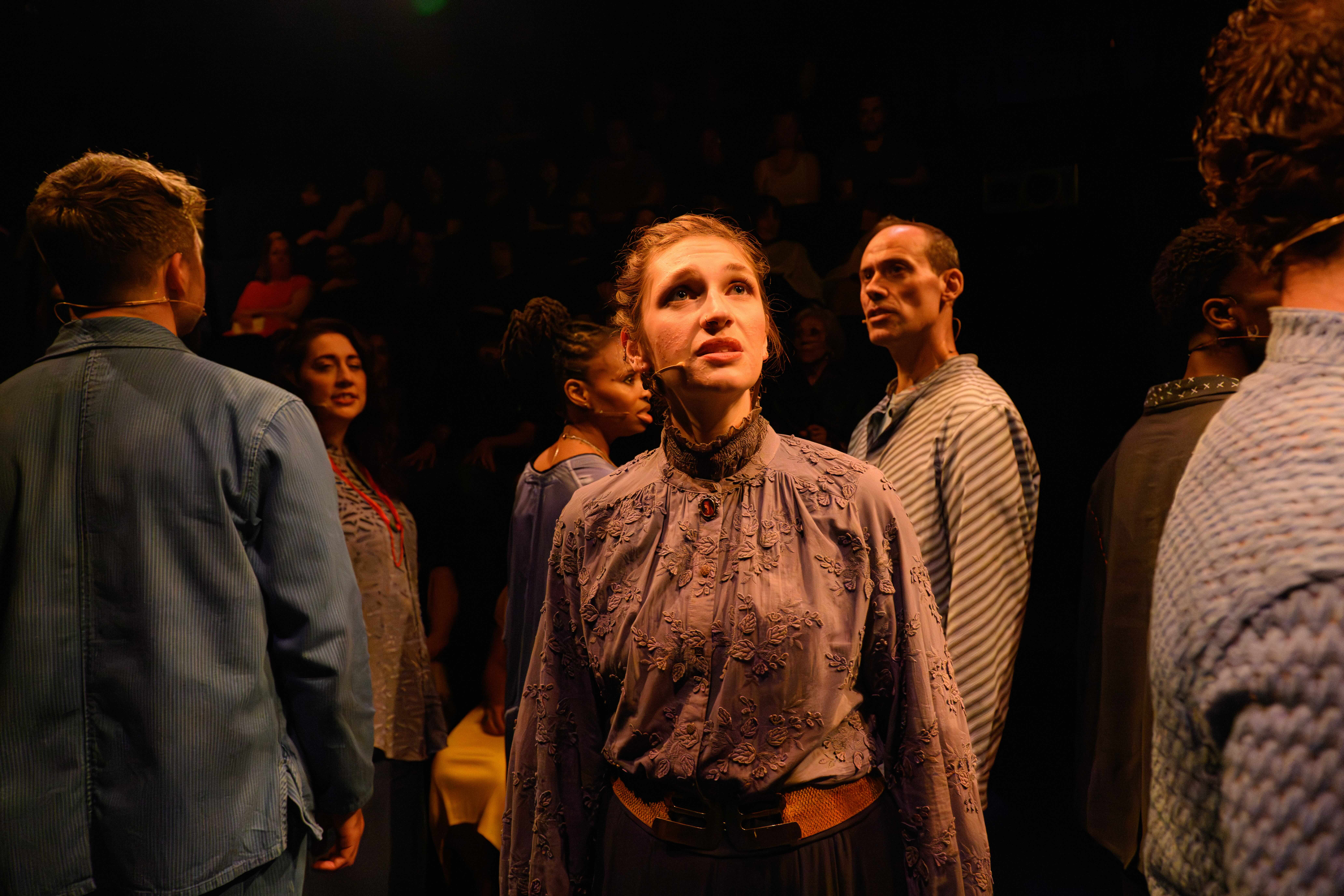
The first thing that struck me was the sheer intimacy of the environment. A tiny custom-built theater arranged in a four-sided rectangle, with walkways funneling directly into the center—a spatial choice crafted with remarkable precision by scenic and environmental designer Krit Robinson. Suspended in that center: a light fixture glowing like a nucleus, as if the entire performance were taking place inside a living cell. I was genuinely surprised to learn that this production was previously staged in an even smaller venue; this already felt as though the walls were close enough to hear the heartbeat of the audience. That intimacy deepened once the performers began. They maintained intense eye contact with audience members as they sang, holding each gaze with a steadiness that felt both personal and slightly exposing. We often enter a theater ready to watch, to disappear into anonymity for a while. But here, disappearing wasn’t an option. The performers didn’t allow it. We were asked to be present, to be implicated, to join this collective thought process rather than just observe it.
experience
It began with a single note. Then another. Then another. Voices stacking and swelling into something that felt like an awakening. No instruments at first, everything purely human, just breath and microphones catching it. It was already beautiful, then slowly the instruments seeped in all at once, the drums adding warmth and pulse and soul. Moments like this remind me why we create. In Heather Christian’s music, creation feels elemental. Her compositions move like living things; both layered and breathing. She builds sound the way other artists build worlds, inviting you into something beyond our world while grounding you in the grit of the human voice. The work doesn’t just entertain, it reminds you that art is a form of aliveness, a way of making sense of the chaos and beauty we carry.
understanding
One moment really crystallized this intent: in the piece’s final beat, the audience was instructed to stand. There was a palpable pause for sure; an internal negotiation, a subtle scanning of the room for communal permission. The tiny social gamble. Then people began to stand, and the room shifted. The connection, the sameness of it all. We are all human, and sometimes we just need someone else to stand first. And in a way, that same dynamic played out in the music itself. I’ll admit: I couldn’t always understand the lyrics, especially the operatic passages and definitely the parts in Latin. I kept on wishing I could catch every word because you could tell the text mattered. But even without full comprehension, the emotional clarity was undeniable. The sound design was extraordinary and throughout the piece I kept wondering where certain voices originated or how the mix remained so impossibly crisp, an achievement that speaks directly to the meticulous work of sound designer Nick Kourtides. Later learning about the precision behind the show’s sonic design only deepened my appreciation. Music really is the universal language - but how much of it do we actually understand? And do we need to?
time and place
How much time do we actually spend living? That seems to be a core question Heather Christian is reaching for. How do we measure our lives? “Thirty two days and seven hours deciding not to call someone back” and/or “Four minutes hearing your favorite song for the first time.” Do we need to have a measure? Or can we just be? I loved that the spoken lines came from anonymous voicemails; moments preserved, real voices now immortalized in song. “I was like five years old and both my parents were working late all the time.” Simple yet heavy. The fusion of ancient-sounding vocal techniques with modern technology—latin chants and live microphones, timeless spirituality and voicemail confessionals—created a complex layering of eras, voices and lived experiences. Stories from people just like us, living in the same moment, breathing the same air, all in the same room. Here to tell, here to listen, here to collide.
honesty
There were so many elements I genuinely loved, moments I admired but the meaning felt slippery, like a puzzle insisting it only has one answer. Maybe the point is that there isn’t one. Meaning becomes whatever you make of it, and everyone’s version is different. Maybe uncertainty is allowed.
But I do know this: I felt renewed. I felt grateful to have shared that space, that time, that fleeting moment of being human together. Sometimes that’s enough. In a piece preoccupied with time, presence, and the act of living, maybe the most meaningful thing was simply being there at all.
‘Oratorio for Living Things’ ran through November 23, 2025 at Signature Theatre Company. Production Photo by Ben Arons.